
Fund the build on evidence
You and the tech lead agree a pass mark in week one, and the result is measured against it. Your MVP budget goes into something that has already cleared a bar you set.

Find out whether your AI feature, image search or document reader works on your real data before you pay for the full product.
4.9 on Clutch from 45 reviews · 500+ projects since 2013 · Risky features tested in computer vision, document reading and data matching
Our PoC software development services test the one technical risk that could sink your product, on your own data, in 2–6 weeks. You get a measured pass or fail, the running cost and a go/no-go with an MVP estimate.
An AI accuracy PoC tests whether a model does your job well enough on your own examples, against a pass mark you agree. Two or three models are compared where it matters, so you choose on evidence, not a vendor demo. See AI software development.
A computer vision PoC checks whether software can read your photos, video or drawings as they really arrive, with glare, blur and faint marks. Sure reads are settled automatically and unsure ones go to a person, so you see the real saving.
Document extraction PoCs test whether marks, fields or counts can be pulled reliably from your scans and PDFs. Numbers are calculated in code and AI looks only at the unclear items, which keeps errors and running costs low as volume grows. See intelligent document processing.
For records spread across exports and systems, a data matching PoC links them with fixed rules such as barcodes and a name dictionary. Unknown items are flagged, not guessed, so you can trust every match before automating a workflow. See enterprise AI integration.
This PoC tests whether shoppers or staff can find items by photo or by meaning across your catalog, using embeddings such as CLIP. You see real queries return real results before you invest in a full search feature. See RAG development.
Once the PoC passes, the same tech lead scopes and quotes your MVP from what it proved. The build starts from tested parts and measured numbers, so your launch plan rests on evidence. See MVP development services.
A PoC that ends in a measured go/no-go stops you funding an idea that would stall later. In Deloitte’s January 2026 State of AI in the Enterprise, only 25% of respondents had moved 40% or more of AI pilots into production.
A PoC is worth it when one unknown could stop the product and planning alone can’t answer it. When the technology is already proven, such as payments, sign-in or admin panels, skip the PoC and scope the MVP.
Surprises usually come from the data, not the model. In an Iron Mountain survey (October 2026), four in 10 organizations spent at least 41% of AI project timelines on manual data preparation. So we test on your real samples from the start.
If your open question is whether users want the product, prototype development answers it faster. If the scope itself is unclear, start with product discovery and return to a PoC once you know what to test.
Pick a PoC if the hard part might fail, a prototype if users must try the flow, an MVP to see if people pay. Many products need only one or two of the three.
Not sure which fits?
A tech lead tells you where to start on a 30-minute call. Planning a first product? See software development for startups.
Three early builds, each made to answer one hard technical question.

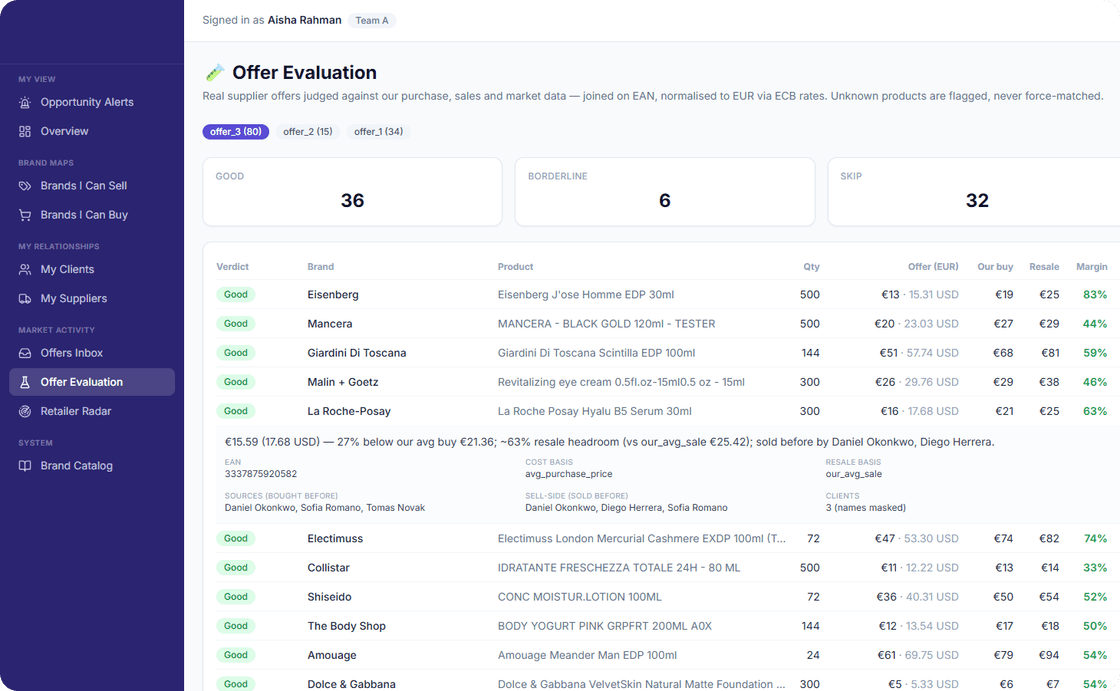
An early build on the client’s sample files tested whether barcodes and a fixed brand dictionary could link supplier offers to the right traders. It grew into a web app with 11 screens, now being tested with selected beta users. On the client’s own files, order lines linked to a trader rose from 10% to 100%. In one offer, only 4 of 31 barcodes were in the catalog, and the app said so instead of guessing.
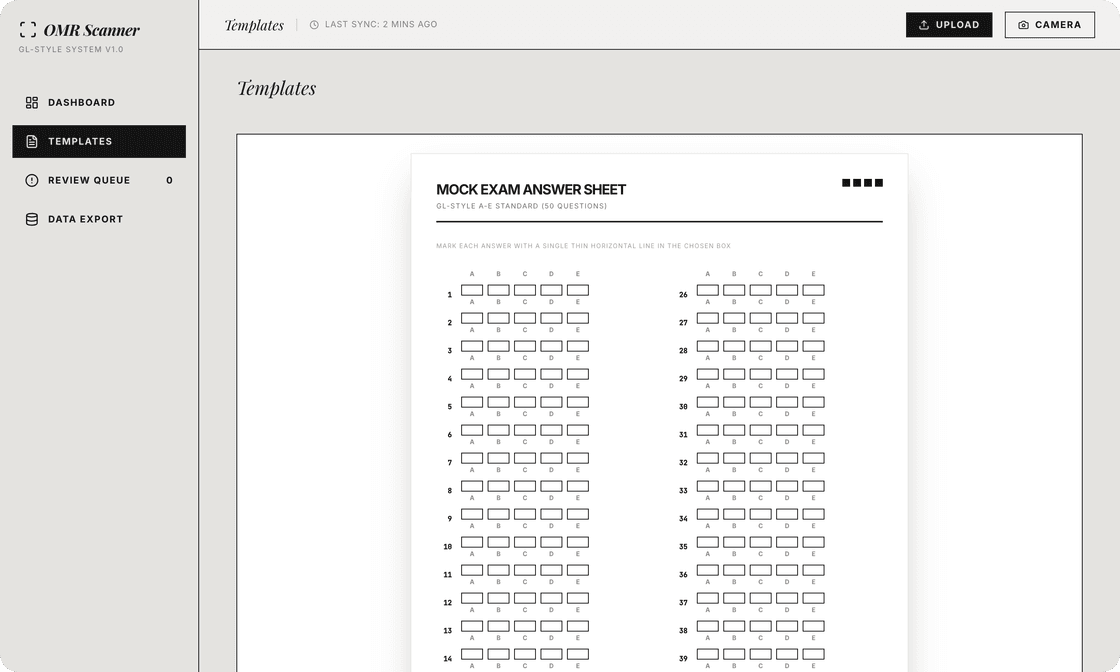

An early build that tested whether computer vision could read thin line marks that standard OMR tools miss. Clear marks are scored automatically, AI checks only the unclear boxes, and staff confirm them in a review queue. Computer vision settled about 96% of answer boxes across nine test sheets, with no AI call needed.
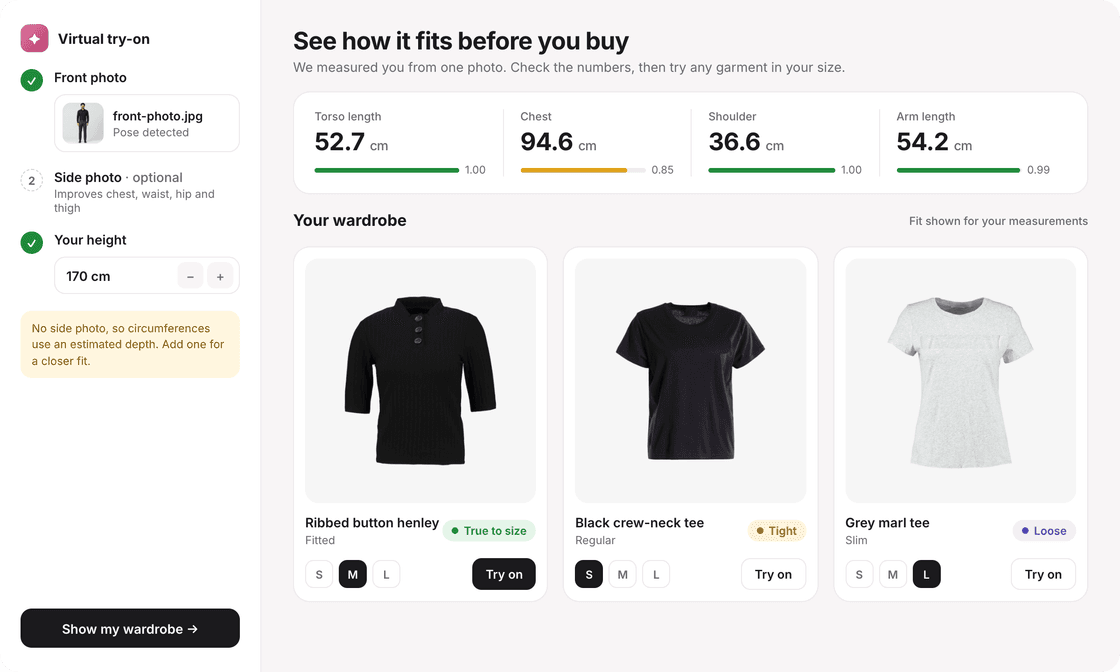

An early build that tested whether one photo could show how a specific size will fit, not just how a garment looks. It measures the shopper, compares that with the garment in centimeters and renders the try-on on our own GPU service. The pipeline runs end to end, and a size S and an XL now look different on the shopper’s own photo.
A PoC takes 2–6 weeks, and an AI PoC usually 2–4. Across the 8+ projects we built with Claude Code in the last year, delivery took up to 50% less time than comparable builds the year before. See how we work.
AI PoC
2–4 weeks
One AI job tested on your samples
Other technical PoCs
2–6 weeks
Data matching, integration, vision
AI PoCs cost $4k–10k over 2–4 weeks; other technical PoCs are priced after the free scoping call. Rates are $20–25 an hour, by role and seniority.
In Mavvrik’s AI cost governance report (August 2026), 62% of organizations said an unexpected AI cost had materially altered a business decision.
Every PoC includes the signed brief, the build, our report and the read-out call. You own the code and the findings, and model or GPU fees are paid to the provider at cost. If you sign the MVP within 60 days, the PoC fee is credited against it.
You share only the samples the question needs, under NDA, and they are deleted after the project.
We pick the quickest route to an answer you can trust, using tools already proven in our client work. See LLM integration and fine-tuning and AI infrastructure.
Compare several before you commit to one
Read photos, scans and drawings
Find and link items by meaning or by rule
A screen you can click, on top of working code
GPUs that run only while the PoC needs them
Techuz is not the right fit for a PoC that needs a large model trained from scratch, or hardware and IoT at its core. If the technology is already proven, such as payments or sign-in, skip the PoC and scope the MVP. If your question is whether users want the product, start with a clickable prototype.
A software proof of concept is a small working program that tests whether one risky idea works on real data before a full build. For example: can a model read scanned answer sheets well enough to replace hand marking? Techuz ends each one with a measured go, no-go or pivot.
A PoC asks whether the hard part can work, and it stays internal: you get working code on your data plus a short report. An MVP asks whether people will use it and pay, so it goes to real customers on production code. At Techuz, a PoC takes 2–6 weeks and an MVP 6–28 weeks, depending on size (8–14 weeks for an AI MVP).
An AI proof of concept with Techuz costs $4k–10k and takes 2–4 weeks. Other technical PoCs, such as data matching or integration tests, are quoted after a free 30-minute scoping call. Model and GPU fees are paid to the provider at cost.
A Techuz PoC takes 2–6 weeks, and an AI PoC usually 2–4 weeks. The first few days set the question and check your sample data. The build takes one to four weeks, and the last few days go to measuring, our report and the read-out call.
A no-go or a pivot is a valid result, not a wasted budget. Techuz gives you the measured reason, the report and the code after weeks, not after a full build. If your data can’t answer the question, you can stop at the end of week one and pay for that week only.
A PoC is a script or notebook with a simple demo screen, built to answer one question fast. Techuz builds the MVP as production code, with code reviews, automated checks and tests, so it can grow into the full product. The tech lead says in the go/no-go which parts carry into the MVP.
Techuz needs the one question you want answered, a small set of real samples, someone who knows that data and a signed NDA. You don’t need a detailed spec: the scoping call turns your question into a PoC brief.
Tell us what you're building. We reply within 24 hours and send a ballpark estimate within 48.


