
Help when a learner is stuck, not next week
An AI tutor or role-play partner is there at night and on weekends. Learners practice whenever they have time, not when a class slot opens.

We add AI tutors, practice quizzes and feedback to your learning product, built on your own courses. Learners get help the moment they’re stuck.
4.9 on Clutch from 45 reviews · 500+ projects since 2013 · Education software since 2017
Our AI in EdTech development services build the AI features learners and teachers use daily: tutors, fresh practice quizzes, feedback and smarter search. We start with the feature that saves the most hours.
An AI tutor app gives each learner a patient guide that explains topics, asks questions back and hints before answering, by text or voice. Learners get help between lessons, and teachers stop repeating the same explanation.
Practice tools write fresh questions for each learner’s board, grade and subject, with math and science formulas that display properly on any screen. Your subject experts review generated questions instead of writing each one.
Assessment tools read a learner’s answer, session or written work and return a score, the gaps and what to try next, against your rubric. Learners improve between classes, while your experts check AI scores instead of marking every attempt from scratch.
Adaptive learning software can choose each learner’s next question or lesson from their past attempts and scores, using rules your educators set. Strong learners move on sooner, and struggling ones get more practice.
An AI powered learning platform puts courses, practice, feedback and progress on one data layer that the AI reads to guide each learner. You launch a product whose guidance improves as your content and learner data grow, which a bolt-on chatbot can’t match. See MVP development.
AI for education teams takes over the slow work behind the classroom: CVs read into trainer profiles, drafted bios, smarter search and course promotions matched to interests. Trainers go live sooner, and learners find the right course on their first search.
Building with generative AI outside learning?
AI in elearning pays off where the work is slow and repetitive: drafting, practice and first-pass feedback. In TPT’s State of the Classroom report (April 2026), creating teaching resources was educators’ top use of AI, at 44%. Grading was just 4%.
In an NPR/Ipsos poll of K-12 teachers (June 2026), 55% said AI is mostly a shortcut for students to avoid work. The AI we build is designed the other way round: it makes learners think, and your educators decide what it says.
Tutors offer a hint or a question back before a full worked solution, and you set the default per exercise. On practice products we’ve built, the AI supervisor gives hints only when asked.
Questions follow the learner’s board, grade and subject, with the mix you set; for math and physics, 80% numerical and 20% theory. Formulas come out in LaTeX, so equations render cleanly on phones and laptops.
Each quiz is generated new for the learner, so nobody passes by memorizing. We can log every generated question, so your experts can review it or reuse it in a bank.
An admin panel holds every prompt, by type and variable, so your subject experts change how the tutor, supervisor or scoring behaves. A course change never waits in a developer’s queue.
A pre-flight check catches inconsistencies before any AI call. Before launch, your educators review a sample of generated items.
The AI drafts and your educators approve, so learning quality stays with the people who answer for it.
Add AI to your current platform when learners already come for your content and one job is slow. Build AI-first when the AI is what learners pay for, such as a tutor or practice app.
Need the platform itself first?
See custom LMS development, education app development or mobile app development.
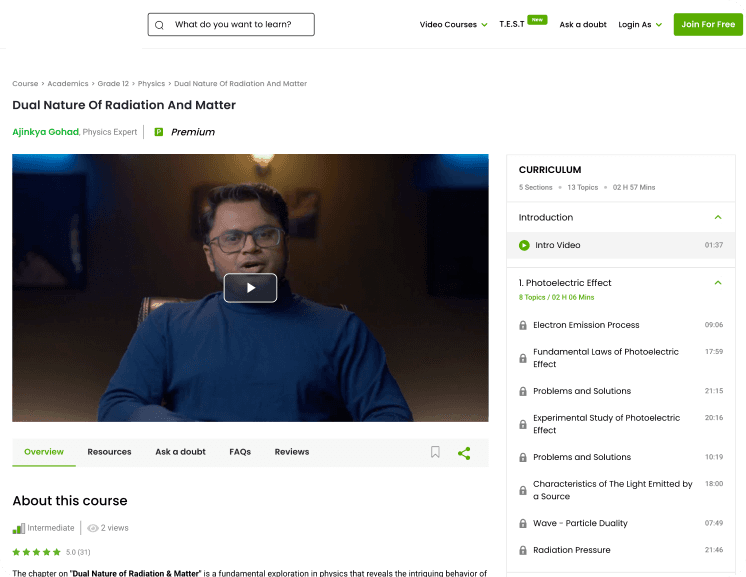
Three AI learning products in production, from exam prep to therapist and radiology training.

A JEE and NEET platform for Grade 11 and 12 students. Its Practice AI writes a board-aligned quiz of 5, 10 or 15 questions on request, with formulas in LaTeX. Subscribers practice with up to 10 fresh quizzes a day, and free users get 2.
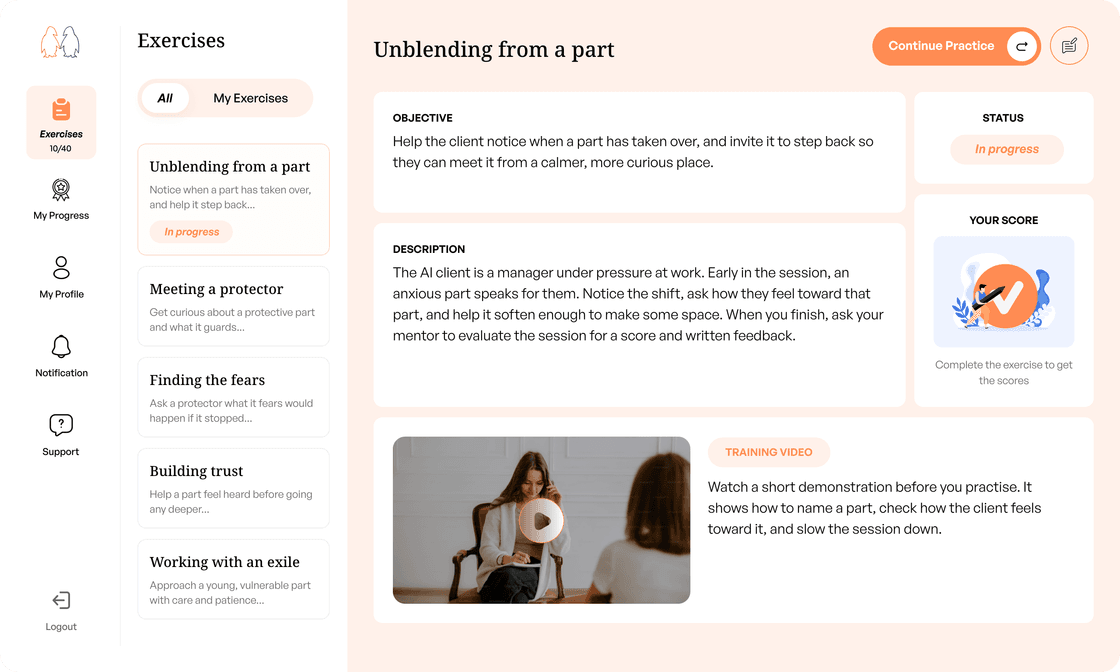

A browser app where IFS practitioners speak to an AI that plays the client out loud, using Whisper, GPT-4o and OpenAI voices. A second AI follows as supervisor, gives hints on request and scores the session. The app is live.
Two AI tools for oncology and radiology education. Tumour-board preparation with AI specialists and guideline checks, and radiology report scoring, built for HIPAA in about two months.
An AI MVP for learning takes 8–14 weeks. One AI feature in your existing platform takes 3–6 weeks: discovery in week 1, then 2–5 weeks of build and testing.
One AI feature
3–6 weeks
Quiz generation, AI search or feedback in your platform
AI MVP
8–14 weeks
A voice or text tutor with admin panel and paid plans
AI-first platform
5–9 months
First release, then grown in phases
With Techuz, a paid proof of concept costs $4k–10k, and one AI feature in your existing platform costs $10k–25k. An AI tutor or practice app built as an AI MVP costs $25k–50k, and an AI-first learning platform $50k+, built in phases.
$4k–10k
Proof of concept
2–4 weeks
Two or three models tested on your course content, ending in a go/no-go
$10k–25k
AI feature
3–6 weeks
Quiz generation, AI search or feedback inside your LMS or app
$25k–50k
AI MVP
8–14 weeks
A voice or text tutor with admin panel and paid plans
$50k+
AI-first platform
Built in phases · 5–9 months
Courses, practice, feedback and adaptive paths on one data layer
Proof of concept
2–4 weeks
Two or three models tested on your course content, ending in a go/no-go
$4k–10k
AI feature
3–6 weeks
Quiz generation, AI search or feedback inside your LMS or app
$10k–25k
AI MVP
8–14 weeks
A voice or text tutor with admin panel and paid plans
$25k–50k
AI-first platform
Built in phases · 5–9 months
Courses, practice, feedback and adaptive paths on one data layer
$50k+
Every estimate covers QA, project management and 30 days of free support.
Model fees are paid by you straight to the provider, estimated per 1,000 calls in the proposal. Rates are $20–25 an hour, by role and seniority.
With practices you can check. AI that scores learners or steers their learning is on the EU AI Act’s high-risk list. Gibson Dunn’s May 2026 alert reports those obligations moving to December 2, 2027, once the Omnibus is formally adopted. We check every AI feature against the Act in discovery.
More on AI security.
We pick a model per job: a stronger one where the conversation matters, a smaller one for routine scoring.
Conversation, questions, scoring and search
Spoken practice and CV reading
Equations that render on every screen
APIs, question banks and AI services
Techuz isn’t the right fit if you need a ready-made chatbot plugin live this week; an off-the-shelf tool is faster. We don’t write course content or design curricula, so your educators own the syllabus. We also advise against AI grading high-stakes exams without human review.
AI in education means software that uses AI models to help people learn or teach. Examples are tutors, practice-question writers, feedback on answers and search that understands learners. Techuz builds these features into learning products, tied to the provider’s own courses and checked by its educators.
An AI tutor is a learning assistant that explains topics, answers questions and guides practice, by text or voice, at any hour. A good one asks questions back and gives hints before answers. Techuz builds AI tutors on a provider’s own course content, so explanations match what learners are actually taught.
Start where people do slow, repeated work: writing practice questions, giving first feedback, onboarding trainers or matching learners to courses. Techuz begins with a paid proof of concept on your content, so you see quality and model costs before a full build.
AI tutoring can help students learn, and Techuz builds AI into structured practice and feedback for that reason, not into a separate chat window. In an NBER working paper from August 2026, AI support raised next-attempt correctness after a mistake. The clearest later gains came when AI was built into mastery practice.
With Techuz, one AI feature in your existing platform takes 3–6 weeks. An AI tutor or practice app built as an MVP takes 8–14 weeks. An AI-first learning platform reaches its first release in 5–9 months once the scope is clear, then grows in phases.
Tell us what you're building. We reply within 24 hours and send a ballpark estimate within 48.


