


Audit the data and agree the score
We check quality, duplicates, versions and access rights, then build a golden set of real cases with expected answers. The metric, such as recall@5, is signed off before any tool is chosen.
- Before any tool

We build data and AI features that learn from your own records, images and documents, such as semantic search, vision models and AI assistants, on the cloud you already use.
4.9 on Clutch from 45 reviews · 500+ projects since 2013
Our machine learning development services turn your data into features: search that finds the right record, models that read images, answers from your files. We measure a baseline first, so you pay only for work that improves results.
Custom models read images, drawings and records for one clear job, such as spotting symbols on a plan or sorting documents by type. We fine-tune open-source models on your data and ship the one that beats the baseline, so results hold on your real files. See fine-tuning open-source models.
Machine learning consulting answers one question before you fund a build: can your data support the feature you want? We agree the success metric, check sample data and hand you a go or no-go with build and running costs. See AI consulting for wider AI strategy.
Data science consulting starts with what you already hold: we audit its quality, plan the labeling and build a scored test set. Our data science services give every later model the same fair exam, so you decide on numbers, not demos.
AI data engineering builds the pipelines that feed your product and its AI: ingestion, checks at upload, media transcoding and per-customer search indexes. Our data engineering consulting covers the data your app uses, not warehouses or BI, so spend goes where users feel it. See our cloud services.
Vector databases store documents and images as embeddings, so search finds meaning rather than matching words. We pick the simplest store that passes your test set and keep each customer’s data apart, which holds down both hosting bills and risk. See vector database services.
MLOps and LLMOps keep a model or AI feature healthy after launch: versioned prompts and models, evals before each change, drift and cost checks. Your team stops guessing whether a change helped, because every release comes with a score. See MLOps services.
AI infrastructure covers where models run: managed APIs, private deployments in your own cloud tenant, open-weights models on request, and GPUs for training. You get hosting that fits your data rules and traffic, with monthly running costs priced before you commit. See AI infrastructure solutions.
Building the AI feature on top?
Our ML specialists work inside product squads, so every model ships inside an app people already use. More about Techuz.
12+ yearsbuilding software (since 2013)
500+projects delivered
250+clients
45 engineers4 of them ML specialists
Most ML projects stall on the data, not the model. In a Harris Poll survey for Collibra reported in September 2026, 72% of AI decision-makers traced their AI shortfalls to poor data foundations. So our work starts with your data and a number to beat.
Our view: production AI needs evaluation, guardrails and monitoring, not just an API call. See our AI security work.
Two products in production and one proof of concept, each with the data work behind the feature.

Each customer organization’s documents are embedded into its own Pinecone namespace, so one company’s records never reach another’s answers. The assistant runs on Claude through OpenRouter, with lighter models for summaries and GPT-4o for device classification, and AI cost tracked per organization. In production since March 2026, with a QA suite across 15 areas run before each release.

Each lesson is transcoded once by AWS MediaConvert into four HLS qualities, from 360p to 1080p, plus audio. Chunks switch quality with the learner’s connection, and each carries a hash tied to its signed CloudFront URL instead of paid DRM. Lessons averaging over 2 GB per 20 minutes play on slow mobile connections.
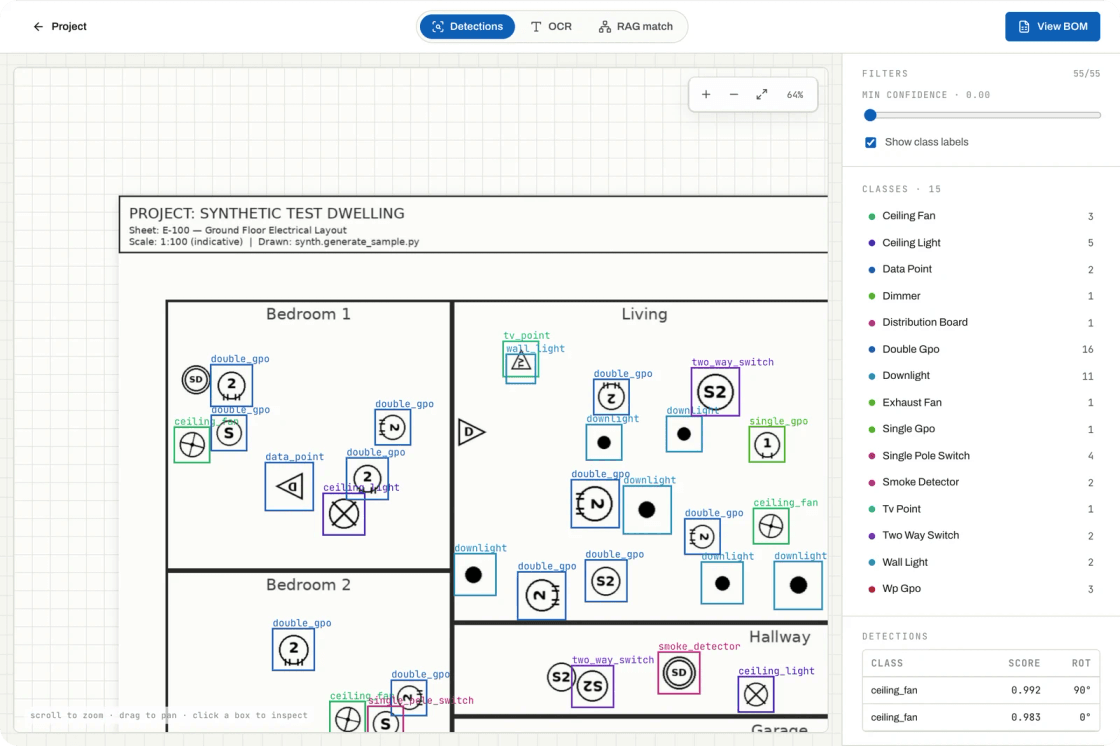

A YOLOv8-nano detector trained on 150 generated plans (5,454 labeled symbols, 15 classes) finds switches, lights and power points on CPU through ONNX. FAISS matches symbols to a library, plain code computes each quantity and price, and Claude never does the counting. 0.89 mAP@50 and 0.97 recall on held-out synthetic plans; accuracy on real client plans is still to be measured.
A paid proof of concept on your data takes 2–4 weeks, and one search or vision feature in an existing product is scoped after it. A production build, such as retrieval across several sources or a trained model behind an API, takes 8–14 weeks. A multi-model platform takes 4–8 months, released in phases, and every size needs 2–4 extra weeks if no labeled data exists yet.
Paid proof of concept
2–4 weeks
A baseline on your data, ending in a go/no-go
Production build
8–14 weeks
Retrieval across sources, or a trained model behind an API
Multi-model platform
4–8 months
Released in phases
Start with a paid software proof of concept.
Go straight to the production build.
Move it onto an MLOps support plan.
A production build runs in seven phases over 8–14 weeks, from data audit to release, with a demo every sprint and a go/no-go after the baseline. We also offer a one-page data readiness score after the audit, and we test cost per 1,000 queries before launch. The phase-by-phase plan sits on our MLOps services and vector database services pages.
If your search is keyword lookup over a small, structured catalog, plain SQL or full-text search is cheaper than vectors and just as accurate. We’ll tell you before you pay for an index.
Machine learning work with Techuz costs $4k–10k for a paid proof of concept and $10k–25k for one search or vision feature in an existing product. Production retrieval, a trained model behind an API or an AI MVP costs $25k–50k. A multi-model or multi-tenant platform costs $50k+, built in phases. In Domino Data Lab’s July 2026 enterprise AI report, 57% of enterprises said AI returns still didn’t outpace their investment. So you see the monthly running cost before you approve the build.
$4k–10k
Paid proof of concept
2–4 weeks
$10k–25k
One feature in an existing product
Scoped after the PoC
$25k–50k
Production build or AI MVP
8–14 weeks
$50k+
Multi-model or multi-tenant platform
Built in phases · 4–8 months
Paid proof of concept
2–4 weeks
$4k–10k
One feature in an existing product
Scoped after the PoC
$10k–25k
Production build or AI MVP
8–14 weeks
$25k–50k
Multi-model or multi-tenant platform
Built in phases · 4–8 months
$50k+
Discovery, build, launch, QA, project management and 30 days of support all sit inside the estimate.
Tokens, embeddings, the vector store tier, storage and GPU hours are estimated monthly in the proposal and paid straight to the providers. Rates are $20–25 an hour by role and seniority.
Pick fixed price for a proof of concept or one scoped model. Pick time and materials when test results will change the plan, and a dedicated team for a product you’ll keep improving.
Scale up in 1–2 weeks or down with 30 days’ notice, and get a replacement engineer within 2 weeks at no cost. See our dedicated development team.
We build machine learning into products people already pay for, and we tell you early when you need a different kind of partner.
Want to automate a business workflow rather than build a model? See AI automation services.
We choose the tools per job and explain each choice in writing. Models change often over a product’s life, so every model call we build goes through one gateway that can switch or fall back.
Tested on your golden set; each job goes to the smallest model that passes
Open models we can train, export and run cheaply on CPU
A separate search space per customer; local search when no service is needed
Event-driven jobs that check data at upload
Your account and region; cloud GPUs only when training needs them
Golden sets and prompts versioned like code
Industries where our data and ML work already runs, with the project behind each.
When you need a data warehouse or BI program on Snowflake or dbt, an MLOps platform on Kubeflow or SageMaker, or GPU clusters at scale. Techuz hasn’t delivered those, and a specialist fits better. We’re also the wrong first step if you have no data yet or need classic demand forecasting.
Machine learning services cover finding a use for your data, building and testing models, and running them inside a product. At Techuz that means semantic search, vision models, AI features and the data pipelines behind them. Each one is measured against a test set from your own data before launch.
Data engineering is the work of collecting, cleaning, moving and storing data so people and software can use it. Techuz builds the operational side inside products: ingestion, checks at upload, scheduled jobs, media pipelines and search indexes. We don’t build analytics warehouses or BI dashboards on tools like Snowflake or dbt.
Start with one use case and a sample of real cases with the answers you expect. Then remove duplicates and old versions, record who may see each item, and mark anything sensitive. Techuz turns that sample into a versioned golden set during the data audit, so every later model is measured the same way.
Fix the data one product feature needs first: ingestion with checks at upload, access rights per record, and a search index per customer. Techuz builds that operational layer inside your app; warehouse and BI programs need a specialist.
Yes: Techuz deploys models, indexes and storage in your own AWS, Azure or Google Cloud account and region. We’ve also run Azure OpenAI inside a client’s own Microsoft tenant. Your data reaches an outside model provider only with your written approval, with training on your data switched off.
Yes, for jobs that need counting, measuring or the same answer every time. Large language models write well, but a trained detector or a rule in code is cheaper and repeatable for counts, scores or prices. Techuz often combines them: classic models produce the numbers, and an LLM writes the explanation around them.
Tell us what you're building. We reply within 24 hours and send a ballpark estimate within 48.


