
One database to run instead of two
When pgvector fits, vectors live beside the data they describe. Backups, access rules and monitoring stay as they are, and your team has no new system to learn.

We build the search layer behind your AI products, from semantic search to RAG assistants. It runs on your own data, in the database that suits your stack.
4.9 on Clutch from 45 reviews · 500+ projects since 2013
Our vector database services build the search behind AI products: semantic search in SaaS apps, RAG assistants for teams and per-customer search in multi-tenant platforms. Founders get search inside the product they sell; operations and support teams get it over their own documents, on the store their stack already supports.
Semantic search finds products, documents and records by meaning, so a query for “rain-ready trail shoes” also returns your waterproof hiking boots. More searches end in a click instead of a reworded query or a support ticket. See SaaS development.
If your app already runs PostgreSQL, pgvector adds vector search to the same database that holds your users, products and permissions. Results join your business data in one query, and you avoid a second vendor bill and a second backup.
An enterprise vector database such as Pinecone gives each customer, project or workspace its own space, run and scaled by the provider. Your team ships search to every account without running database servers, and one customer’s files stay out of another’s results.
Embedding jobs turn your documents, product data or support tickets into vectors, tagged with source, version and who may see them. New and changed items are indexed as they arrive, so results reflect today’s catalog rather than last month’s.
Moving between stores, or to a newer embedding model, runs as a side-by-side rebuild scored on your own test queries before any traffic switches. You get the better model or the cheaper store without a dip in search quality.
Retrieval tuning starts with a golden set of real queries and the results each should return. Every change to chunking, filters or models is scored against it, so you know in numbers whether search got better. See MLOps and LLMOps.
Part of our machine learning and data engineering services, alongside AI infrastructure for model hosting.
The right store cuts what you run and what you pay. Postgres teams are moving fastest: in Datadog’s State of Postgres report (August 2026), pgvector was the fastest-growing optional Postgres extension, up 24% in the six months to May 2026.
For RAG, the store matters less than how data goes into it. Four decisions shape answer quality and running cost, and we settle each one on your documents before the build starts.
A RAG vector database also needs upkeep: re-indexing when documents change, and deleted files removed from the index. For the assistant built on top, with prompts, citations and answer testing, see our RAG development services.
Use pgvector when your app runs PostgreSQL and volumes are moderate. Use Pinecone for managed scale or hard separation between customers. In VentureBeat’s October 2026 survey of 100 enterprises, 37% used Postgres-based pgvector, more than any dedicated vector database (Pinecone 29%).
Weighing Weaviate, Qdrant or OpenSearch?
If you already run one of these Pinecone alternatives, we test it on your queries too.
Two production platforms that give every customer its own search space, and a proof of concept that keeps vector search on a local index.

Each production gets a Pinecone index of its own, built from the contracts and documents its team uploads. Crew questions go to GPT-4o-mini with passages from that index alone. Running in production, with no index shared between two productions.
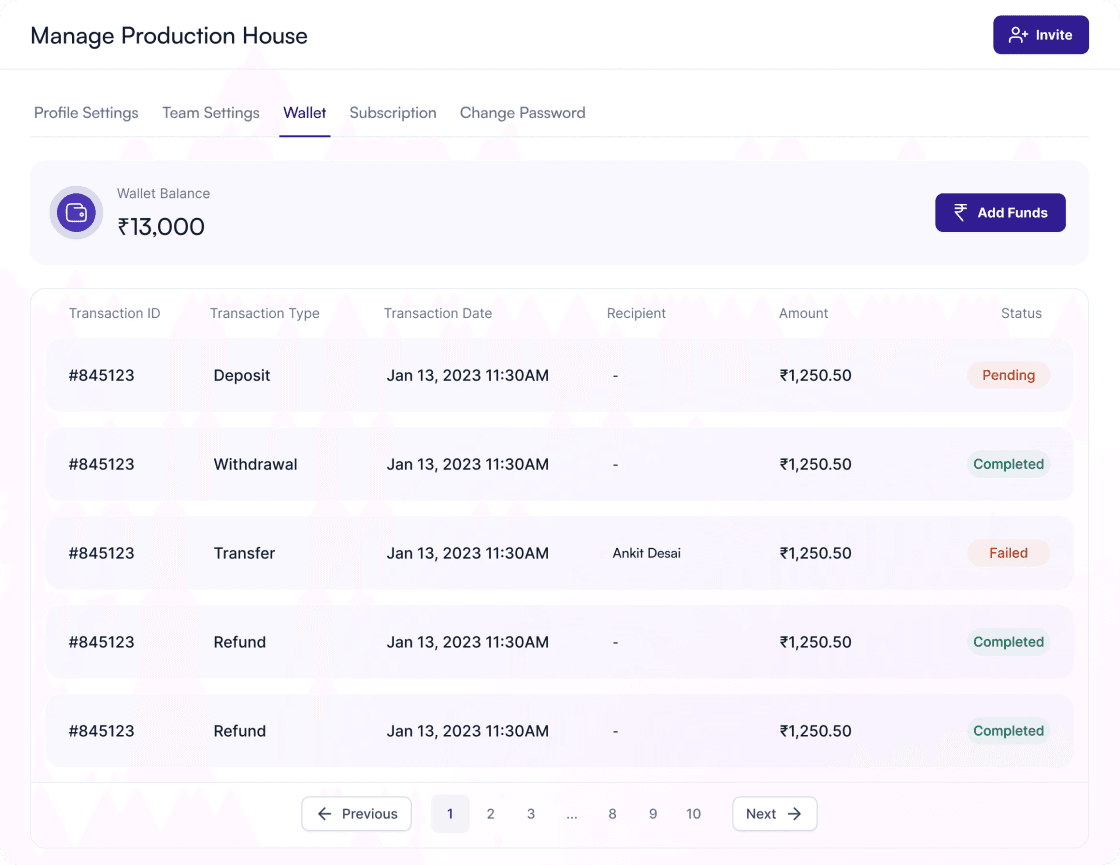
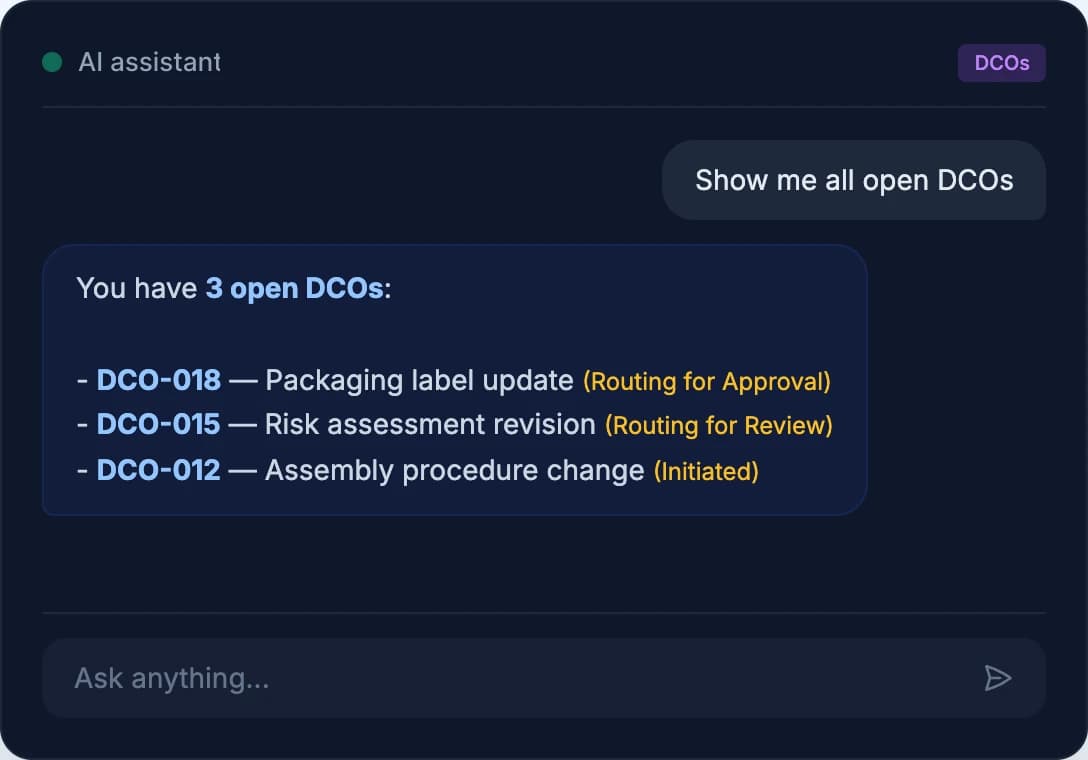

Each customer organization’s released documents are embedded with OpenAI embeddings into its own Pinecone namespace. The project spec puts it plainly: “the namespace IS the security boundary”, so a metadata bug can’t move one company’s records into another’s answers. A QA suite of 55 test cases across 15 areas covers the AI assistant that searches these records.
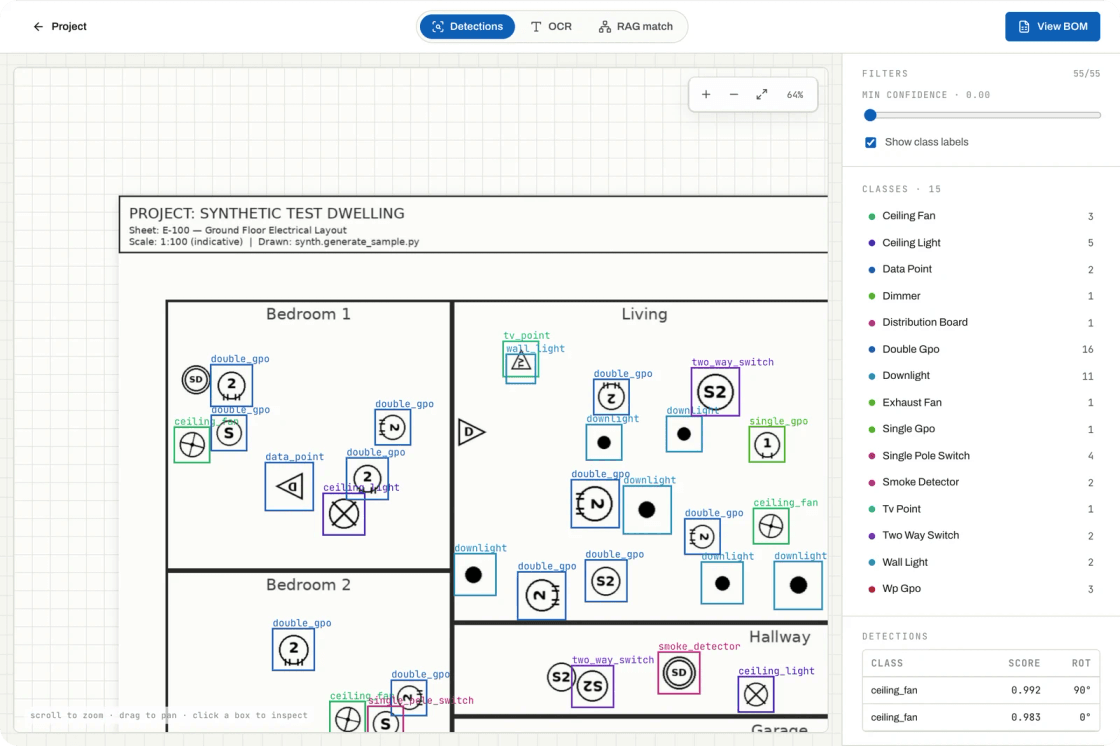

Detected symbols are matched to a symbol library with sentence-transformers embeddings and a local FAISS index, so no vector database service runs. Plain code then counts every item for a priced Bill of Materials. One plan page priced in about 71 seconds (on generated test drawings).
A production vector search project takes 8–14 weeks across six phases, with a demo after every sprint. Adding search over one document set to an existing app is shorter; we confirm its timeline on the scoping call.
A paid proof of concept with Techuz costs $4k–10k, and vector search inside an existing product costs $10k–25k. Production retrieval across several sources costs $25k–50k, and multi-tenant platforms start at $50k, built in phases.
$4k–10k
Proof of concept
2–4 weeks
Your top queries on a sample of your data, ending in a store recommendation
$10k–25k
Search in your product
Set at scoping
One document set or catalog, inside your app
$25k–50k
Production retrieval
8–14 weeks
Several sources, tenant isolation, golden set and monitoring
$50k+
Multi-tenant platform
Built in phases · 4–8 months
Many customers, large ingestion pipelines, scheduled re-testing
Proof of concept
2–4 weeks
Your top queries on a sample of your data, ending in a store recommendation
$4k–10k
Search in your product
Set at scoping
One document set or catalog, inside your app
$10k–25k
Production retrieval
8–14 weeks
Several sources, tenant isolation, golden set and monitoring
$25k–50k
Multi-tenant platform
Built in phases · 4–8 months
Many customers, large ingestion pipelines, scheduled re-testing
$50k+
The price covers discovery, the build, retrieval testing, QA, project management and 30 days of support. Store, embedding and storage fees are paid to the providers monthly, and the proposal lists them.
Isolation is designed into the index, not checked after the search. The Cloud Security Alliance’s October 2026 review of the OWASP Top 10 for LLM applications ranks vector and embedding weaknesses ninth. It says retrieval should be authorized before information enters the model’s context.
Tools we have shipped come first; the rest are options we test on your queries before recommending them. The reasons go into the architecture note you sign.
Managed isolation in production; a local index where no service is needed
Options we test on your eval set:
Picked on your golden set for accuracy and cost
Answer from retrieved passages, routed per job
Golden sets versioned like code; errors and latency watched
Vectors are overkill for keyword lookups on a small, structured catalog, where plain SQL or full-text search costs less. Techuz also doesn’t build data warehouses or BI on Snowflake, BigQuery or dbt, or run search on self-hosted GPU clusters. And with no sample data to test on, any design would be a guess.
A vector database stores data as embeddings: lists of numbers that capture what a text, image or product means. It returns the items closest in meaning to a query, which is why it’s also called an embedding database. Techuz uses vector databases for semantic search, RAG assistants and matching.
An embedding model turns each document or passage into a vector, and the database indexes it. At search time the query becomes a vector too, and the database returns its nearest neighbors, filtered by metadata such as customer or language.
The best vector database is the simplest one that passes tests on your data. For apps on PostgreSQL with moderate volumes, Techuz proposes pgvector first. For managed scale or strict separation between customers, it uses Pinecone, which runs on two of its client platforms today.
pgvector is an open-source extension that turns PostgreSQL into a postgres vector database, storing embeddings in ordinary tables and searching them by similarity. Because it isn’t a separate product, vectors sit next to your business data. Techuz tests it against a managed store on your own queries before recommending it.
A vector database's monthly cost depends on the store tier, how many vectors you keep, how often they are re-embedded and how many queries run. Techuz estimates embedding, store and storage fees per month before you approve the build. After launch, usage can be tracked per customer account, so your own plan prices rest on real numbers.
Tell us what you're building. We reply within 24 hours and send a ballpark estimate within 48.


