
Faster answers between staff
Group chats, @mentions, read receipts and typing indicators show who has seen a message and who is answering. Handover questions get settled in minutes, not after a round of phone calls.

We build the apps patients open between visits and the tools clinicians carry on shift, with patient data protected on the phone, on the server and in every notification.
4.9 on Clutch from 45 reviews · 500+ projects since 2013 · Care-team messaging on Android, iOS and Windows from one codebase
As a healthcare app development company, we build patient apps, clinician tools and secure care-team messaging for health startups and established care providers. We map which screens touch patient data before design starts, so compliance shapes the app instead of delaying its launch. For wearables and home monitors, see connected-device apps.
Patient apps cover booking, reminders, care content, progress tracking and private messages to the care team, on iOS and Android. We built the same slot booking and secure messaging for a caregiver booking platform, so your first patient app starts from tested parts.
Healthcare mobile app development for clinical staff covers one-to-one and group chat, voice notes, file sharing and company sign-in, with each organization’s data kept apart. Teams stop passing patient details through personal texting apps, and every message stays on record.
Voice practice partners, assistants that answer from your own records and smart summaries run through your back end, never straight from the phone. You add AI where it saves staff or learners time, without patient data reaching tools nobody vetted. See generative AI development.
Every app ships with the web side your team runs it from: users and roles, content, reports and audit views. Managers fix access, check activity and answer an auditor’s question from a browser, without calling a developer. See healthcare web development.
App takeovers start with an audit of the code, security and store status of a health app you already run, followed by a fix plan or a move to Flutter. Your users keep a working app while it is repaired.
Need a portal, EHR work or IT support as well?
See all our healthcare software development services, or our wider mobile app development services.
Good medical app development shows up in daily work: quicker replies, fewer missed steps and no patient data where it shouldn’t be. In a July 2026 study in Open Access Emergency Medicine, 89% of 82 emergency department clinicians reported a positive impact on patient care after their hospital added consult requests through Microsoft Teams.
A health app is only as safe as its weakest copy of the data: the phone, the server, a notification or a crash log. Before design, you sign a data-flow map that shows where patient data may be stored, synced and never sent. Every control below runs in a clinical messaging app we built on Google Cloud.
What we build inAn encrypted local database (SQLCipher), tokens in the iOS Keychain or Android Keystore, a 15-minute idle lock and remote wipe
Why it mattersA lost or shared phone doesn’t expose patient data
What we build inPush alerts through FCM, APNs and WNS that carry no patient details
Why it mattersNothing sensitive appears on a lock screen
What we build inTLS 1.2+, HIPAA-eligible Google Cloud services under Google’s business associate agreement (BAA), row-level security in Postgres and customer-managed encryption keys
Why it mattersEach organization sees only its own records, and you hold the keys
What we build inAudit logs of every access, signed links for shared files, a recovery point of one hour and a recovery time of four hours
Why it mattersYou can answer an auditor and recover from an outage
HHS has proposed making encryption and multifactor authentication mandatory under the HIPAA Security Rule, so we build both in from the first sprint and your app needs no rework when the final rule lands. See Google Cloud services and application security.
Choose Flutter for most patient and staff apps, native Swift and Kotlin when the app depends on the newest phone features, and a browser app for desk-based users. The choice and its reason go in writing during discovery.
Going native?
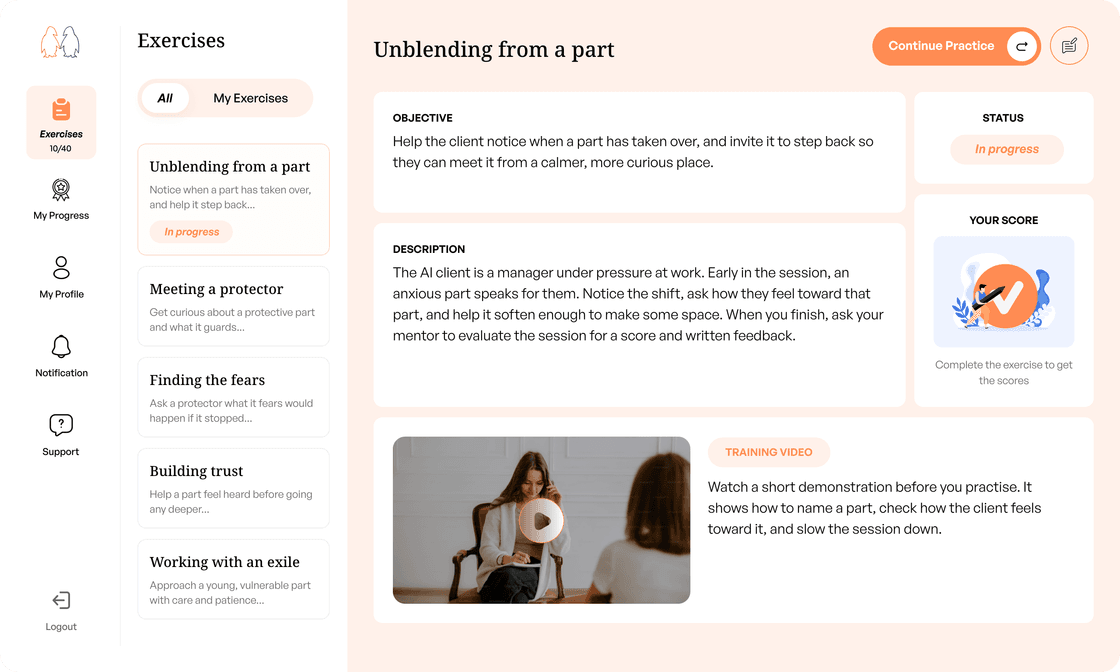
An AI voice practice app for therapists in training.

Practitioners open it in the browser with a microphone, so every update reaches them without an app store release. Behind the AI client and supervisor sit Whisper speech-to-text, six AI voices, Stripe subscriptions and an admin panel: 1,473 commits, 104 API routes and 24 data models delivered between February 2024 and January 2025.
A small healthcare app takes 3–6 weeks, a mid-size app 8–12 weeks and a large one 3–5 months, with the first store review inside those times. The phases below are for a mid-size app; small apps fold discovery and design into one week.
Small app
3–6 weeks
Mid-size app
8–12 weeks
Large app
3–5 months
Healthcare app development with Techuz costs $10k–15k for a small app, $25k–50k for a mid-size app and $50k+ for a large one, built in phases. Rates are $20–25 an hour, by role and seniority.
$10k–15k
Small
3–6 weeks
One app for one user type, such as patient booking and reminders, with a basic admin panel
$25k–50k
Mid-size
8–12 weeks
Patient or staff apps on iOS and Android with a web dashboard, secure messaging and HIPAA controls
$50k+
Large
Built in phases · 3–5 months
Several roles and organizations, offline use, a Windows build, AI features or a planned EHR connection
Small
3–6 weeks
One app for one user type, such as patient booking and reminders, with a basic admin panel
$10k–15k
Mid-size
8–12 weeks
Patient or staff apps on iOS and Android with a web dashboard, secure messaging and HIPAA controls
$25k–50k
Large
Built in phases · 3–5 months
Several roles and organizations, offline use, a Windows build, AI features or a planned EHR connection
$50k+
Compliance work, such as audit trails, e-signatures and data residency, is scoped in discovery rather than added as a fixed fee.
Every price includes QA and project management.
Apple and Google developer accounts, cloud hosting and third-party fees are listed with their monthly costs before you approve the build.
HIPAA is rarely the only rulebook. We note the other rules in discovery, so an app reviewer or regulator doesn’t find them first.
Flutter is our default for new health apps, with native Swift and Kotlin when the phone itself is the product. The back end runs in your own cloud account.
Shared code for Android, iOS and Windows; native where it pays off
Encrypted storage that works offline
Company sign-in and push to every device
Managed, HIPAA-eligible services in your account
Voice and text features called from the back end
Checks on every build and every release
When you need video consultations or e-prescribing built fast, Techuz isn’t the right first call: we haven’t shipped either yet. We also don’t build Bluetooth device pairing, wearable firmware or the regulatory filings an FDA submission needs. And we have no clinicians on staff, so your clinical experts stay the decision makers.
Healthcare app development is designing and building mobile or web apps for patients, clinicians and care organizations, with patient data protected throughout. At Techuz it covers the app, its back end and admin dashboard, the HIPAA controls and the store release.
Techuz starts by mapping where patient data appears, then encrypts it on the device, in transit and on the server. Strong sign-in, audit logs, an idle lock, remote wipe and push alerts with no patient details are built in, on hosting covered by a business associate agreement. Compliance also depends on your own policies, so we build to HIPAA requirements rather than certify the app.
With Techuz, a small healthcare app takes 3–6 weeks, a mid-size app 8–12 weeks and a large app 3–5 months, including the first app store review. Offline use, AI features or an EHR connection push a build toward the upper end of its range.
Most booking, messaging and wellness apps don’t, but software that diagnoses, treats or analyzes medical images or signals may. FDA’s January 2026 guidance updates changed where that line sits for decision support and wellness software. Techuz flags the risky features in discovery, your regulatory advisor decides, and we never claim FDA clearance for software we build.
Techuz builds part of a telemedicine app, the parts around the call: booking, secure messaging, reminders, patient records and admin dashboards. We haven’t shipped video consultations or e-prescribing yet, so we scope those honestly and tell you if another vendor suits that piece better.
Design for people on a hard day: a tired nurse, an anxious patient, an older user with weak eyesight. Techuz designs the flows in Figma with large text, clear contrast and plain prompts, then your clinicians or trainers test a clickable prototype. Changes at that stage cost hours, not weeks.
Yes, through a planned integration built to FHIR R4. Techuz’s FHIR work is FHIR R4 mapping and integration design, including mapping against Epic for a breast-imaging tool, where the Epic integration build is in progress. See HL7 FHIR integration.
Tell us what you're building. We reply within 24 hours and send a ballpark estimate within 48.


