HR software development for hiring, people and payroll

We build the HR software your team runs on or your HR tech product sells, from applicant tracking and AI interviews to payroll.

4.9 on Clutch from 45 reviews · 500+ projects since 2013 · 500+ real interviews run on our own AI interviewer

What our HR software development company builds

Techuz is an HR software development company building the hiring, people and pay tools HR tech startups sell and growing companies run on. Custom HR software development starts with your costliest task, so release one pays back first.

  • Recruitment and applicant tracking

    Recruitment software development covers the applicant tracking your recruiters live in: job openings, sourcing from portals and agencies, and multi-round interviews. Each interviewer’s feedback sits in one candidate record, so no round repeats the last one. For job boards that match seekers and employers, see marketplace development.

  • AI interviews and candidate assessment

    AI interview software runs spoken first-round interviews in the browser and plans its questions from each CV and the role. Your senior people skip the first round, read the scores and meet only the shortlist. See AI agent development.

  • HRMS and employee records

    HRMS software development gives employees and managers one place for profiles, leave, holidays, activity alerts and monthly awards, each shown by role. HR stops reconciling three spreadsheets before every month-end.

  • Timesheets, leave and utilization

    Timesheet and utilization software ties project allocations, timesheets and leave together, then shows billable against non-billable hours per person. Services firms spot over- and under-booked people before month-end, while there’s still time to move them. For reminders and approvals that run themselves, see business process automation.

  • Payroll and payout workflows

    Payroll software development, as we build it, covers the work around each pay run: approved timesheets, invoices, tax deductions and bulk payouts. Each payment’s status comes back automatically, so finance stops calling the bank.

  • HR SaaS products

    HR SaaS development is for HR tech companies building a product to sell: company accounts, subscription billing, an admin panel and AI features. You launch with the one feature that sets you apart, then grow with paying customers. See SaaS development.

AI in hiring that candidates can trust

AI hiring software earns trust when it scores what people say, says upfront that AI is involved and leaves the decision to a person. In Greenhouse’s 2026 Candidate AI Interview Report, 70% of US candidates who faced AI evaluation said it wasn’t clearly disclosed beforehand. We learned what fixes that by building our own AI interviewer and running it on our own hiring. These rules now go into client products.

Content, not accent

Answers are scored on correctness, detail, the candidate’s own part and the reasoning behind it. Grammar and accent are never scored.

“Not assessed”, never zero

A topic the interview never tested shows as not assessed. Unfair or repeated questions are set aside instead of pulling the score down.

Consent before the first question

Candidates agree to recording and AI evaluation before they start, and the time of consent is stored with the interview.

A person decides

The AI gives advice: a score per answer, what was covered and missed, and a question for the next round. Your hiring team makes the call.

Feedback for every candidate

Candidates can get their score, what worked and what a stronger answer sounds like, written from their own words. You decide whether it’s shown.

Before launch, we can test fairness on your own interviews: rewrite real answers in fluent native English and confirm scores barely move. See AI security for LLM features.

HR tools we run on our own team

Most of our HR tech started at home. As Techuz grew to 70 people, we built the tools we needed to track and reward our own team. Our in-house HR team owns and uses every one of them.

Resource utilization system

Allocations across four project types, timesheets that lock after four weeks, leave and billable-hour views. A Google Chat reminder goes out at 10 am each weekday, skipping holidays and anyone on leave.

Performance tracker

Each morning it imports yesterday’s time-and-activity data from Google Drive. Anyone below the hours or efficiency thresholds gets an email, and management gets a summary.

Rewards and recognition

Monthly awards such as Employee of the Month and Star Performer, fed by working-hours and leave data, with a timeline of past winners.

Our view after building them: for a services business, utilization data matters more than headcount. It only works when allocations, timesheets and leave live in one system with an audit trail.

Custom HR software or an off‑the‑shelf HRMS?

Pick an off-the-shelf HRMS when your processes match its defaults. Choose custom HR software when your hiring, scheduling or pay rules set your business apart. Many teams keep a standard HRMS suite for core records and build the rest; HCM software development follows the same rule.

Custom HR software or an off‑the‑shelf HRMS?
Off-the-shelf HRMSCustom HR software
Time to startSwitch on and configure8–12 weeks for a first tool
Cost patternA fee per employee, every monthOne build cost, then your hosting and support
Fit to your processYou adapt to its screensScreens follow your workflow
AI in hiringThe vendor’s model and rulesYour scoring rules, consent text and human review
Candidate and employee dataOn the vendor’s platformIn your own cloud account
New pay or hiring rulesWait for the vendor’s releaseChange the workflow yourself
Best forStandard HR adminThe part of hiring or pay that sets you apart

New pay rules show why flexibility matters. Baker McKenzie noted in June 2026 that only four EU countries fully passed the EU Pay Transparency Directive by its June 7 deadline. For EU employers, we can map the pay fields you’ll need to report during discovery. A technical architecture review decides which parts to build and which to keep.

HR tech projects we’ve delivered

Three HR builds, with team, time and budget for each. See all the industries we build for.

Understudy

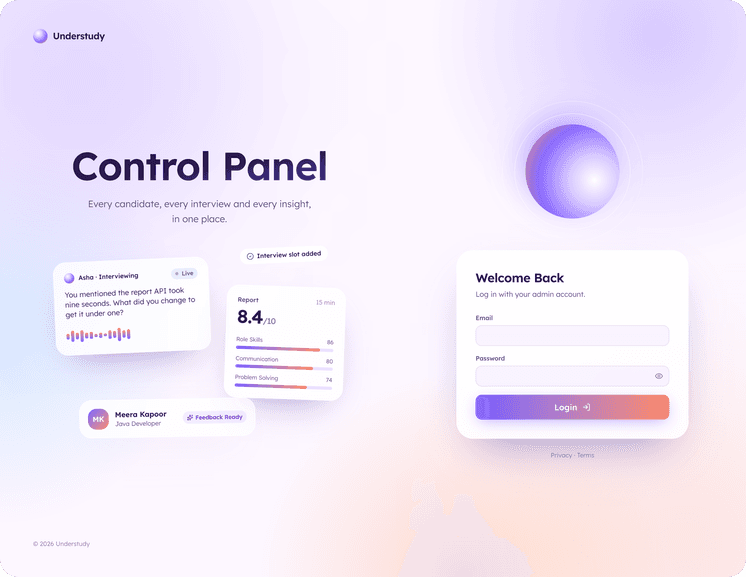
Understudy, our AI interviewer

HR tech, Our own product

A spoken first-round interviewer that plans 8–14 topics from each CV and rates every must-have skill as shown, shown weakly or not covered. Every Techuz candidate now starts with an Understudy first round, so senior engineers meet only the shortlist.

Team
2 people
Timeline
October 2026
Budget
Under $30k
Understudy, our AI interviewer — HR tech
Job marketplace with candidate matching — Online recruitment

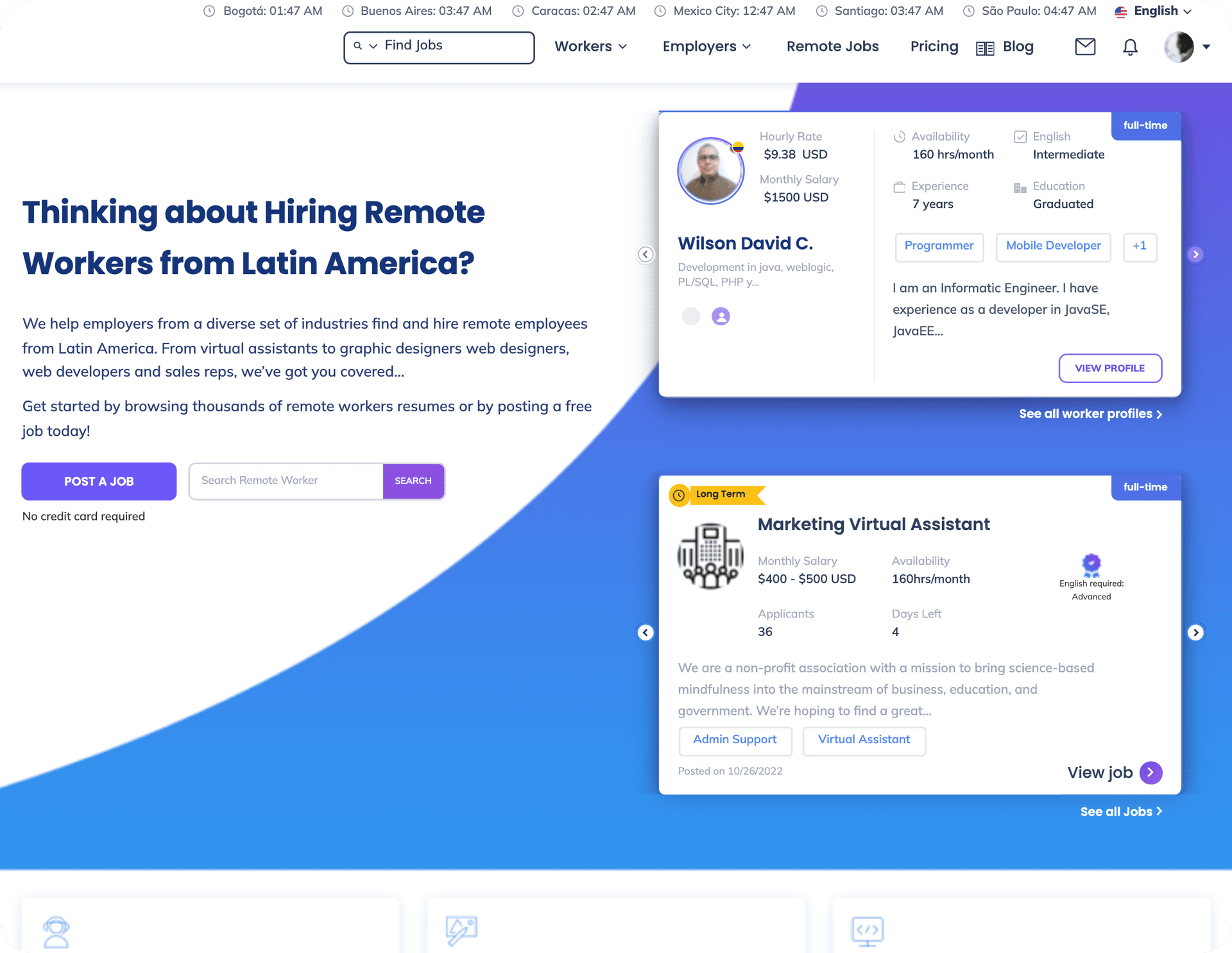
Job marketplace with candidate matching

Online recruitment, Latin America

A job portal where seekers build profiles and employers post jobs, review candidates and hire. Matching runs on 15+ parameters with a rules-based algorithm, with subscriptions through Stripe and PayPal. More than 12,000 jobs posted and 1,500+ people hired through the platform, by the team’s last known figures.

Team
6 people
Timeline
About 18 months
Budget
$50k–100k
Interview scheduling software for HR teams — HR tech · Interview management
Techuz

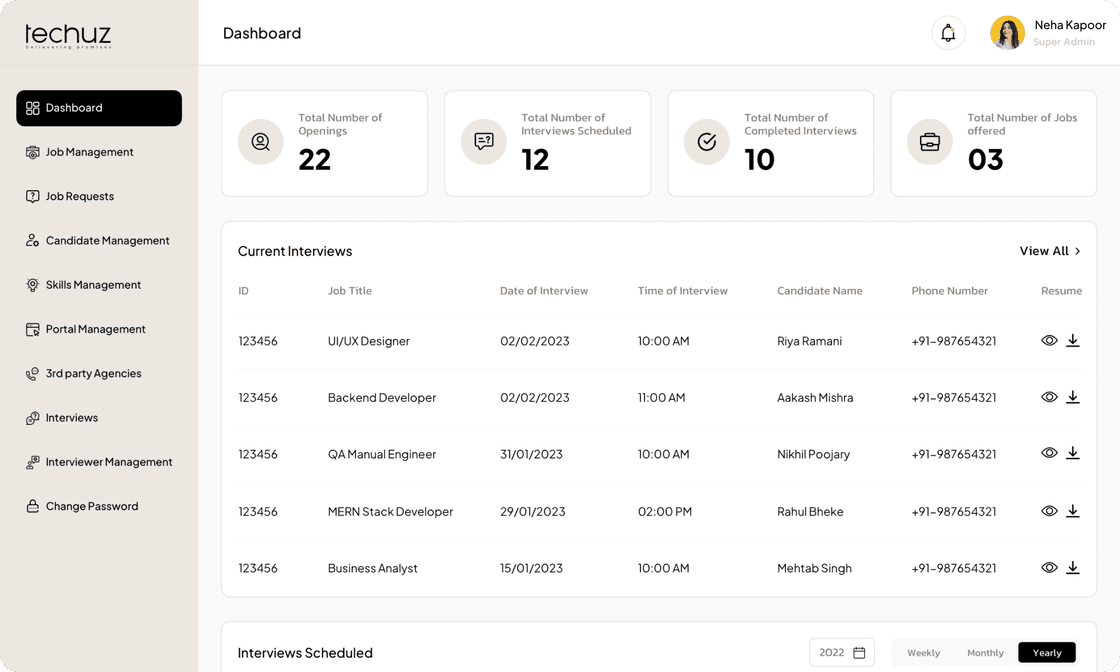
Interview scheduling software for HR teams

HR tech · Interview management

A web portal where HR books interviews around each interviewer’s availability and keeps CVs and feedback together. Invites reach interviewers and candidates through the Google Calendar API. Scheduling, invites, feedback and time-to-hire numbers in one portal, with candidate data encrypted and access set by role.

Team
8 people
Timeline
About 20 months
Budget
$25k–50k

How an HR software project runs

A first HR tool, such as an applicant tracker, takes 8–12 weeks from discovery to launch; larger HR products take 12–24 weeks or more. Across the 8+ projects we built with Claude Code in the last year, delivery took up to 50% less time than comparable builds the year before.

The four phases

How much does HR software development cost?

HR software development at Techuz costs $10k–⁠15k for one tool, $25k–⁠50k for an HRMS or HR SaaS product, and $50k+ for larger platforms built in phases. Team time is billed at $20–25 an hour, by role and seniority.

Typical cost by project type (steps not to scale).
  1. Small

    8–12 weeks

    One tool: applicant tracking, leave and timesheets, or interview scheduling

    $10k–15k

  2. Mid-size

    12–24 weeks

    An HRMS or HR SaaS product with 3–4 user roles, payments or AI interviews

    $25k–50k

  3. Large

    Built in phases · 6–12 months

    A multi-tenant HR platform with web, mobile, AI and compliance work

    $50k+

What moves the price

  • The number of user roles
  • Integrations: calendars, payroll providers, job boards
  • AI features
  • How much compliance evidence you need

AI model usage is paid by you to the model provider, and we estimate it before you commit.

What’s included

Discovery, design, build, testing, deployment and 30 days of free support after go-live, with the code in your own repository from day one.

Mid-size builds start with a Discovery Sprint ($1,500–2,000, about one week), and large platforms with Product Discovery ($4,000–6,000, 3–4 weeks). Support plans then run at 40, 80 or 160 hours a month.

How we protect candidate and employee data

HR software holds the most personal data a company keeps: CVs, recordings, ID numbers and performance scores. We build it to keep only what you need and to delete people properly. The rules are tightening: Bright Defense noted in August 2026 that Illinois now requires employers to tell applicants when AI is used.

Retention you set, deletion that works

A scheduled job deletes interview recordings after a set period, 90 days by default, and keeps the transcript and scores. An admin can remove a candidate’s profile, CV, recordings and reports in one confirmed step.

An audit trail on every change

Changes to employees, leave, holidays and projects are logged with the old value, the new value and the IP address, visible to management only.

Access by role

Recruiters, interviewers, managers and employees each see only what their role allows. Candidate data is encrypted.

Clean logs and short‑lived keys

Logs redact tokens and transcripts, and interview links use a 256-bit token stored only as a hash. The browser gets a voice key that expires after 120 seconds.

On AI hiring features, we can add an AI-use notice and a “request a human interviewer” option by default. See our application security work.

Tech stack for HR software

We pick the stack for the data HR holds and the systems it has to talk to.

  1. Front end

    Fast admin and candidate screens

    • React
    • Next.js
    • Angular
  2. Back end

    One language; Python for AI

    • Node.jsExpress, Fastify
    • PythonAI and data services
  3. Data

    Relational people and pay data

    • PostgreSQL
    • MySQL
    • MongoDB
  4. AI

    Spoken interviews, CV scoring

    • OpenAI Realtime voice
    • Transcription and language models
    • Prompts and test sets versioned
  5. Cloud and delivery

    Hosting, file storage, deploys

    • AWSEC2, RDS, S3
    • GitHub Actions
  6. Integrations

    Invites, imports, reminders, payments

    • Google Calendar API
    • Google Drive API
    • Google Chat webhooks
    • Stripe
    • PayPal

HR software development FAQ

  • HR software is any application that runs people processes: hiring, employee records, leave, timesheets, performance and pay. Off-the-shelf suites cover the common jobs, while custom HR software covers the rules specific to your company. Techuz builds internal HR tools for growing companies and HR products for HR tech companies to sell.

  • HRMS (human resources management system) software runs people processes such as leave, timesheets, recruitment and payroll workflows on top of employee records. An HRIS (human resources information system) mainly stores employee records and core data, though vendors use both labels loosely. Techuz builds the modules your current system lacks, or a full HRMS when nothing on the market fits.

  • Techuz is not the right fit if a standard HRMS already covers your processes and you only need it configured. We don’t implement SAP, Dynamics or Salesforce HR modules, and we don’t build face or emotion analysis into interviews. For multi-country payroll calculation, a specialist payroll provider is usually the better core, and we can connect your tools to it.

  • A single HR tool, such as an applicant tracker or a timesheet and leave system, takes 8–12 weeks at Techuz, including discovery and testing. A full HRMS or HR SaaS product takes 12–24 weeks. Larger platforms with web, mobile and AI run 6–12 months, built and released in phases.

  • Yes in most places, with tightening conditions. Some laws require employers to tell candidates when AI is used, and the EU AI Act treats recruitment AI as high-risk. Techuz builds AI interviews with a consent step, content-only scoring and a person making every final decision. Your legal team confirms the rules in each country you hire in.

  • Yes, through each system’s API. Techuz has shipped Google Calendar invites for interviews, Google Drive data imports, Google Chat reminders and bulk payouts through payment providers. For your HRIS or payroll provider, we check its API during discovery, before the fixed quote, so the estimate covers the real integration work.

Get a Ballpark Estimate for Your Project

Tell us what you're building. We reply within 24 hours and send a ballpark estimate within 48.

Tell us about your project

A few lines are enough. We reply within 24 hours.

By sending this form I confirm that I have read and accept the Privacy Policy