Marketplace development company for two-sided platforms people trust

We build booking, B2B and peer-to-peer marketplaces where buyers and sellers who have never met feel safe paying each other, so both sides come back.

4.9 on Clutch from 45 reviews · 500+ projects since 2013 · 8+ marketplaces built

What our marketplace development company builds

Our marketplace software development services build service, B2B and peer-to-peer marketplaces for founders and for businesses opening their own platform. We build the payment and trust core first, so the buyers and sellers you sign up at launch can trade safely.

  • Service and booking marketplaces

    Service marketplace development connects customers with local providers, from beauty and home care to tutoring, through booking, matching and reliability rules for no-shows. Customers hear back fast, and good providers fill their calendars without chasing work.

  • B2B marketplaces

    B2B marketplace development puts brands or suppliers and trade buyers on one platform, with catalogs, shareable shortlists, sample requests and a dashboard per brand. Suppliers learn which products buyers want, and buyers stop collecting quotes by email.

  • Classifieds and peer-to-peer marketplaces

    Classifieds and resale sites built through our peer to peer marketplace development let anyone list safely. Identity checks, fraud signals at sign-up and moderation tools keep honest sellers on the platform and flag suspicious accounts before they post.

  • Skills, hiring and training marketplaces

    Custom marketplace development fits models no template covers, such as reverse marketplaces where buyers post a need and sellers send proposals. Work is paid in milestones, so bigger deals close without either side paying or delivering everything upfront. See education software development.

  • Marketplace apps for both sides

    Marketplace app development gives buyers and sellers their own iOS and Android apps, sharing one back end with your web platform and admin panel. Providers accept jobs and get payment alerts on the go, which keeps response times short. See mobile app development.

  • Marketplace websites that rank

    Marketplace website development renders every listing and profile page on the server, so search engines read it in full. Each new listing becomes one more page that can bring in buyers. See web development services.

See all the industries we serve. If you sell only your own products, our eCommerce development team builds stores, and our software development services cover the systems around a marketplace.

Why buyers and sellers stay on a custom marketplace

A marketplace earns only when strangers feel safe enough to pay. In TrustedSite’s June 2026 State of Ecommerce Trust research, 89% of US shoppers said they had abandoned a purchase because a site raised doubts. A custom build lets you remove those doubts one rule at a time.

Commission and payout rules you set

Commission can change by plan tier or by booking, with no commission taken on payouts for no-shows or cancellations. Tax is handled at payout too, such as GST and GST collected at source (TCS) for Indian sellers, so the books match every transfer.

Payment methods your market actually uses

Cards alone don’t work everywhere. In Uganda people pay with Mobile Money, and an Indian platform with US customers needs INR and USD side by side. We pick payment and payout rails per market at scoping.

A platform you own outright

Code goes into your repository, and every vendor account, from hosting to payments and SMS, is opened in your name. Nothing has to move when you change teams or raise money.

Building a two-sided marketplace: trust, matching and money

Every two-sided marketplace has one problem underneath: two groups who don’t know each other must trust each other with money. These four parts decide whether your first users trade a second time.

Trust before the first listing

Identity checks and fraud controls go in before anything can be listed. On FlipXz, a UAE classifieds marketplace we’re building in English and Arabic, sellers verify through UAE Pass or an Emirates ID upload. Every document is virus-scanned before it’s stored, and sign-ups that share a device or IP are flagged.

Matching that never double-books

A booking goes to a small group of eligible providers at once. Each gets an SMS and a quick flash call, and if nobody accepts, the next group hears automatically. The first to accept locks the job in the database, so two providers can never win it.

Money that waits for the work

The buyer pays upfront, and the seller’s share sits in escrow as held until the buyer approves the work and a holding period passes. A dispute freezes the money until your admin splits it between payout and refund, and unconfirmed bookings become disputes automatically. For bigger jobs, buyers pay per milestone, and each payment is released to the seller on schedule.

AI that removes a reason not to buy

The most useful marketplace AI helps people decide. In ChannelEngine’s January 2026 Marketplace Shopping Behavior Report, 58% of shoppers had used AI to research products, yet only 17% would complete a purchase through it. So AI goes where doubt sits: a try-on on the customer’s own photo.

For payment-heavy products, see fintech software development. Starting from zero? A marketplace MVP launches with just the flow that earns money.

Custom marketplace or a ready-made builder: which should you start with?

Use a ready-made marketplace builder to test whether anyone will trade at all. Go custom once your commission, escrow, matching or payout rules are what make your marketplace different, because those rules are where builders run out.

How the two starting points compare

How the two starting points compare
Ready-made builder (SaaS)Custom marketplace
Time to a first versionDays to weeks8–12 weeks for a small build
Commission and payout rulesThe builder’s fixed optionsAny rule: per plan, per booking, per milestone
Escrow and disputesBasic, or through add-onsHolding periods, freezes and split refunds
Local payment methodsThe builder’s supported providersChosen per market, such as Mobile Money
Matching and bookingSearch and request flowsRounds, ranking and race-proof acceptance
Data and codeStay on the builder’s platformYours to keep, move and extend

Not sure which fits?

Our product discovery work ends with a written build-or-buy recommendation and a fixed estimate.

Marketplaces we’ve built

A skills marketplace in India, a beauty booking marketplace in Uganda and a materials marketplace for interior designers: three markets, three ways money moves.

Client logo

Skills marketplace for IT training

EdTech, India

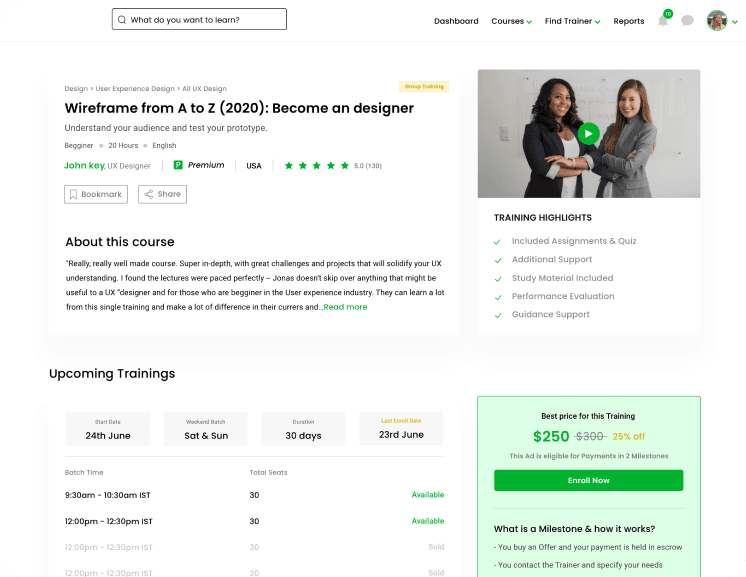
Learners in India and abroad hire freelance IT trainers and training agencies through training ads, job posts, proposals, direct hiring and demo classes. Classes run live in the browser and in native iOS and Android apps. Payments run per milestone in INR or USD, with commission deducted and GST collected at source before direct bank payouts. Seven types of user, from students to agency staff, run on one API of about 1,160 endpoints.

Team
12 people
Timeline
5 years
Budget
Over $100k
Skills marketplace for IT training — EdTech
Beauty booking marketplace — Beauty services
Client logo

Beauty booking marketplace

Beauty services, Uganda

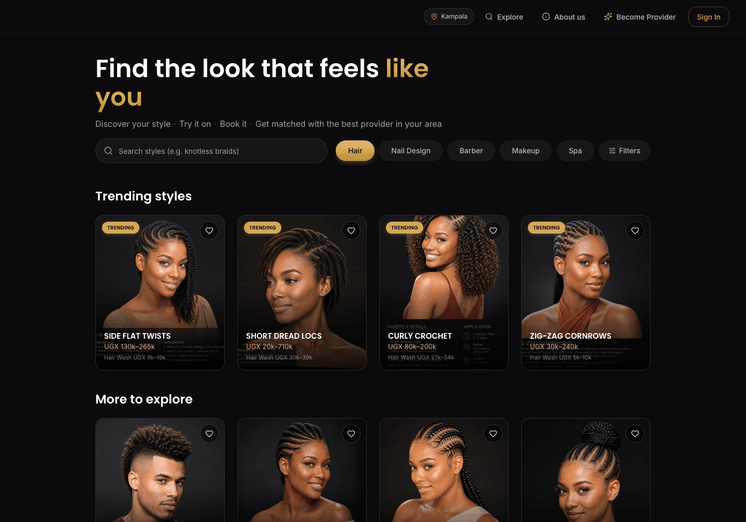
A mobile-first customer web app, provider portal, admin panel and back end, built from scratch. Customers try a hairstyle or nail look on their own photo, book a nearby professional and pay by card or Mobile Money, with the provider’s share held until the job is approved. Live with real payments, and handed over with every vendor account already in the client’s name.

Team
4 people
Timeline
About 6 months
Budget
$30k–50k
Interior design materials marketplace — Interior design
Client logo

Interior design materials marketplace

Interior design, India

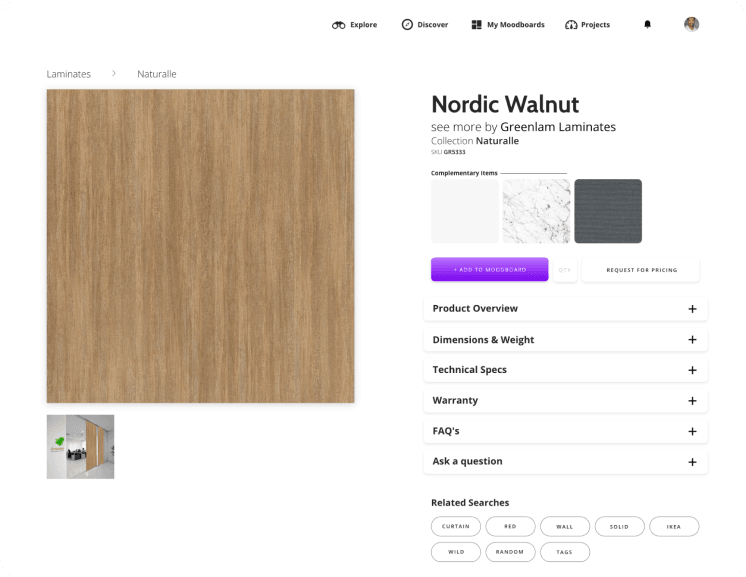
An interior design materials marketplace with 2,000+ materials. Designers saved and shared boards, and brands saw views, saves and sample requests in their own dashboard.

Team
5 people
Timeline
About 12 months
Budget
$25k–50k

What our clients say

Clients on Clutch, where we hold a 4.9 average across 45 reviews. Quotes are the reviewers’ own words; the result lines are ours.

5.0 out of 5on Clutch, Jan 2020
It was a joy collaborating.

The result

Every task delivered on time and to a high standard.

Client logo

Founder

Interior design materials marketplace

5.0 out of 5on Clutch, Mar 2020
We never once had a major issue with the team.

The result

Platform launched with very positive sign-up rates and is being built out into a complete platform.

Client logo

Benedict Lee, Director, Antgage Pte Ltd

Arts & entertainment

5.0 out of 5on Clutch, May 2020
I’m very happy with the final product.

The result

A satisfactory final product, with bugs fixed and minor changes made after launch based on the client’s feedback.

Client logo

Founder, Collectible Trading Cards Company

Collectible trading cards

How we build your marketplace, step by step

Six phases take a mid-size marketplace from scope to launch in 12–24 weeks, then it grows in product sprints.

The six phases

How much does marketplace development cost?

Marketplace development with Techuz costs $10k–⁠15k for a small build, $25k–⁠50k for mid-size and $50k+ for a large platform, built in phases. Rates are $20–25 an hour, depending on role and seniority.

Typical cost by project type (steps not to scale).
  1. Small

    8–12 weeks

    Two sides, one category, listings, booking or ordering, card payments and an admin panel

    $10k–15k

  2. Mid-size

    12–24 weeks

    Three or four roles, escrow or milestone payments, payouts, reviews and seller verification

    $25k–50k

  3. Large

    Built in phases · 6–12 months

    Web and mobile apps, several markets and payment rails, matching, AI features, compliance

    $50k+

What moves the price

  • The number of sides and user types
  • How many countries and payment rails you need
  • Escrow or milestone payments
  • Native apps
  • Identity checks
  • AI features

Marketplace platform development across several markets usually grows in phases after launch.

What’s included

Every price includes QA and project management. Payment, SMS, hosting and AI fees are billed to your own accounts and listed in the proposal.

How do we keep a marketplace safe for both sides?

By building the rules your users never see. In a Clutch survey of 401 US consumers in February 2026, 61% said platforms such as marketplaces are most responsible for preventing online shopping scams.

Reviews only after a completed job

Buyers can review only after a completed booking, providers can reply, and admins moderate. Ratings stay worth reading, because nobody can post one without a real transaction.

Privacy written into the code

Logs never contain phone numbers, ID numbers, names, one-time codes or tokens. Identity documents are deleted on a schedule, and the data region is fixed from day one. On FlipXz, that means UAE PDPL rules and AWS storage in the UAE.

Admin access locked down

Admins sign in with two-factor authentication, and every admin action goes into an audit log. Rate limits slow down sign-up and one-time-code abuse.

See our application security work.

Technology we use for marketplaces

Our marketplaces share one core stack; the payment, identity and messaging services change with each market.

  1. Web and admin

    Listing pages rendered on the server for search; quick admin panels

  2. Mobile

    Apps for buyers and providers on one shared API

  3. Back end and jobs

    One API for every side; scheduled payouts, matching rounds and dispute checks

    • Node.js
    • Express
    • MySQL
    • Redis
    • BullMQ
    • Socket.IO
  4. Payments and payouts

    Local payment methods, escrow and seller payouts

    • Stripe
    • Razorpay
    • Pesapalcard and Mobile Money
  5. Trust and messaging

    Verification, bot protection and booking alerts

    • UAE Pass
    • ClamAV
    • reCAPTCHA
    • Twilio
    • SendGrid
    • WhatsApp templates
  6. Cloud

    Hosting that grows from a few cities to a whole country

  7. AI

    Try-on and smarter search inside the product; AI in how we build

    • Perfect Corp try-on
    • OpenAI
    • Claude Codefor delivery

Marketplace development FAQ

  • A two-sided marketplace is a platform where two separate groups, such as customers and providers, find each other and trade. A service marketplace works the same way: customers book a provider, pay through the platform, and the provider is paid once the job is done. The platform earns a commission or fee on each deal.

  • Most marketplaces take a commission on each transaction, and many add seller subscriptions, paid listing boosts or buyer memberships. Techuz has built all four: commission per plan tier or per booking, trainer plans with ad quotas, boosted training ads and a beauty membership.

  • Start with one side, one category and the one transaction that earns money, then prove people will repeat it. At Techuz, that usually means a one-week Discovery Sprint, then a first release of 8–12 weeks with payments and trust built in.

  • With Techuz, a small marketplace costs $10k–15k, a mid-size one $25k–50k and a large platform $50k+, built in phases. Native iOS and Android apps for both sides usually move a build up a tier.

  • Online marketplace development at Techuz takes 8–12 weeks for a small build, 12–24 weeks for a mid-size marketplace and 6–12 months for a large platform. Our beauty booking marketplace, with escrow and AI try-on, went live in about six months.

  • If you sell only your own products, a Shopify or WooCommerce store fits better than a marketplace build. Techuz doesn’t run marketplace operations, seller recruitment or moderation for you. And if a ready-made builder already covers your rules, start there.

Get a Ballpark Estimate for Your Project

Tell us what you're building. We reply within 24 hours and send a ballpark estimate within 48.

Tell us about your project

A few lines are enough. We reply within 24 hours.

By sending this form I confirm that I have read and accept the Privacy Policy