Know whether an offer is worth pursuing
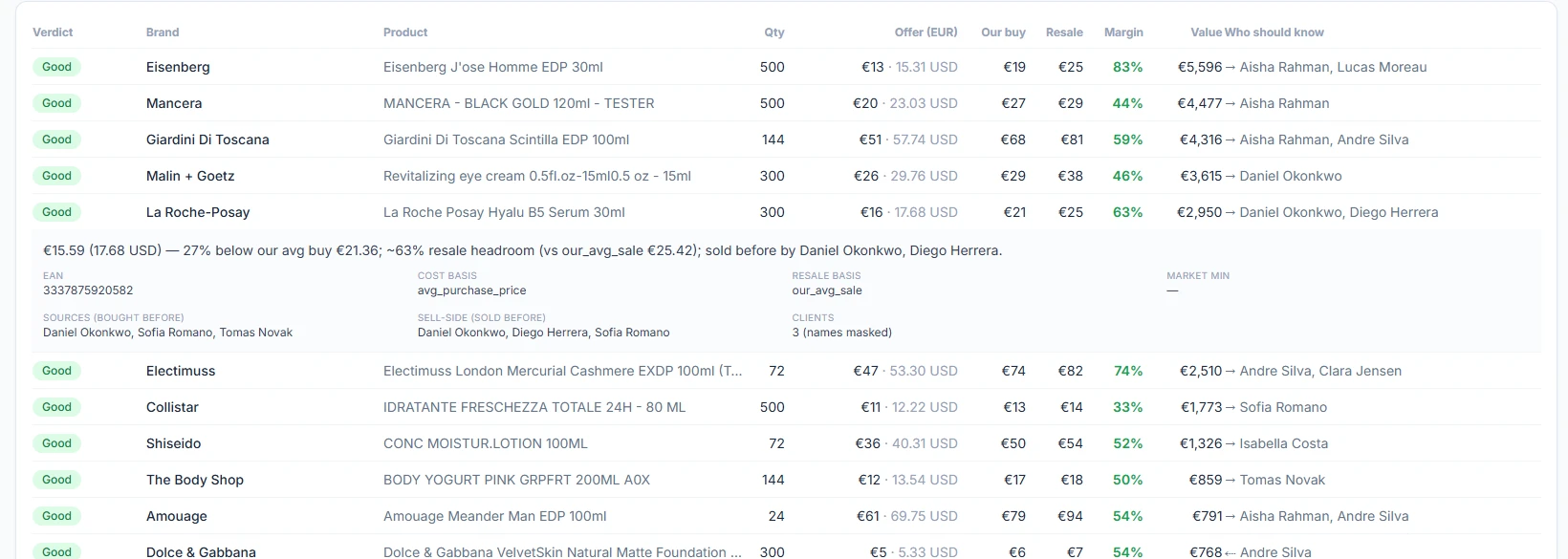
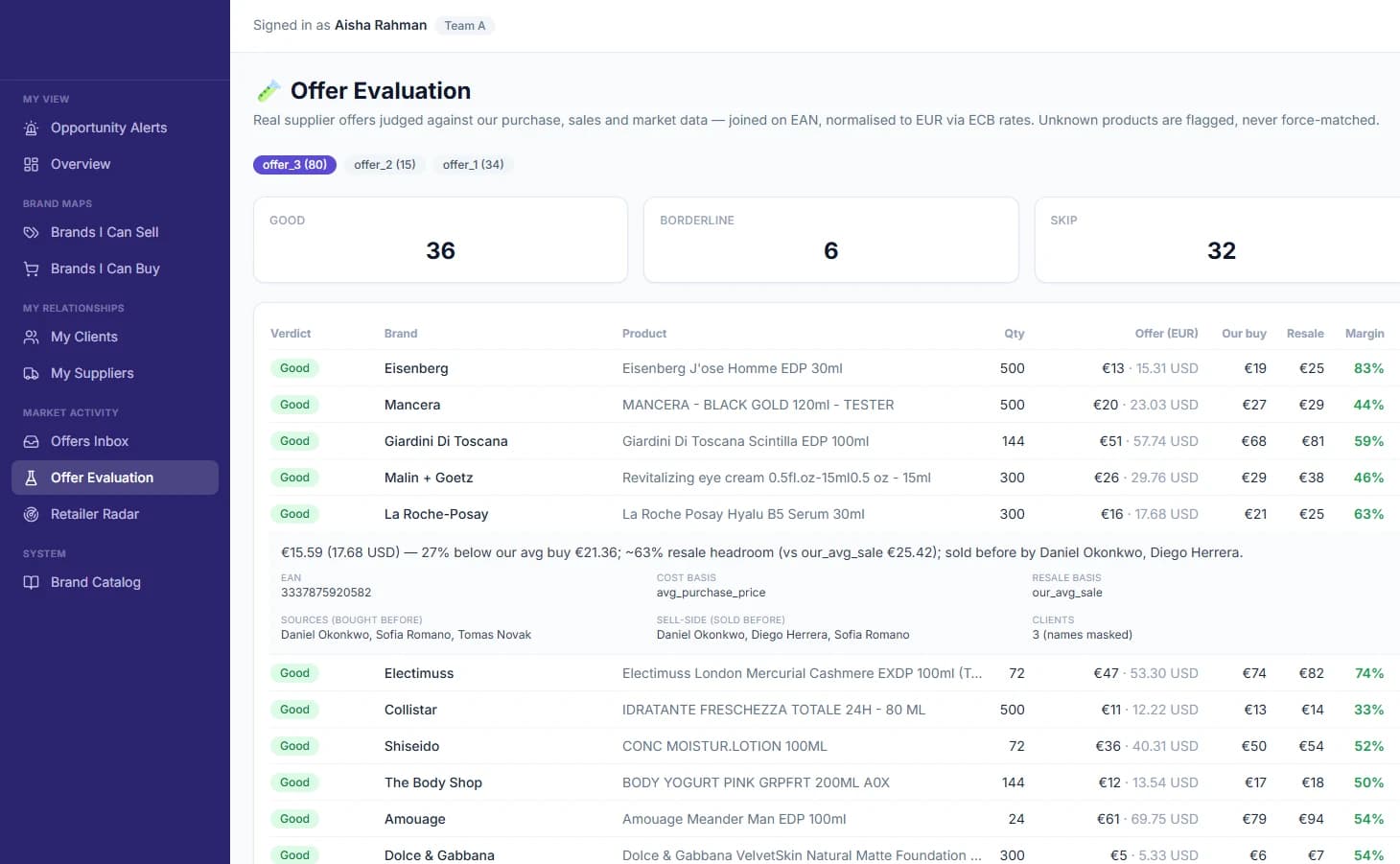
An offer evaluator that gives a verdict, the reason and which colleagues to loop in

Traders get a short, ranked list of deals meant for them and a clear verdict on each supplier offer. It's being tested with selected beta users.
 Distributor and wholesaler of branded beauty products
This web app helps a beauty products wholesaler connect what it can buy with who wants to buy it. It sends each trader a short, ranked list of deals, judges every supplier offer against the company's own history, and keeps each trader's clients private. Techuz built the first version in about three weeks, using plain rules for every match and AI only to read offer emails.
The client buys branded beauty products, such as perfume, skincare, cosmetics and hair care, from manufacturers and distributors. It resells them to other distributors and retailers, and aims to sell everything it buys rather than hold stock.
Its traders work in several teams, moving hundreds of brands across five continents.
Some traders only buy, some only sell, and some do both. They all work in a web browser.
Linking a buy to a sell still depended heavily on manual back-and-forth between people. A brand, a price, a client's need and a supplier's offer often sat in different places, and in different people's heads.
The client wanted a structured web app, not a chatbot, that tells the right trader when a real opportunity appears.
The tricky part was brand names. The same brand turns up as “YSL”, “Saint Laurent” or “Yves Saint Laurent”, and the client saw this as one of the biggest technical risks.
Three choices shaped this app. We matched on barcodes and a fixed brand dictionary, enforced trader privacy on the server, and made the offer verdict a visible rule.
The easier options were fuzzy name matching, which guesses from similar spellings, or letting an AI model decide which products match. We matched products on the EAN, the barcode number printed on each product, and resolved brand names with a fixed, rule-based dictionary.
Here's how it works. The dictionary is built from the client's product master, plus known aliases. It copes with accents, punctuation, initials like “Y.S.L.” and endings like “Paris”.
If a brand isn't in the dictionary, the app flags it instead of forcing a match.
Each trader sees only their own clients and suppliers. Where a colleague handles an account, it shows only as “via” plus that colleague's name.
The easy option was to hide names on screen. We enforce the rule in the back end, on every response, instead.
Here's how it works. Each trader signs in and gets a signed session token, called a JWT. Ownership and masking checks then run in the service layer, the part of the back end every request passes through.
The client gave no target margin, on purpose. So we didn't hide a number in the code; we made the logic explicit.
Here's how it works. The app converts the offer price to euros and compares it with the client's own average and best purchase price. Then it checks the room to resell, against the lower of the client's average sale price and the market price.
The price thresholds (25% and 10%) sit in one settings file and show on screen.
AI reads emails; rules make the calls. Claude Haiku 4.5, Anthropic's AI model, turns a supplier's offer email into a structured offer. Matching, alerts and verdicts stay as plain rules, so every result can be traced.
The database sits between the data and the app. The data pipeline fills the database, and the API reads from it. Later, a live read-only feed from the client's Odoo business software can replace the file exports without changing the API.
Traders work in one web app with 11 screens. Behind it, a data pipeline loads the client's exports and a matching engine raises the alerts.
An offer evaluator that gives a verdict, the reason and which colleagues to loop in
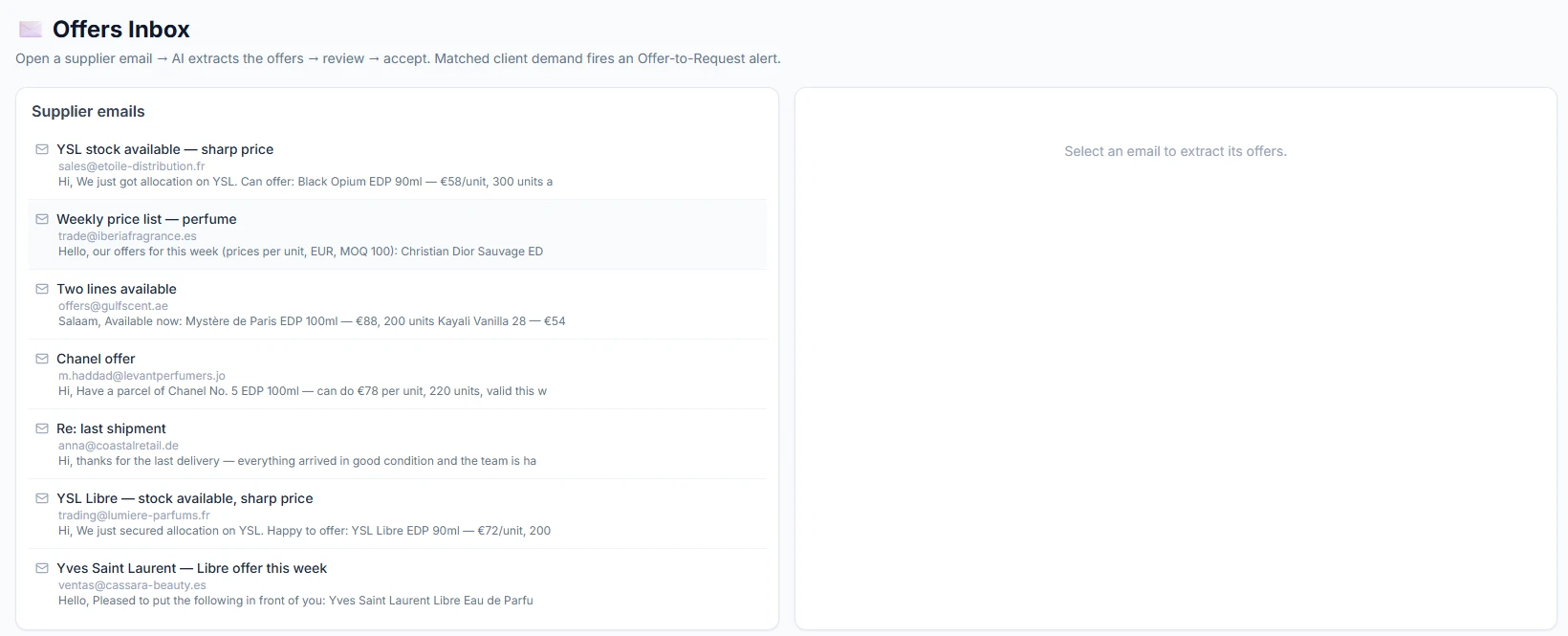
AI email reading in the offers inbox, ready to check and accept
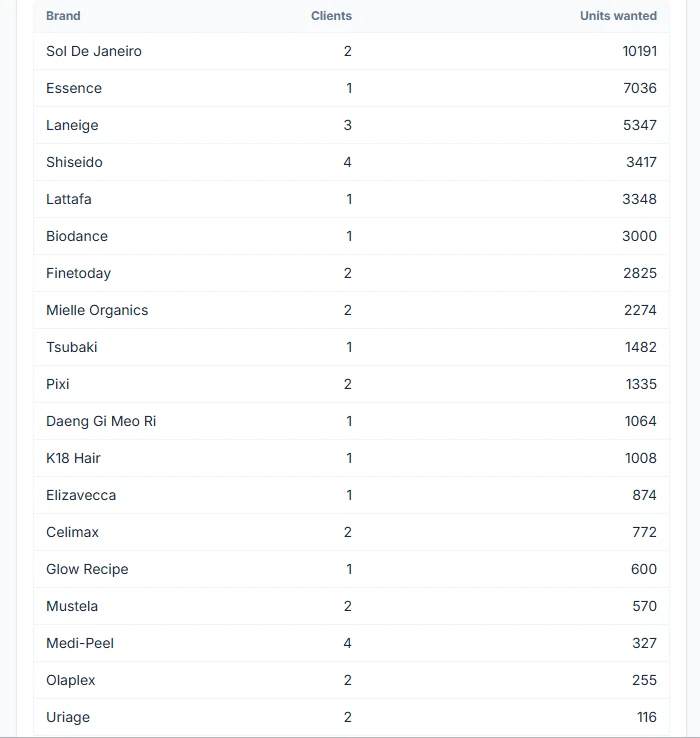
Brand maps that hide colleagues' client names
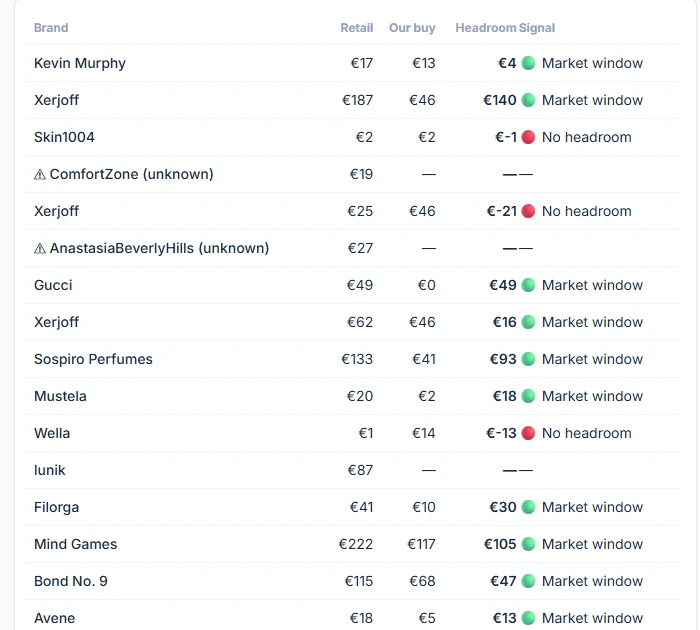
A retailer price radar
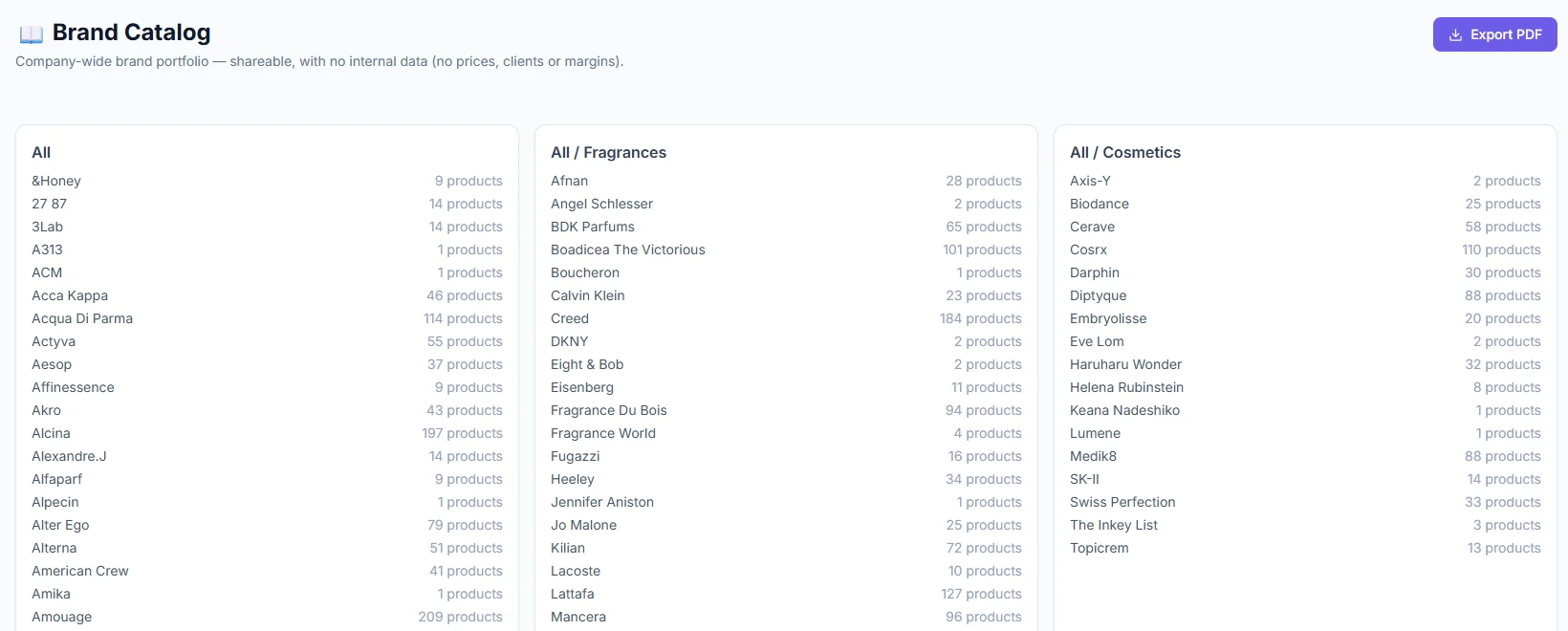
A PDF export with no internal data in it
We built a first demo on generated data with 50 hand-picked brands. The client's real files had far more brands, with much messier names, so we rebuilt the brand dictionary from their product master.
The order exports caused a second surprise. They carried the salesperson and customer only on each order's first line, so at first most lines had no trader.
The “who should know” output still looked believable. Filling each order's header down to every line fixed it.
1people
The app is being tested with selected beta users, so there are no usage or deal figures yet. On the client's own files, it matched offers by barcode and flagged what it couldn't place. In one offer, only 4 of 31 barcodes were in the client's catalog, and the app said so instead of inventing a benchmark.
Figures from a test run on the client's sample files and the app's database.
FastAPI is part of the client's specified stack
The client's target is PostgreSQL 16 on AWS, in an EU region
React, TypeScript and Tailwind are the client's specified stack
Match on the product barcode first, then use a fixed dictionary for brand names. Here, products match on their EAN barcode, and a rule-based dictionary handles spellings like “YSL” and “Saint Laurent”, flagging any brand it doesn't know.
Not when every result has to be traced. In this app, matching, alerts and offer verdicts are plain rules, and AI only reads free-text offer emails.
Enforce it on the server, not just on the screen. Here, every response passes ownership and masking checks, so other traders' client names never leave the server.
Tell us what you're building. We reply within 24 hours and send a ballpark estimate within 48.