
One version of every order and number
Data is entered once and synced to your ERP and CRM through their APIs. Nobody re-keys an order, so finance, sales and operations quote the same figure.

Get one application for the orders, approvals and reports your teams now juggle in spreadsheets, linked to the ERP, CRM and other systems you already run.
4.9 on Clutch from 45 reviews · 500+ projects since 2013 · 250+ clients
Our enterprise software development services build the internal platforms your teams run on: ordering and approval systems, partner portals and reporting dashboards connected to your ERP and CRM. We build the workflow that costs your teams the most time first, then add the next.
Operations and approval platforms put requests, approvals, scheduling and handoffs into one system, with an owner and a status on every item. Managers see where work is stuck without chasing anyone over email.
ERP and CRM extensions add the screens, rules and automations your core system can’t model, built outside it and synced through its API. Upgrades to the core stay simple, because your custom logic never touches it.
Portals give employees, dealers, partners or vendors one login to their own orders, documents and requests, with access set by role. Fewer calls and emails reach your back office, because people check status themselves. See employee and partner portals.
Reporting dashboards pull numbers from your ERP, CRM, accounting tools and spreadsheets into live views for each role. The weekly summary stops costing someone a day, and every meeting works from the same figures.
Legacy system modernization moves a system nobody dares to change onto a current stack, one module at a time, after a code audit shows what to keep. Your business keeps working on the old system while each module moves across. See software consulting.
An AI layer on your own records and documents adds search, drafting and triage to the applications your teams already use. Staff find answers and clear routine work faster, using knowledge your company already holds. See enterprise AI agents.
Beyond internal platforms
Most of this is enterprise web application development, and field teams also get mobile apps. Both sit within our wider software development services.
One system ends the copy-paste between tools and the seat fees for features nobody uses. In Zylo’s January 2026 SaaS Management Index (vendor research), organizations left an average of 36% of their SaaS licenses unused.
In discovery we list every system your application will touch: who owns it, how it signs in, what data moves and what happens when it is down. Each connection is planned before any screen is designed and gets automated tests against a sandbox or mock. In a 2026 connectivity benchmark of 1,050 IT leaders, reported by CIO Dive in February 2026, only 27% of the average organization’s 957 applications were connected. We connect any system with a documented API.
Your application
Sync log
All systems in sync
Replacing an old system? We map its fields to the new data model, rehearse the move on a copy of your data, then migrate in batches with counts and totals checked. The old system stays read-only until your team signs off, and migration usually adds about a week. See backend and API development.
Buy SaaS when a tool covers about 90% of the job. Extend your ERP or CRM when the gap is a few screens or rules. Choose custom enterprise software development when the way you run the process is how you win. Heavy customization inside an ERP core makes every upgrade a risk, so we keep custom logic outside it.
Not sure which fits?
A technical architecture review, or a 30‑minute call with a tech lead, shows which parts to buy and which to build.
Three systems companies run every day: a garment ordering platform, a clinic management app and a monitoring dashboard. Our enterprise clients typically stay with us for 3–4 years.

A made-to-measure garment ordering ERP where orders take about 15 minutes, not over 24 hours. Dealers order with saved styling templates, and an admin checks every order before production (figures from the client’s Clutch review).
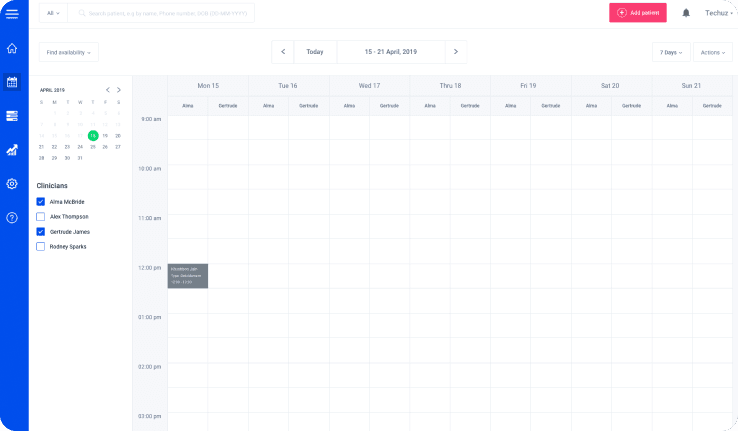
Patient records, appointments, billing and reporting run in one web application for clinic staff, with invoices synced to QuickBooks. Built to HIPAA requirements on Angular, Node.js and MySQL. In daily use, with a HIPAA audit passed.
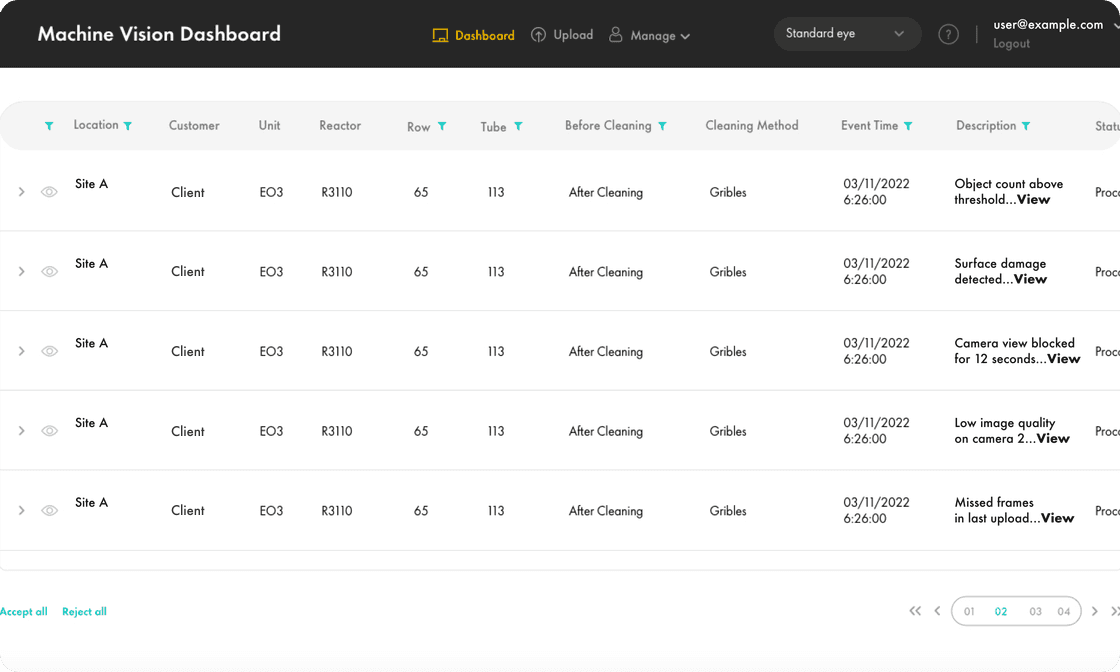

A dashboard where hundreds of specialists and non-specialists across a large enterprise follow machine-vision issues through tables, graphs and a reader mode. We handled UX/UI design and the React front end alongside the client’s back-end team. A 20-month product partnership.
Clients on Clutch, where we hold a 4.9 average across 45 reviews. Quotes are the reviewers’ own words; the result lines are ours.
New systems stall when every team switches on the same day, so we release to one pilot team first and roll out department by department. In WalkMe’s April 2026 State of Digital Adoption study (vendor research), workers lost the equivalent of 51 working days a year to technology friction.
A mid-size enterprise project with Techuz costs $25k–50k. Larger projects are priced by scope after Product Discovery and built in phases, or run as an agile dedicated team billed on time and material.
Every build includes design, development, QA with written test cases, UAT, data migration, release into your cloud account, a handover pack and 30 days of free support after handover.
Access rules are written down before the build and tested role by role, for people and for any AI feature acting for them. In Okta’s April 2026 Businesses at Work report, 91% of organizations used AI agents, but only 32% secured them as rigorously as human employees.
For enterprise web development we choose long-supported frameworks your next team can hire for, and relational databases for money, permissions and audit trails.
Relational by default; queues and rate limits for heavy workloads
Verified webhooks, logged syncs, standard sign-in protocols
Models working on your own records, with prompts and test sets versioned
Techuz is not the right fit for implementing or customizing a large ERP or CRM core, 24/7 on-call operations, or programs that need a large team on site in the US or Europe.
Enterprise application development is building software that runs a company’s core operations for many users and roles. It connects to systems such as the ERP, CRM and sign-in, and includes access control, audit trails and long-term support.
At Techuz, scope is set in a one-week Discovery Sprint, or a 3–4 week Product Discovery for larger builds. The build then runs in 2–3-week sprints, and the first team uses each release before the whole system is finished.
Yes, if the system has a documented API. Techuz has delivered integrations with QuickBooks, CRM and support tools, bank APIs and e-signature services. ERP work starts with paid discovery that maps your data and decides which system owns each field, so two systems never overwrite each other’s records.
ERP is rarely replaced by a single product. Many companies keep a smaller ERP core for finance and inventory, add SaaS tools for standard jobs and build custom applications for the work that sets them apart, connected through APIs. Techuz builds those custom applications and the connections between them.
Ask to see a similar project, who reviews the code, who owns the code and cloud accounts, and what support costs after launch. At Techuz, your code is in your repository from day one, and we hold 4.9 on Clutch from 45 reviews.
The usual four are integrations, data migration, permissions and user adoption. Techuz plans each connected system in discovery, checks migrated data against totals, signs a permission matrix before the build and runs UAT with your own staff.
Tell us what you're building. We reply within 24 hours and send a ballpark estimate within 48.


