
New features on the same foundations
API conventions and permission rules are fixed early, so each new module follows the same pattern. One marketplace API we built kept growing on those foundations for five-plus years, and it’s still in use.

Grow your users, partners and payment volume without a rebuild, on a back end that runs your web app, mobile app, marketplace or SaaS product.
4.9 on Clutch from 45 reviews · 500+ projects since 2013 · One marketplace API grown to about 1,160 endpoints for 7 user types without a rewrite
Our backend development services build the APIs, data and payment logic your apps run on, for startups launching and for businesses that have outgrown their back end. New user roles, partners and AI features plug into the same API, so growth costs less.
Custom backend development services give your web or mobile product its server side: data model, business rules, admin APIs, background jobs and real-time updates. Every new feature builds on that one foundation. See custom software development and mobile app development.
API and integration work gives your web app, mobile apps and partners one shared REST API, connected to CRMs, identity checks, e-signature, video and inventory tools. You launch a new channel or partner deal without building a second system.
Payment work is for marketplaces, platforms and subscription products: wallets, payouts, escrow and subscriptions on Stripe, Stripe Connect, Razorpay, Cashfree, PayPal or Pesapal. Money moves on rules you can audit, so everyone gets paid the right amount at the right time.
Multi-tenant SaaS backends let one product serve many customer organizations, each with its own data, roles and usage tracking. You can sell to larger accounts that ask hard security questions, without a data migration later. See SaaS development.
AI back-end work adds AI features to the product you already have: Python AI services beside your main API, and MCP servers that let AI agents use your existing endpoints. Your users get AI that works on their real data, with no back door into it. See AI development services and AI agent development.
Backend rescue is for a back end that is slow, fragile or built by another team: a code audit decides what to keep, replace or migrate. You stop paying for rework on working parts, and your service keeps running during the switch. See software consulting.
Backends are one part of our software development services.
A well-planned backend lets you add features, users and channels without a rebuild, and keeps money and data correct as you grow.
Your API is written as an OpenAPI contract and approved with the data model (ERD) and permission matrix. CI then checks every endpoint against it, so the contract doubles as your live API inventory. In Salt Security’s April 2026 report, only 24% of organizations had a fully automated API inventory.
The signed OpenAPI contract: every endpoint returns the same response envelope with data, error and paging; breaking changes ship as a new version while the old one keeps running; every request passes Auth, RBAC, TenantGuard and Validation; bookings and payouts run in transactions with row locks. The ERD, contract and permission matrix are approved together.
Every endpoint returns the same success and error shape, with shared pagination and soft-delete rules.
Breaking changes ship only in a new version. The old one keeps running for an agreed window, with a changelog sent each release.
Every request passes Auth → RBAC → TenantGuard → Validation, so one organization never reads another’s records.
Transactions and row locks on bookings, wallets and payouts; tax calculations run on the server.
Need an architecture review on its own? See technical architecture.
In our experience, most products should start with a modular monolith and job queues. Split a service out only when load or language demands it, such as an AI feature. Serverless functions take the spiky, event-driven jobs: on GuidedLXP, AWS Lambda unpacks and checks every uploaded course file, so big uploads never slow the API and cost nothing when idle.
We’ve rebuilt a US payments backend, built a crew payments platform in India and scaled a US movie ticketing platform for release weekends.

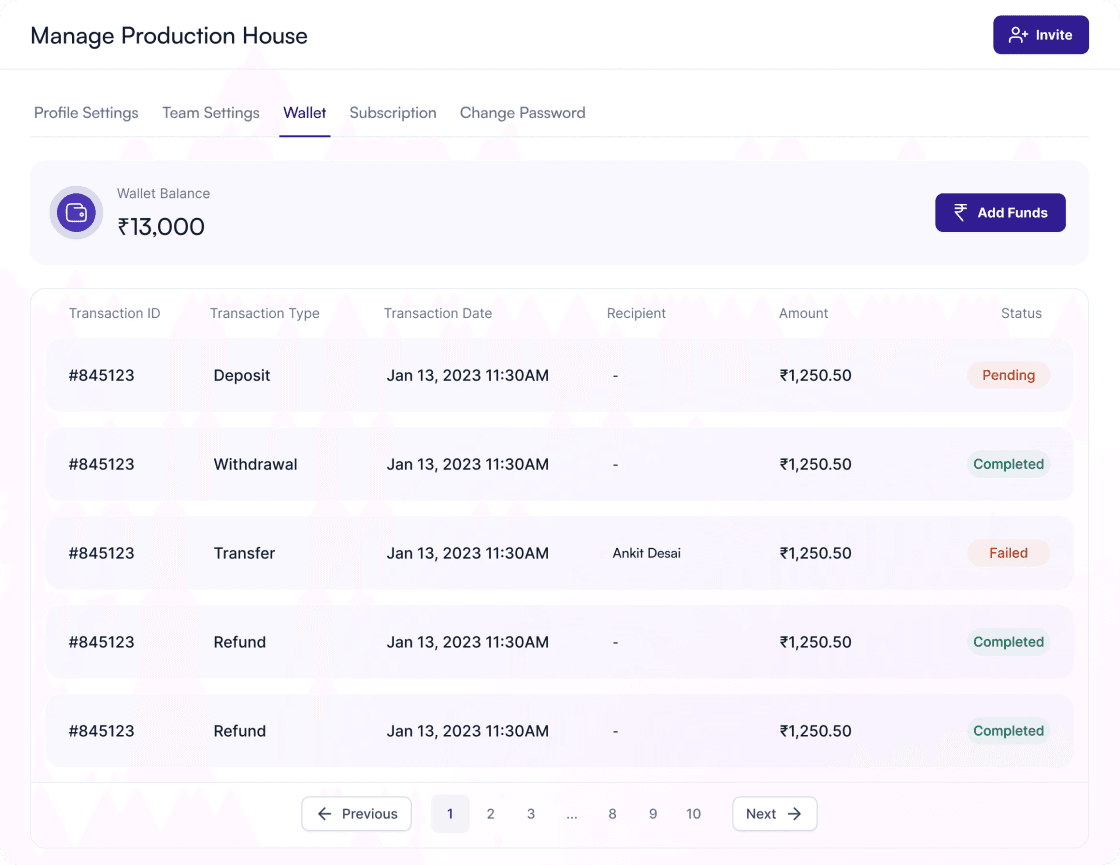
A Node.js, Express and TypeScript backend for a production-management SaaS, with a prepaid wallet and single, bulk and partial Cashfree payouts confirmed by signed webhooks. Identity checks, e-signed contracts and tax-ready invoices run through the same API. One wallet pays single, bulk or partial payouts, and each invoice works out its own GST and TDS.

Gravity Payments’ gift card backend, rebuilt on Node.js and AWS. Old and new systems ran side by side during the move, and each transaction went from 20 seconds to about 8.
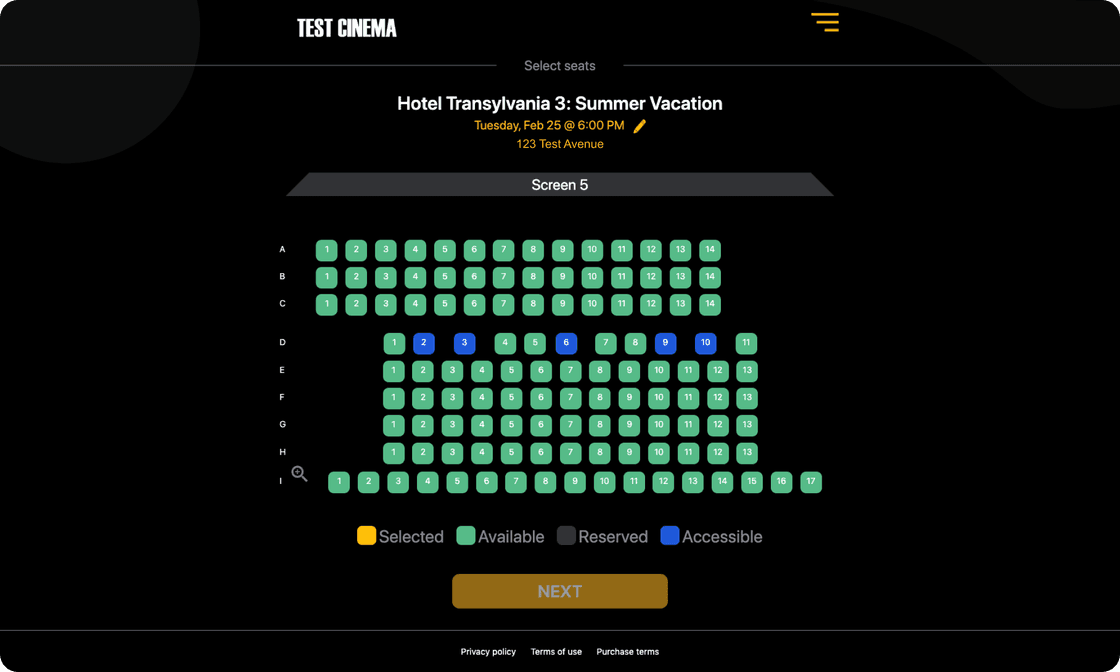

A Node.js and Express backend for a US theater-ticketing SaaS, serving a web app and native iOS and Android apps. A seat-layout simulator turns each theater’s RTS layout data into a seating plan, and AWS auto-scaling adds servers for weekend peaks. On a major release weekend, servers scaled from 2 to 6–8 with no downtime, according to the client’s figures.
Reviews of backend work from Clutch, where we hold a 4.9 average across 45 reviews. Quotes are the reviewers’ own words; the result lines are ours.
The final code quality was excellent and our team has taken no issue.
The result
Server backend replaced successfully, setting up easier future updates and new features, with thorough documentation.

Pankaj Kumar, Architect, Gravity Payments
Payments
The platform is live, fully functioning and earning money.
The result
Positive initial feedback on the launched ticketing platform, with more features in progress and fast support.
CEO, Consulting Firm
Online ticketing
Techuz impressed me with their technical expertise, meticulous approach, and ability to execute our vision with precision.
The result
Faster, more responsive platform with better scalability, engagement and retention, delivered on time with all requirements met.
Partnership Manager, Solicy
Blockchain software
Architecture, build sprints and release make up the development time in the cost table. Discovery comes first and a 2-week UAT sprint runs before release, so the phases add up to the totals below.
Small backend
8–12 weeks
One API for one app with one or two roles, or a backend for an existing front end
Mid-size backend
12–24 weeks
A SaaS or marketplace backend with payments, an admin panel and 3–4 roles
Large backend
6–12 months
A multi-tenant platform for several apps, with AI and compliance
Add 1–2 weeks of discovery and the 2-week UAT sprint to each for the total.
A small backend costs $10k–15k with Techuz, a mid-size one $25k–50k, and a large one $50k+, built in phases. Hourly rates run $20–25, depending on role and seniority.
$10k–15k
Small
8–12 weeks of development
$25k–50k
Mid-size
12–24 weeks of development
$50k+
Large
Built in phases · 6–12 months
Small
8–12 weeks of development
$10k–15k
Mid-size
12–24 weeks of development
$25k–50k
Large
Built in phases · 6–12 months
$50k+
QA, project management and 30 days of free support are in every price. Add 1–2 weeks of discovery and the 2-week UAT sprint to each development time for the total.
See engagement models and pricing, or set up a dedicated development team from 160 hours a month per engineer.
Security is designed into the API, not added before launch. In Akamai’s March 2026 research, the average number of daily API attacks rose 113% year over year.
See our application security services.
Node.js is our default API stack: one language across API and front end, and a large hiring pool. Any other choice gets its reason written into the architecture document.
Relational by default for money, permissions and audit trails
Heavy work and live updates kept off the request path
AWS by default, Azure when you’re Microsoft-first
One contract for every team; checks before merge
Models, document search and agents, with prompts and test sets versioned
Backend development is building the server side of a product: the APIs, databases, business rules, background jobs and integrations that apps call. Users never see it, but every login, payment and search depends on it. At Techuz, back end development services also cover security, monitoring and documentation, so another team can run what we build. See also front-end development.
Hiring a back-end developer through Techuz costs $20–25 an hour, depending on role and seniority. A dedicated engineer joins for at least 160 hours a month. Fixed-scope builds are priced by project instead, starting at $10k–15k for a small backend. See hire Node.js developers.
With Techuz, development takes 8–12 weeks for a small backend, 12–24 weeks for mid-size and 6–12 months for large. Add 1–2 weeks of discovery up front and a 2-week UAT sprint before release. Cutting the first release down to the one flow that earns money is the fastest way to shorten it.
Yes, Techuz can take over or rebuild your existing backend. We start with a 1–2 week code audit, keep what passes and replace only what blocks you. For Gravity Payments, we rebuilt a gift card backend and ran the old and new systems side by side while cards and their transaction history moved across.
Yes, when the controls are written down and checked. At Techuz, every engineer signs an NDA and IP assignment, access runs over VPN with MFA, and production data stays in your cloud account. Our access is revoked and our copies deleted within 7 days of the project ending.
Ask to see the API contract and permission matrix before any code, and who reviews each pull request. Ask how they verify payment webhooks and test tenant isolation. Then check reviews: Techuz is rated 4.9 on Clutch (45 reviews) and 4.7 on GoodFirms (11).
Techuz isn’t the right fit for Kafka-scale streaming, petabyte data platforms or large Kubernetes estates, which we haven’t run. We don’t offer 24/7 on-call operations or SAP and Salesforce customization. If a SaaS tool covers most of your workflow, we’ll tell you to buy it.
Tell us what you're building. We reply within 24 hours and send a ballpark estimate within 48.


