AI SaaS development services, from MVP to paying customers

Turn an AI idea into a subscription product customers pay for every month, on a build that grows from your first account to your thousandth.

4.9 on Clutch from 45 reviews · 500+ projects since 2013 · AI SaaS products live in the US and UK

Our AI SaaS development services

Launching a new AI product or adding AI to the SaaS you already sell? Our AI SaaS development services build what customers pay for: the AI that does the job, plus the plans and billing around it.

  • AI SaaS MVPs

    AI MVP development focuses on the one AI feature that sets your product apart, built with the basics around it: sign-up, a paid plan and an admin panel. You test it with real customers before you scale it. See MVP development.

  • AI for the SaaS you already run

    AI solutions for SaaS providers add one AI feature that works for every customer account, inside each account’s own data and plan limits. You sell it as an upgrade to your whole customer base, not a custom build for one client. See AI software development services.

  • Multi-tenant AI platforms

    A multi-tenant AI platform runs all your customer companies on one codebase, each with its own users, roles, AI settings and usage limits. Every new customer adds revenue, not another deployment to maintain. See RAG development.

  • Plans and billing

    Plans and billing run on Stripe, with self-serve upgrades charged only for the days used, promo codes and invoices. When customers want more AI, they move up a plan, so your revenue grows with their usage. See SaaS development.

  • Admin consoles and white-label brands

    One admin console manages users, plans and AI settings, and one platform can run several branded sites, each on its own web address. You can enter a new market or resell under a partner’s brand without a second codebase. See UI/UX design.

  • Machine learning inside your SaaS

    Some products need more than a call to a large language model. Our machine learning services train models on your own data, for scoring, predictions or classification, and run them inside your SaaS for every customer account. Training runs on our Google Cloud or yours, with PyTorch. See MLOps & LLMOps.

What an AI-powered SaaS needs on day one

On day one, an AI SaaS needs to reach the market fast, with AI your product team can tune and models you can swap without a rebuild.

Faster to market, faster to traction

Sign-up, plans, billing and admin come from patterns we’ve already shipped, so your sprints go into the AI feature that sets you apart. You launch with a paid plan in the first release and learn which customers stay and pay while others are still building.

Your team tunes the AI, not a developer

Prompts and their variables live in the admin panel, so your product team adjusts the AI per feature. Improvements ship when you decide, not next sprint.

No lock-in to one model provider

Models sit behind your backend, so changing provider is a configuration change once your test set passes. When one platform’s first model didn’t use its tools reliably, we moved it to one that did. See LLM development services.

AI SaaS monetization: plans, limits and cost per customer

Every AI request costs money, so an AI SaaS earns its margin in the design. In ICONIQ’s July 2026 survey of about 300 software executives, AI products averaged a 45% gross margin in 2025. We decide what each AI action costs, which plan pays for it and what happens at the limit.

An example admin view. Two plans carry an AI allowance: Starter, 20 AI runs a day, and Pro, 200 a day. Each account’s AI usage and monthly AI cost show against its plan price; one account nearing its limit has had an 80% alert. A spending check runs before each AI call. A router sends the conversation to a stronger model and scoring to a smaller one, and reuses cached replies.

  1. 1

    Cost per customer, measured

    Each account’s AI calls and spend are recorded inside the product, so plan prices come from measured usage, not estimates.

  2. 2

    An AI allowance on every plan

    Each plan carries an AI allowance, such as a daily quota that rises on paid tiers, so paid API calls follow revenue. A spending check before each call protects your monthly budget.

  3. 3

    The right model for each job

    A stronger model handles the conversation customers pay for, and a smaller one does routine work such as scoring. Prompt caching and stored, reusable output cut repeat costs further.

So far we’ve shipped plans with included AI usage; credit packs or metered billing can be built in Stripe.

AI SaaS builder or a custom build: which fits?

Use a no-code builder to test an idea with a few users. Build custom once you sell plans to many accounts, or need control over each customer’s data and AI cost.

AI SaaS builder or a custom build: which fits?
No-code builderCustom AI SaaS build
Best forEarly idea testsSelling plans to many accounts
First versionDaysWeeks, after a paid proof of concept
Code, prompts and AI accountsMostly held by the platformYours from day one, in your name
Billing and plansThe builder’s templatesPlans shaped to your pricing model

Idea validated?

Start with product discovery and a costed MVP plan.

Live work from our AI SaaS development company

Three AI SaaS products we built, all live today.

Client logo

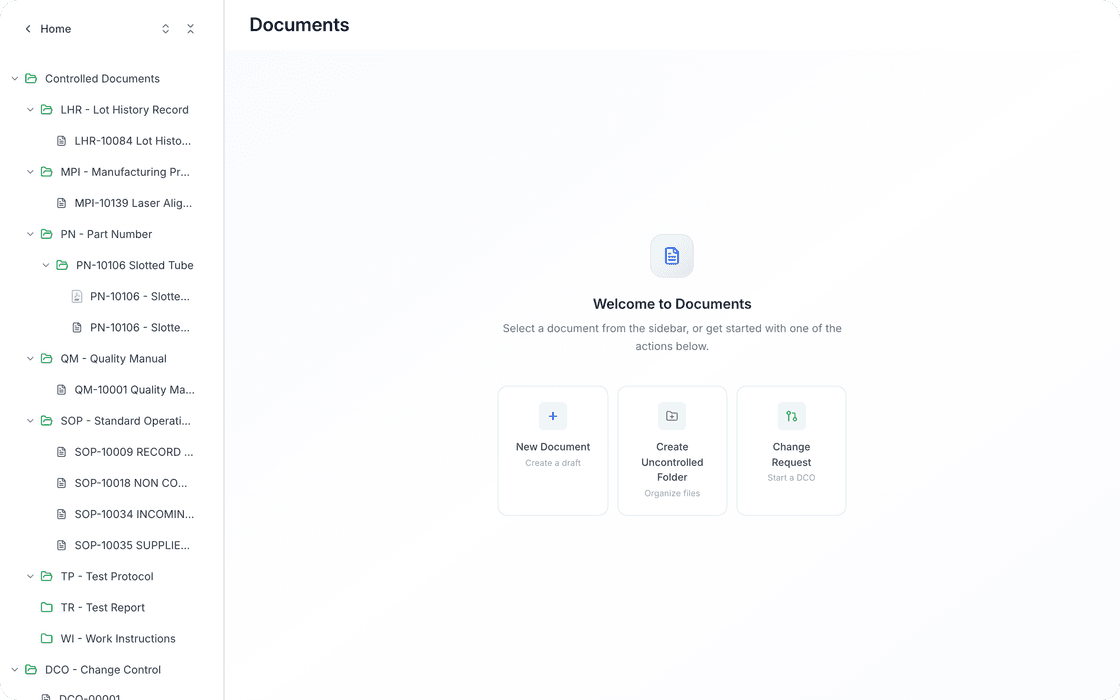
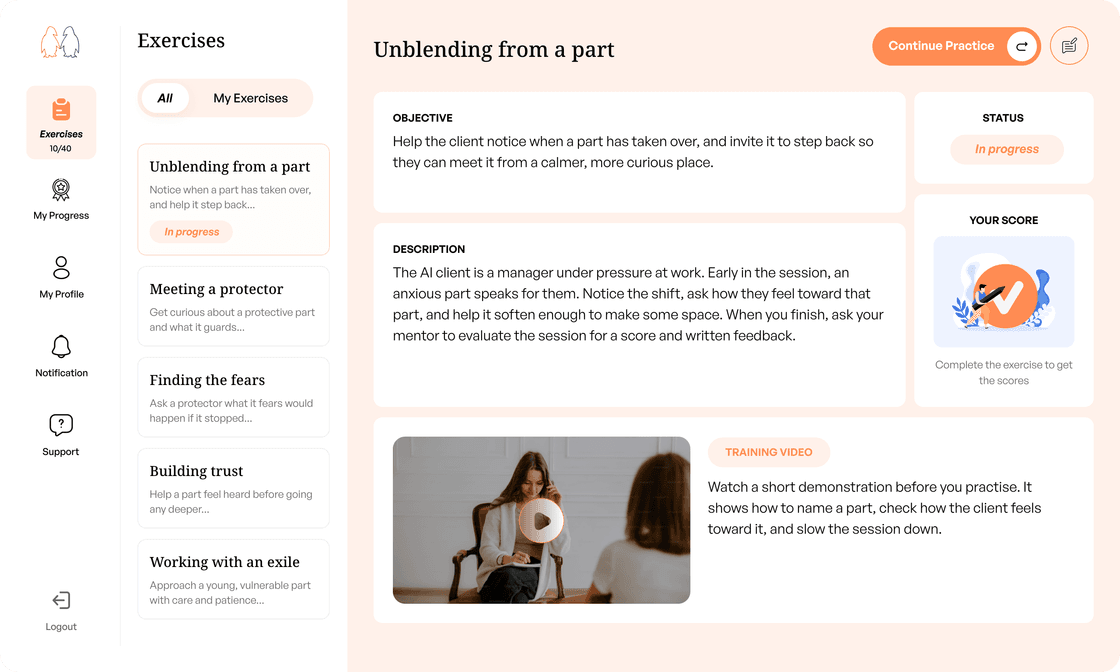
AI role-play practice for therapists

Therapist training, UK

A subscription product where the AI is what customers pay for: it plays the therapy client out loud and scores each session. Stripe plans run across several branded sites. Live, and the client’s About page credits Techuz as its app developers.

Team
3 people
Timeline
About 11 months
Budget
$30k–50k
AI role-play practice for therapists — Therapist training
AI quality management for medical device teams — Medical device SaaS
Client logo

AI quality management for medical device teams

Medical device SaaS, USA

One AI assistant serves every customer company, searching, summarising and updating that company’s own records and nothing else. More than 20 releases live since launch, and the web app’s first download cut from 5.5 MB to 0.89 MB.

Team
5 people
Timeline
13+ months, ongoing
Budget
$100k–250k
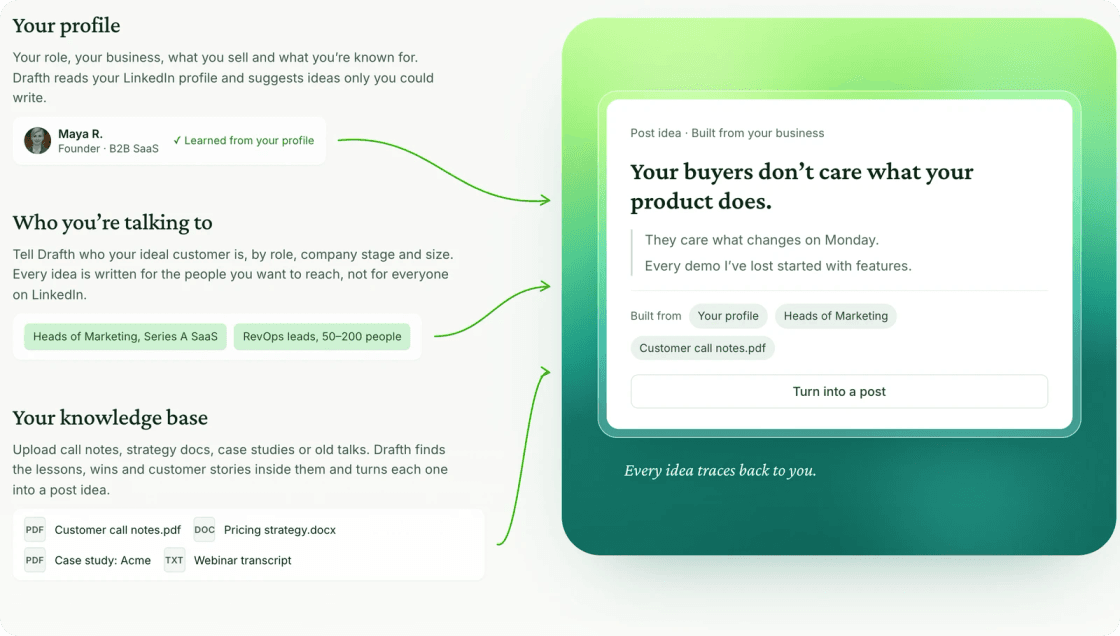
Drafth, an AI content SaaS for LinkedIn — Marketing tech
Drafth

Drafth, an AI content SaaS for LinkedIn

Marketing tech, Our own product

Separate agents each handle one job, from ideas to edits, with live research through Perplexity. Each post takes several AI calls, so cost per user has to be planned. Any one agent’s step can be improved without breaking the rest.

Team
4 people plus a shared PM
Budget
Over $250k (internal investment)

How we build an AI SaaS product, step by step

How to build an AI SaaS: start with unit economics, not the model.

Typical timelines
  • Paid proof of concept

    2–4 weeks

    Your samples run on 2–3 models, with cost per call

  • AI in your existing SaaS

    3–6 weeks

    One AI feature across every account, with limits per plan

  • AI SaaS MVP

    8–14 weeks

    The AI plus sign-up, plans and admin

  • Multi-tenant AI platform

    5–9 months

    To first release: many AI tools, per-customer data and compliance needs

The six phases

An MVP usually runs two build sprints, with discovery alongside the proof of concept and tenancy design overlapping the first sprint. A single AI feature needs a week of discovery and design, one sprint and a shorter test pass.

How much does AI SaaS development cost?

AI SaaS development with Techuz runs from $4k–10k for a paid proof of concept to $50k+ for a multi-tenant platform. Your model provider bills its fees to you directly; we estimate them per 1,000 calls.

Typical cost by project type (steps not to scale).
  1. Paid proof of concept

    2–4 weeks

    $4k–10k

  2. AI in your existing SaaS

    3–6 weeks

    $10k–25k

  3. AI SaaS MVP

    8–14 weeks

    $25k–50k

  4. Multi-tenant AI platform

    5–9 months to first release

    $50k+, built in phases

What moves the price

  • AI jobs and agents
  • How accounts are separated
  • How billing works
  • Extra brands
  • Voice
  • The accuracy bar
  • Compliance
  • Messy sample data

What’s included

Each quote covers discovery to launch, project management, QA, agreed eval cases and 30 days of support.

Rates start at $20 an hour; compare engagement models and pricing, or book a dedicated AI development team.

How we keep each customer’s data and AI apart

Techuz gives every customer its own search space and checks each AI request against the user’s role. The OWASP Top 10 for LLM Applications 2025 warns of context leakage between users in shared vector databases, and recommends strict partitioning.

A separate search space for every customer

Every customer company gets its own Pinecone namespace, and the AI only ever searches the one belonging to the person asking. A mislabelled record can’t cross that boundary.

The AI follows each user’s role

AI requests pass through the same permission checks as your app’s screens. The assistant sees only what its user may see. See AI security.

A person confirms changes to records

In a US medical device SaaS we build for a client, every change the assistant proposes needs the user’s confirmation, a rule set in code. We design the same step for any AI that edits records.

Technology for AI SaaS products

Each layer supports per-customer search, self-serve billing and visible usage.

  1. Models

    Tested on your eval set; the cheapest model that passes wins

    • Claude Opus 5.5
    • Claude Sonnet 5.5
    • Claude Haiku 5.5
    • GPT-6.1
    • GPT-6 Luna
    • Gemini Flash
    • Perplexity Sonarresearch
    • Azure OpenAI in your tenant
  2. Search

    Vector search over each customer’s documents

    • Pinecone
    • OpenAI embeddings
  3. Machine learning

    Models trained on your own data

    • PyTorch
    • Google Cloud
  4. Accounts and billing

    Sign-in and subscriptions customers manage themselves

    • Stripe
    • Google and Facebook sign-in
    • Firebase Auth
  5. Application

    Web app, APIs and agents; MCP servers we build connect your systems

  6. Quality

    Eval runs, error tracking and logs on every release

    • Eval suites
    • Git
    • Sentry
    • CloudWatch

AI SaaS development FAQ

  • When you don’t yet know who will pay or how to measure success, a no-code builder is a cheaper first step. Techuz is also the wrong team when fixed rules solve the job, nobody will review high-stakes output, or you need a foundation model trained.

  • AI SaaS development is building a subscription product in which AI does a core job for many customer accounts. Around the model sit sign-up, billing, admin, per-customer data and cost controls. Techuz builds the whole product, not just the AI.

  • Techuz builds an AI SaaS MVP in 8–14 weeks and adds one AI feature to a live SaaS in 3–6 weeks. A multi-tenant platform takes 5–9 months to first release once the scope is clear. Missing sample data adds time to any of them.

  • Price from what each AI action costs you, then choose plans, usage pricing or a blend. In ICONIQ’s July 2026 survey, consumption pricing rose from 35% to 42% of AI builders in six months. Techuz costs every AI action against each plan in discovery, before you set prices.

  • No, Techuz doesn’t let your customers’ data train AI models. We use provider APIs whose data isn’t used for training, with data-sharing settings off and accounts in your name. Where your customers need stricter controls, the models can run in Azure OpenAI within your own Microsoft tenant and region.

  • It’s the first version customers pay for, with the AI doing the main job, plus sign-up, plans and admin. With Techuz it costs $25k–50k, after a separate paid proof of concept on your samples. You know the AI works before you build the product around it.

Get a Ballpark Estimate for Your Project

Tell us what you're building. We reply within 24 hours and send a ballpark estimate within 48.

Tell us about your project

A few lines are enough. We reply within 24 hours.

By sending this form I confirm that I have read and accept the Privacy Policy