Watch a clip being read live
Plate boxes, read text, and the value locking in once enough frames agree

A truck pulls up, the camera reads its plate many times, and the gate opens only on a confident read. Everything else goes to a quick review.

 Truck parking and gate operator
This system turns gate camera video into one record per tracked plate. Each record holds the plate, how confident the read is, and a decision to open the gate or flag it for review. It reads each plate many times and votes, and opens the gate only when the read passes its checks. Techuz built the pipeline and review dashboard, tested on recorded gate clips.
The client runs truck parking and gate facilities across the US, with cameras at each gate and a small computer on site.
Drivers just pull up. Gate staff would use a browser dashboard to check only the reads the system isn't sure about.
Identifying a truck at the gate was manual or semi-manual: slow, error-prone and staffed.
The client wanted camera feeds turned into truck data automatically. A truck pulls up, the system reads it, and the gate decides in seconds.
Three choices shaped this system. We read each plate many times and vote, we let the system say when it isn't sure, and we kept one codebase for every machine.
The easy option was to trust one good frame. Instead, a tracker gives every plate a stable ID, and the text is read every third frame.
The winning text is the one with the most total confidence, scaled down when the reads disagree.
A read opens the gate only if it passes a format check and scores at least 0.55 for confidence. That's how sure the reader is, on a 0 to 1 scale. Everything else is flagged for review, where an operator sees the plate image and confirms or dismisses it in one click.
The same code picks its device when it runs: a CPU, or a named GPU. It reads video the same way from a file or a live camera stream.
Hard cases saved for retraining. Unsure and invalid reads are collected automatically, with the plate image and details, ready to relabel.
Rules ready for more than plates. Format checks cover a general plate rule and four US state patterns, and rules for USDOT and MC numbers are already written.
Gate staff work in a browser dashboard with a live view and a review page. Every read lands in a database, and hard cases go to an outbox for retraining.
Plate boxes, read text, and the value locking in once enough frames agree
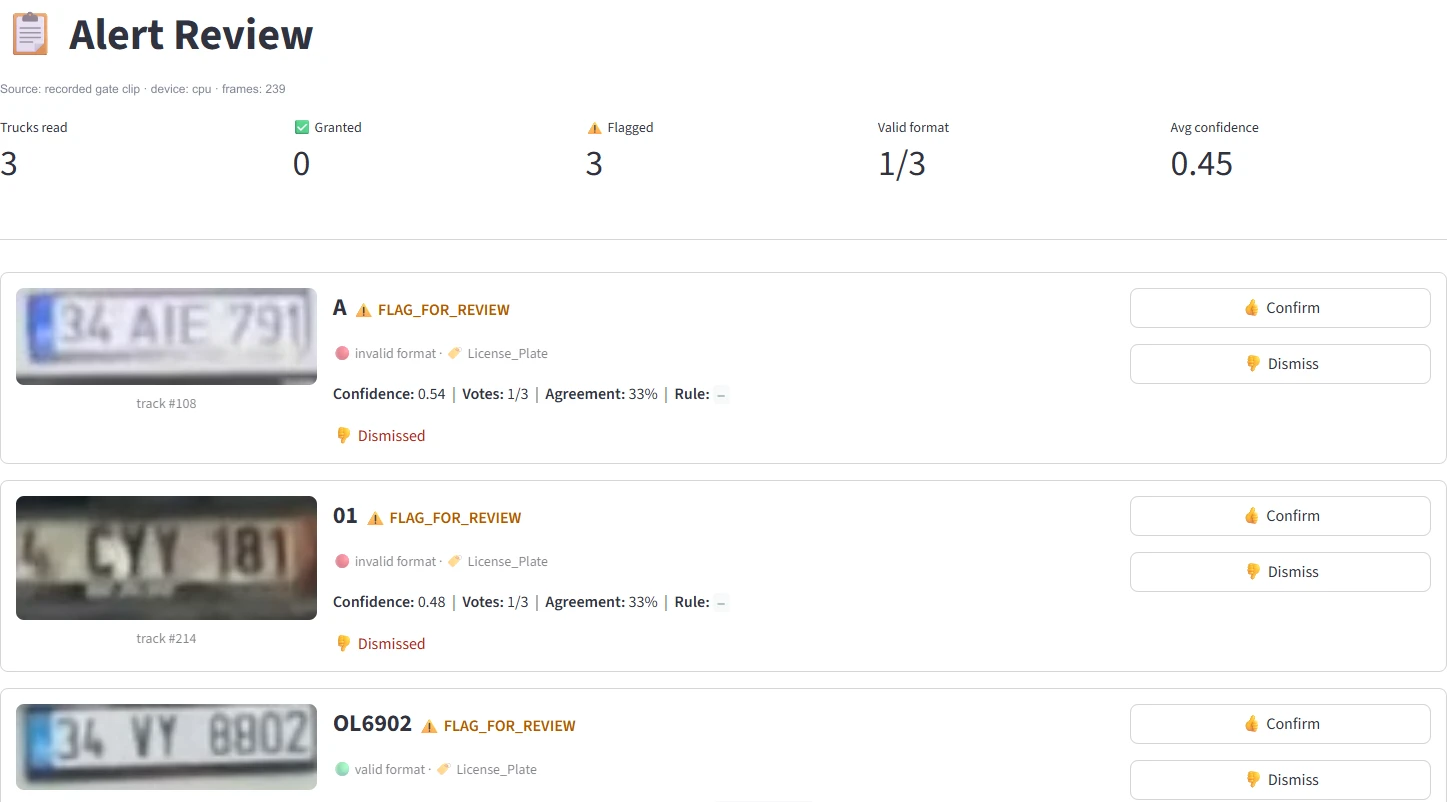
Review page with the plate image, to confirm or dismiss
We built the pipeline, the dashboard, a demo deck and the setup and demo guides.
2people
The system reads plates end to end, from camera video to a gate decision. With this setup, gate staff would only check the reads the system isn't sure about. Every unsure read is saved, so the model can be retrained on the client's own conditions. The client has since shared footage from its own gates, which is what the next phase needs to add USDOT, MC and trailer numbers.
Stable IDs are what make voting across frames possible
Easy to run on Windows and on a CPU
Reads files and live camera streams the same way
SQLite needs no setup, and the same models can move to PostgreSQL later
Billed per second
License plate recognition accuracy at a gate depends on the footage, so test it on your own cameras. Here, anything below the confidence bar goes to a person instead of opening the gate.
One frame is often wrong because of glare, blur or a partial view. Here, each plate is read every third frame and the reads are combined in a vote.
Plate recognition can run without a GPU for testing. Here, a CPU handled about 1.5 to 3 frames a second, so a live gate needs a GPU or an edge device.
Tell us what you're building. We reply within 24 hours and send a ballpark estimate within 48.