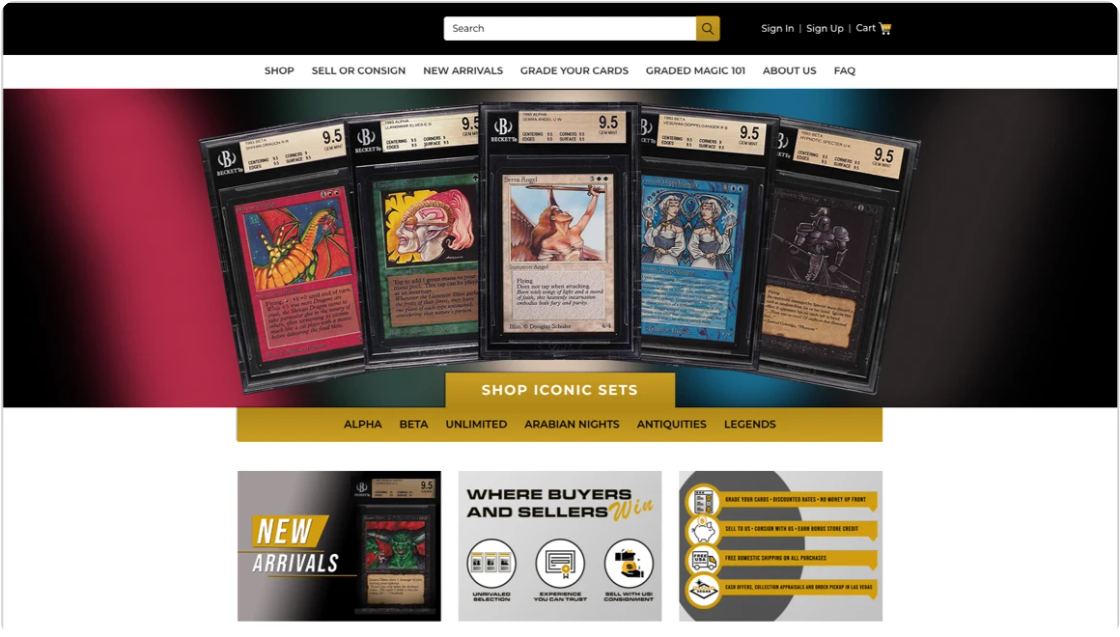
Collectible card marketplace with grading
Marketplace, USABuyers and sellers trade cards and send them for grading, with PayPal checkout

Buyers could pay a seller’s fixed price or make an offer and negotiate, while sellers answered each buyer and chose the final bid themselves.
One cosmetics listing has a fixed price and a floor price only the seller sees. Buyers can buy at the listed price or make an offer. Three buyers make offers; the seller sends a counter-offer to two of them separately, picks the final bid by hand, and the sale goes through at that price.
This cosmetics marketplace web app let buyers pay a seller’s fixed price, or make an offer and negotiate, and chat with the seller. Sellers set a floor price, sent counter-offers to individual buyers and chose the winning bid themselves. Techuz designed and built it in about 7 months, then supported it for a year, during which 250 offers were completed.
The client was a startup founder who wanted cosmetics buyers to have a choice. They could buy at the listed price, as in any store, or make the seller an offer.
The founder started the product as a pilot.
A fixed-price checkout is familiar ground. Negotiation is harder, because one product can draw offers from several buyers at once.
The tricky part was keeping every seller in charge of their own prices, while each buyer still got an answer.
Two choices shaped this marketplace. We kept the final say on every offer with the seller, and we ran the back end as small services on AWS Lambda.
Every negotiation followed the same steps, and the seller made each call.
Here’s how it worked. The seller set a floor price, the lowest they’d accept. Several buyers could then make offers.
The seller sent a counter-offer to any of those buyers. When ready, the seller picked the final bid by hand.
We split the back end into microservices, small services that each do one job, and ran them on AWS Lambda.
On Lambda, the services run only when called, so they don’t cost money while idle.
One web app served both sides. Buyers browsed, bought and made offers. Sellers listed products, answered offers and chatted with buyers. The chat was our own, built on sockets, a live two-way connection.
We took the marketplace from wireframes and UI/UX design to a working web app, then supported it for a year after the build.
5people
During the year we supported it, the marketplace ran with real sellers and buyers. Buyers used offers, not only fixed prices, and every final price was one the seller had chosen.
Platform figures from Techuz’s 1 year of support after the build.
The seller sets the lowest price they’ll take, buyers make offers, and the seller accepts one or replies with a counter-offer. On this marketplace, sellers countered individual buyers and picked the final bid by hand.
Yes. Each product can carry a listed price and still accept offers, so buyers choose how they want to buy. Buyers here could pay the fixed price or make an offer instead.
It often is, because you pay only when your code runs, not for idle servers. This marketplace ran its back end as microservices on Lambda to keep infrastructure costs down.
Tell us what you're building. We reply within 24 hours and send a ballpark estimate within 48.