
Audit questions answered from the system
Approvals, signatures and training on each revision are recorded as the work happens. When the auditor asks, the answer is on screen, not buried in email.

Get regulated healthcare software that answers an auditor from day one, whether it’s a quality system, a care platform or an AI assistant, built and supported by one team.
4.9 on Clutch from 45 reviews · 500+ projects since 2013 · FDA 21 CFR Part 11 e-signatures in production
Our healthcare IT services build and support the software health-tech companies and care providers run on: quality systems, clinic platforms and AI tools. Compliance controls are agreed in discovery, so audit questions get answered from the system, not patched in before launch.
Healthcare IT consulting services turn a regulated idea or a spreadsheet-run operation into a signed spec. Every role, record and rule is mapped to its control, so you know what an auditor will ask before the build starts.
Quality management systems, document control, change approvals and training records are built so each action is logged and each signature stands as evidence. Your team runs its quality system in one place instead of folders and shared drives.
AI assistants for regulated teams answer from your own records, cite the record behind each reply and respect who may see what. Clinicians and quality staff get answers they can check, and you see what the AI costs per organization. See RAG development.
Your product is hosted on HIPAA-eligible services covered by the cloud provider’s BAA, in an account you own and a region you choose. Patient data stays where your regulator expects it, and you keep the keys if you ever change vendors. See Google Cloud services.
Interoperability design begins with a FHIR R4 map of your records and a plan for the exchange between your product and an EHR such as Epic. You see the field mapping and the integration plan before you commit to a build. See HL7 FHIR integration.
Healthcare IT support at Techuz covers the software after launch: monitoring, security patches, library upgrades and fixes within agreed response times. It is software support, not a help desk, so your product stays safe and current as the rules change.
These services sit within our wider healthcare software development work.
Compliance added at the end means rework; designed in, it costs a few decisions in discovery. The FDA Group reported in February 2026 that FDA’s new device quality rule, aligned with ISO 13485, is now in effect. Quality records have to live in the system, not beside it.
These controls run in healthcare products we built; one row is designed and not yet built. Nixon Peabody reported in April 2026 that OCR had completed 19 ransomware breach investigations. Encryption and audit logs are standard on every healthcare build we do, so your risk analysis has real controls to point to.
We build to HIPAA requirements; Techuz holds no certifications of its own, and your compliance owner and auditor sign off the system. In discovery we can agree a control matrix with you that maps each requirement to its control and the test that proves it. See application security.
Choose a managed IT provider to look after a help desk, devices, networks and EHR logins. Choose a software partner like Techuz when the problem is the product: its records, rules and audits. Many care providers use both.
Know it’s the product but not the scope yet?
A one-week Discovery Sprint turns it into a written plan. See product discovery.
Three products from three corners of care: medical device quality, clinical education with AI, and clinic management.

For Nirvan AI we built the web app, API, real-time document editor, admin console and an in-house Part 11 signing module. It replaced a third-party e-signature service, so every signature is evidence the platform holds itself, and training is assigned automatically on each new revision and tracked person by person.
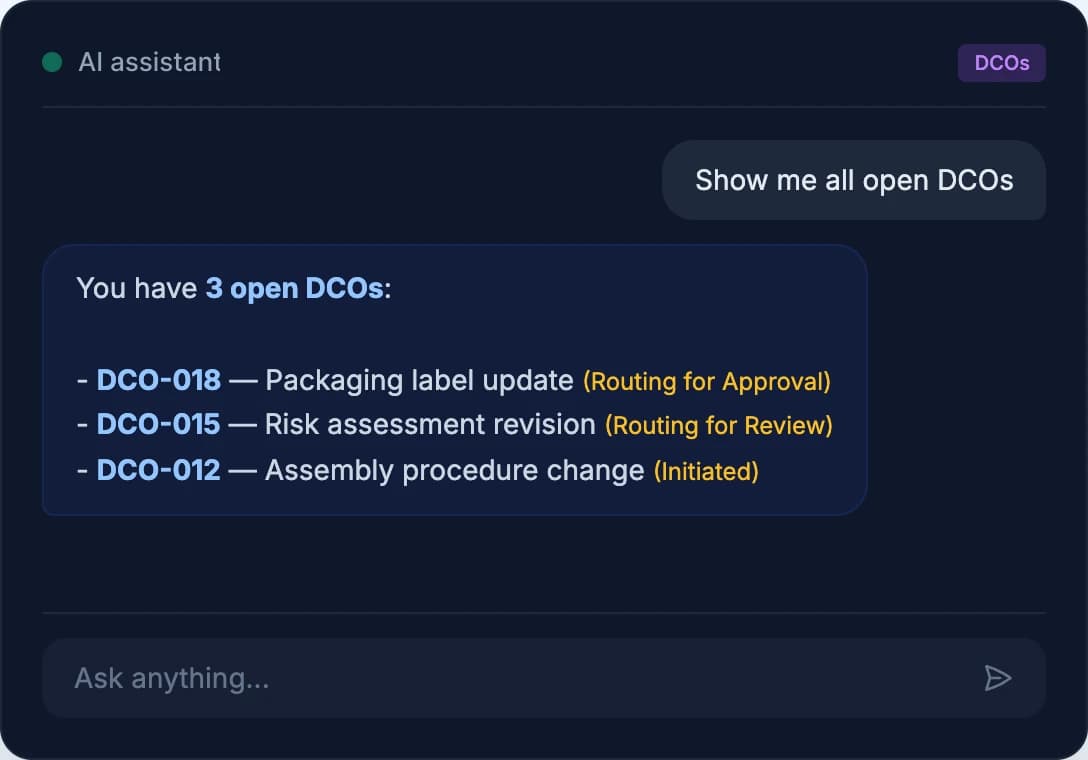
Two AI tools for oncology and radiology education. Tumour-board preparation with AI specialists and guideline checks, and radiology report scoring, built for HIPAA in about two months.
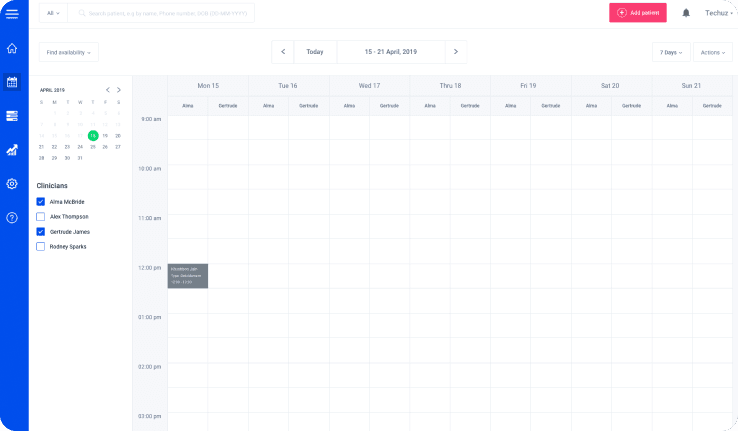
Patient records, scheduling, billing and payments, reporting and a QuickBooks integration in one web app, on Angular, Node.js and MySQL, designed to HIPAA requirements. The client reports thousands of clinics and practitioners using it.
A mid-size healthcare build takes 12–24 weeks from discovery to release, with a working demo every two weeks. Small builds fold discovery and design together and finish in 8–12 weeks.
Small build
8–12 weeks
Discovery and design folded together
Mid-size build
12–24 weeks
A working demo every two weeks
A healthcare IT project with Techuz runs $10k–15k when small, $25k–50k at mid-size and $50k+ when large, built in phases. Rates are $20–25 an hour, depending on role and seniority.
$10k–15k
Small
8–12 weeks
One focused tool, or a compliance module such as audit trails and e-signatures for an existing product
$25k–50k
Mid-size
12–24 weeks
A clinic platform or an AI tool with three or four user roles
$50k+
Large
Built in phases · 6–12 months, then ongoing sprints
A multi-tenant regulated SaaS product with AI
Small
8–12 weeks
One focused tool, or a compliance module such as audit trails and e-signatures for an existing product
$10k–15k
Mid-size
12–24 weeks
A clinic platform or an AI tool with three or four user roles
$25k–50k
Large
Built in phases · 6–12 months, then ongoing sprints
A multi-tenant regulated SaaS product with AI
$50k+
Compliance work like audit trails, e-signatures and data residency is scoped in discovery, not sold as a fixed add-on.
Every price includes QA, project management and 30 days of free support after go-live.
Hosting and model costs are listed monthly in the proposal.
With the same discipline we build into your product: least access, written rules and tests before launch. In HIPAA Journal’s July 2026 breach report, published in October 2026, 87% of large healthcare breaches were hacking or IT incidents.
We choose the stack that fits your product and the team that will own it next.
Records, sessions and document search
HIPAA-eligible services under the provider’s BAA
The right model for each job, through one gateway
Tests before release, alerts after it
When you need a help desk, device management, network support or someone to run EHR logins, a managed IT provider fits better. Techuz has no clinicians on staff, so clinical decisions come from your experts. If you need a team with many Epic go-lives behind it, a specialist integrator is a better fit; we’re strongest when the integration sits inside a product we build with you.
Healthcare IT is the software and systems that store, share and protect health data: EHRs, clinic platforms, quality systems and AI tools. Techuz works on the software side: building and supporting healthcare products, not running hospital networks or help desks.
Techuz builds software to HIPAA requirements: encryption, audit logs, access controls and hosting on HIPAA-eligible services under the cloud provider’s BAA. Compliance belongs to your organization and its policies, so your compliance owner signs off the system.
Yes, Techuz can build FDA 21 CFR Part 11 electronic signatures. We built an in-house Part 11 signing module for a medical device quality platform, with password re-entry, a recorded meaning and a hash per signed item. Each approval produces a certificate PDF listing every signer, and old signatures are kept as history.
In a cloud account you own, in the region your rules require. Techuz runs a clinical messaging app on HIPAA-eligible Google Cloud under Google’s BAA. We also designed a care system on AWS in Sydney to keep Australian data onshore. You hold the keys, not us.
Techuz’s FHIR work is FHIR R4 mapping and integration design. We mapped fields to FHIR R4 against Epic for a breast-imaging tool, and that Epic integration build is in progress.
With Techuz, a small healthcare build takes 8–12 weeks and a mid-size one 12–24 weeks. A large multi-tenant product takes 6–12 months, then ongoing sprints. Discovery sets the exact plan, and you see a working demo every two weeks.
Every Techuz build includes 30 days of free fixes after go-live. After that, support plans of 40, 80 or 160 hours a month cover monitoring, security patches, upgrades and new changes. Outages get a response within 1 hour in Indian business hours.
Tell us what you're building. We reply within 24 hours and send a ballpark estimate within 48.


