
Posted on
August 14, 2026
Updated on
August 20, 2026
Read time
 9 mins read
Quick Answer: Hospital IT leaders distrust software vendors, especially offshore ones, because of a documented history of failed implementations, expensive data breaches, inflated compliance claims, weak post-go-live support, and unclear data ownership terms.
Healthcare remains the costliest industry for breaches at roughly $7.42 million per incident, the 14th consecutive year it has topped the list, and most failed vendor relationships trace back to a gap between what was promised and what was delivered. Vendors earn trust by being transparent about security, data governance, and support commitments before being asked, not after a contract is signed.
There is a moment every experienced hospital IT lead knows well. A vendor is three slides into their pitch, clean UI, bold claims, a logo slide packed with health system names, and something quietly shifts. Not an objection, not a question, just a decision, already made, somewhere behind the eyes.
The demo does not end, but the evaluation did.
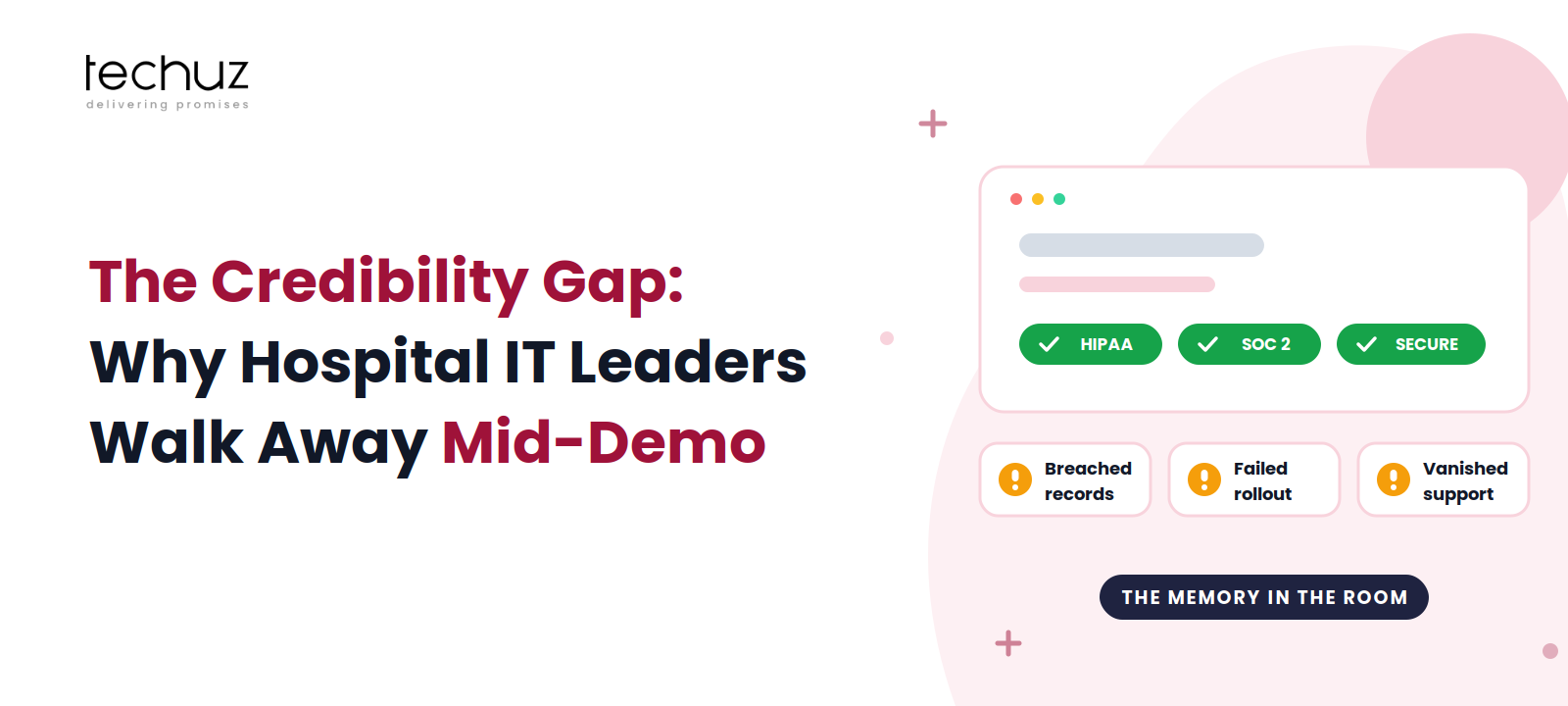
This is not irrational. It is institutional memory doing its job. Hospital IT leaders are not evaluating vendors in a vacuum. They are evaluating them against every botched EHR rollout, every breached patient record, and every support ticket that vanished into a queue and never came back. In healthcare IT, skepticism is not a barrier to a sale; it is scar tissue left behind by an industry that has been burned, repeatedly, at scale.
The Failure Inheritance
Failed implementations don’t just cost money; they freeze IT roadmaps and burn political capital that takes years to rebuild. Large health systems can lose tens of millions of dollars per failed implementation, and staff turnover reliably follows.
The Oracle Health situation illustrates how fast trust converts into market share. After acquiring Cerner in 2022, health systems anticipated transformation. Instead, KLAS Research’s market share data showed Oracle Health losing a net 74 hospitals and more than 17,000 beds in 2024 alone, while Epic posted its largest net gain on record, 176 facilities, and won roughly 70% of all hospitals making EHR decisions that year.
“The level of partnership has emerged as a key differentiator.”
KLAS Research, US Acute Care EHR Market Share 2025
The cause was not primarily technical; it was a decline in relationship quality, responsiveness, and the perception that existing clients had been deprioritized. Hospital IT leads watched this play out through peer networks and CHIME forums, reinforcing exactly the kind of skepticism this article opened with.
Security Is Not a Checkbox, It Is a Memory
When a vendor says “we take security seriously,” an IT lead hears the echo of every breach that happened to a hospital that said the same thing. IBM’s Cost of a Data Breach research shows healthcare has been the most expensive industry for breaches for 14 consecutive years, averaging $7.42 million per incident, nearly $3 million above the cross-industry average, and healthcare breaches take the longest of any sector to identify and contain, at an average of 279 days.
Then there is the breach that made every vendor conversation harder. The February 2024 Change Healthcare ransomware attack ultimately exposed the data of 192.7 million people, per UnitedHealth Group’s final filing with federal regulators, nearly two-thirds of the U.S. population, through a single vendor’s systems. Every hospital IT lead now evaluates third-party access with that number in mind.
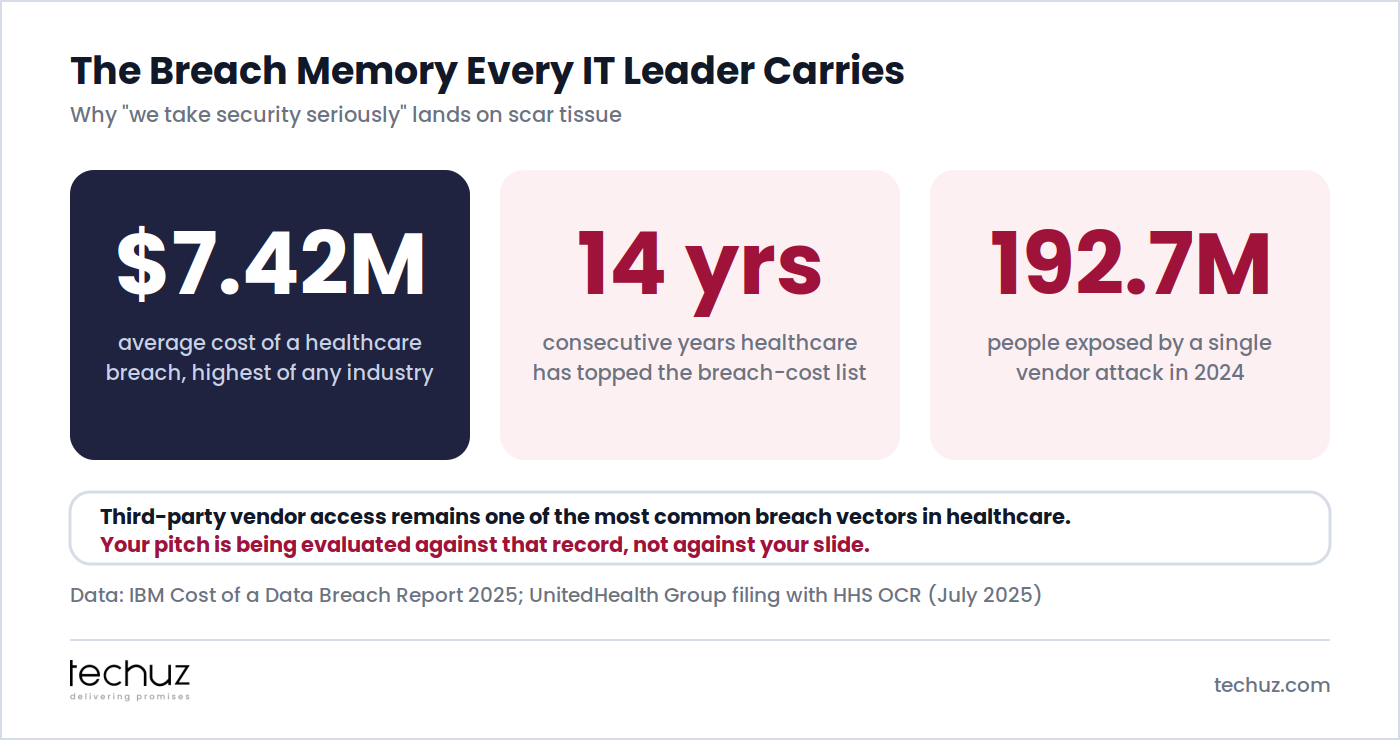
Third-party vendor access remains one of the most common breach vectors in healthcare, which is why an unclear subcontractor chain or a breach notification clause buried in a Business Associate Agreement is never a minor detail. Offshore vendors face added scrutiny here: unclear data residency, breach notification timelines spanning multiple time zones, and regulatory frameworks that do not map cleanly to HIPAA’s Security Rule. It’s the healthcare-specific version of the coordination gap we mapped in why offshore teams fail between the messages: distance doesn’t create the risk, but it multiplies the cost of every ambiguity.
Compliance Fatigue Is Real
HIPAA compliance is a baseline legal requirement, not a differentiator. HITRUST, SOC 2 Type II, and FedRAMP each signal genuinely different levels of rigor, yet most vendor pitches treat them as interchangeable badges. Once IT leads have seen enough unfounded compliance claims, they stop reading the slide and start requesting the most recent audit report directly.
Here’s what each badge actually proves, and the claim pattern that triggers skepticism:
| Badge | What it is | What it actually proves | The red flag |
|---|---|---|---|
| HIPAA | The U.S. legal baseline for handling PHI | The vendor is legally permitted to operate | Presenting “HIPAA compliant” as a differentiator |
| SOC 2 Type II | Independent audit of controls over a period of months | Controls operated effectively over time, not just on audit day | Offering only a Type I, or a report more than a year old |
| HITRUST | Certifiable framework mapping multiple regulations | A deep, scoped assessment of specific systems | Claiming certification without naming what’s in scope |
| FedRAMP | U.S. federal cloud security authorization | Rigor sufficient for federal agency workloads | Citing it when nothing federal is in scope |
Contracts that quietly shift audit responsibility onto the hospital, paired with indemnification clauses that protect the vendor, deepen this fatigue further. The vendors who survive procurement are the ones who share the actual report before being asked.
Domain Knowledge and Support Gaps
A generic demo that ignores clinical workflow, or a support team unfamiliar with what a shift handover even is, predicts how a vendor will behave when something breaks at 2 a.m. For AI vendors specifically, the FDA’s AI/ML SaMD framework and the NIST AI Risk Management Framework now set the expected bar, covering explainability and bias auditing as baseline requirements rather than bonus features. Why that bar exists at all is the subject of our companion piece on why passing a healthcare AI demo proves almost nothing.
Time-zone misalignment in critical support scenarios remains one of the fastest ways trust collapses after go-live. A support team that comes online eight hours after a critical failure is not just inconvenient; in a care delivery setting, it can carry real patient safety implications. Vendors who provide named escalation contacts and tested downtime protocols signal a level of preparedness that a marketing deck simply cannot replicate.
Selling into hospitals and hitting the credibility wall?
Techuz builds healthcare software the way procurement teams audit it: BAA-ready architecture, documented subcontractor chains, tested downtime protocols, and support structured for clinical hours, not office hours.
Data Ownership and the Questions Now Written Into RFPs
For AI-powered healthcare software, model training clauses and inference log retention raise real data ownership questions, shaped further by federal health IT rules and emerging state laws like Washington’s My Health My Data Act. Hospitals are increasingly writing explicit data rights language, covering portability, training opt-outs, and deletion rights, directly into RFPs, and vendors without a clear written position on this are filtered out early.
The pattern is consistent: the questions that used to come up in contract negotiation now arrive in the first procurement document. Vendors who treat them as late-stage legal details are already behind.
What Actually Rebuilds Trust
Vendors build trust through transparent SLAs with contractual teeth, named escalation contacts, reference sites at genuinely comparable hospitals rather than flagship academic centers, and phased contracts with defined exit clauses. Industry bodies like HIMSS frame vendor selection as a strategic relationship rather than a transaction, and that framing is exactly what separates vendors who retain hospital relationships across contract cycles from those who win a single deal and lose the renewal.
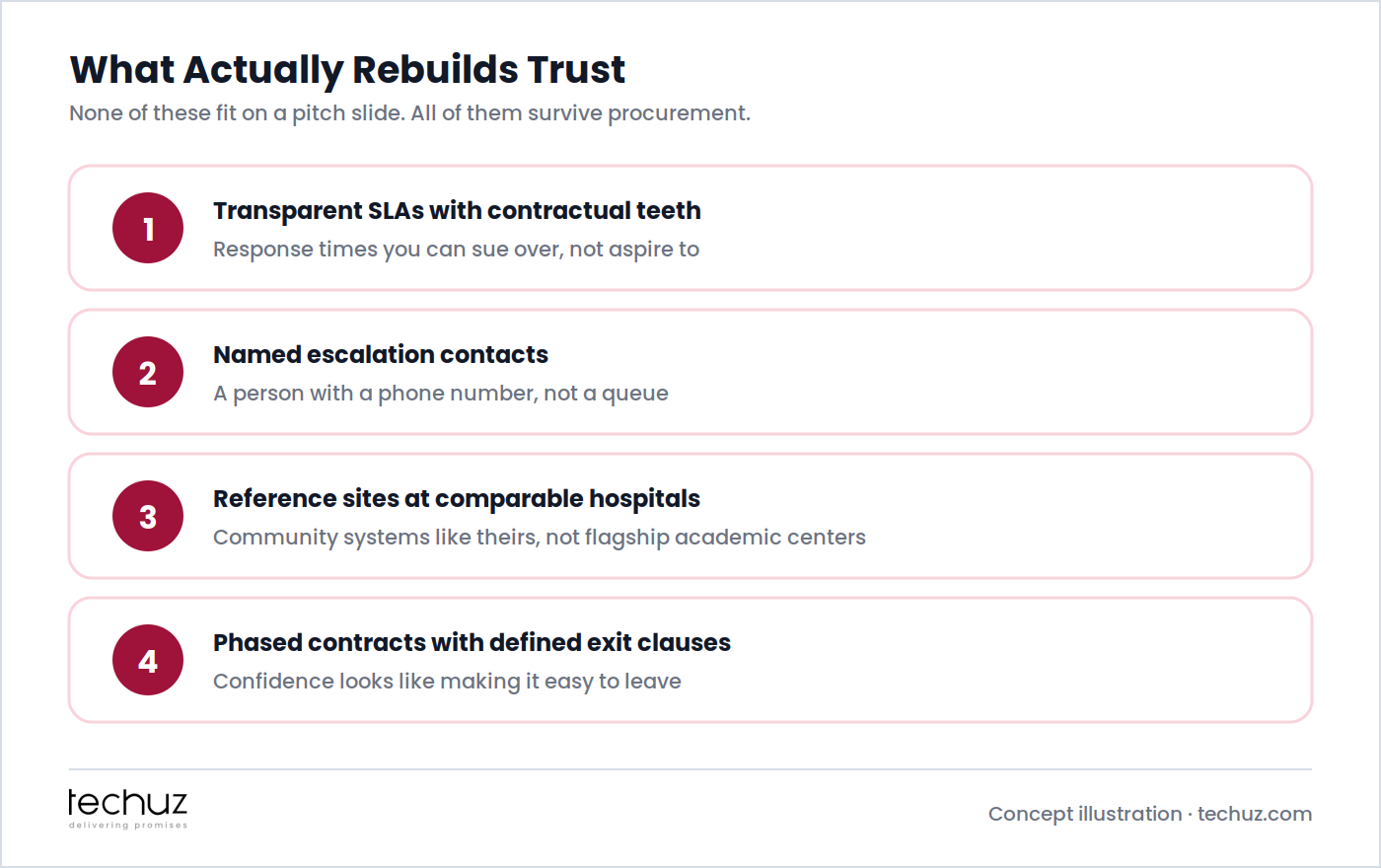
Notice what all four have in common: each one is a commitment that costs the vendor something if they underdeliver. That is precisely why they work. A pitch slide is free. An exit clause is not. The same logic applies after go-live: AI-powered tools drift as clinical practice and data change, which is why continuous monitoring commitments carry more weight than launch-day accuracy claims, a dynamic we unpacked in the half-life of an AI agent.
The Demo Isn’t the Decision
The software is what was purchased; the credibility is what made the purchase possible. Every interaction before a contract is signed, the first email, the demo, the reference call, is a data point, and hospital IT leads are reading all of them.
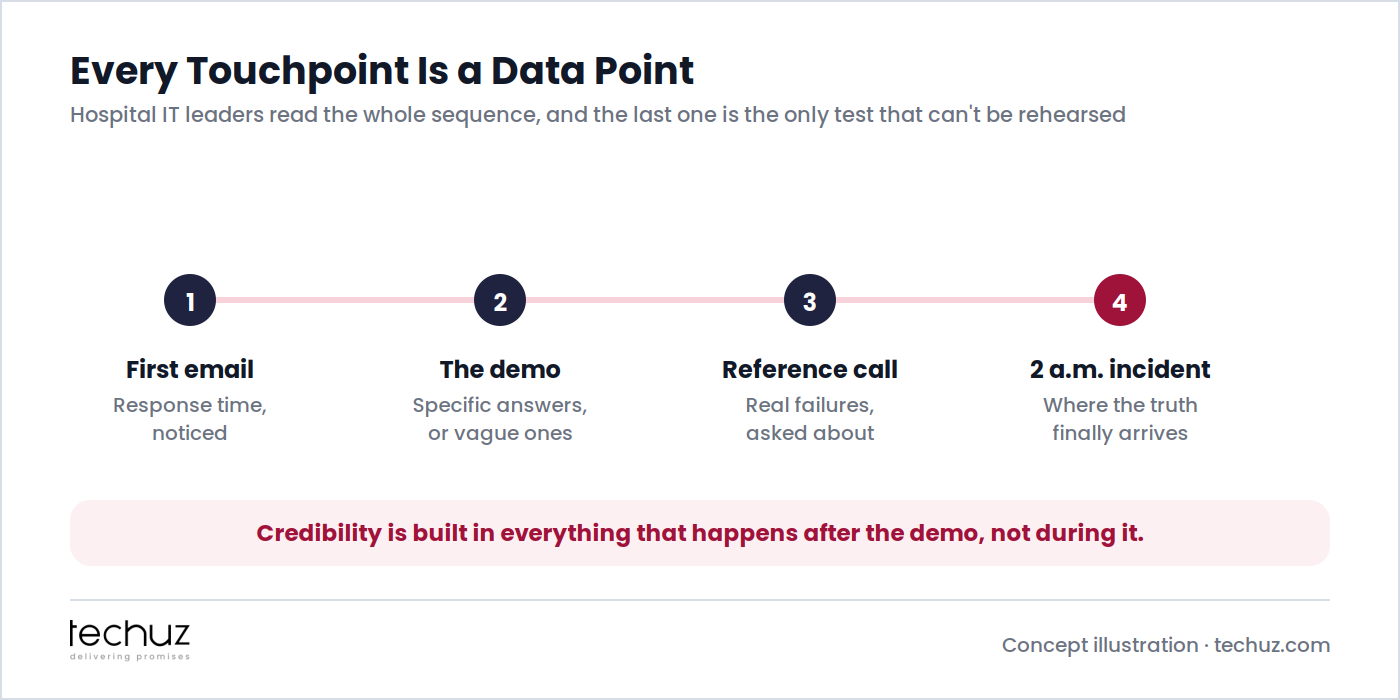
The most dangerous vendor is not the one who fails loudly; it is the one who erodes trust quietly, one missed expectation at a time. Credibility is built in everything that happens after the demo, not during it.
Build healthcare software that survives procurement
As an AI healthcare software development company and a machine learning development company, Techuz ships with the audit trail, data rights language, and escalation structure that hospital RFPs now demand by default.
FAQs
Why do hospital IT leads distrust offshore vendors more than domestic ones?
It comes down to compounded concerns: data residency, breach notification timelines across jurisdictions, and unfamiliarity with U.S. regulations like HIPAA’s Business Associate Agreement requirements. Offshore vendors who address these proactively, rather than hoping they go unnoticed, consistently perform better in procurement evaluations.
What’s the most common reason hospitals walk away during procurement?
A perceived gap between what was promised in sales and what gets delivered, such as undisclosed custom development or support quality that doesn’t match the pitch. Vague answers to specific technical questions during the demo often predict this gap well before the contract stage.
How can a vendor demonstrate HIPAA compliance credibly?
Share the Business Associate Agreement and a current SOC 2 Type II report early, and explain HITRUST scope specifically rather than treating certifications as interchangeable badges. The vendors who volunteer the audit report before being asked are the ones who tend to pass the review.
What do IT leads look for in post-go-live support?
Named escalation contacts, contractual response times for critical issues, tested downtime protocols, and references from clients who navigated real support challenges, not just smooth rollouts.
How do IT leads assess vendor security risk today?
Through structured reviews aligned with frameworks like NIST’s, covering encryption, access controls, incident response, and, for AI vendors, training data isolation and explainability. A healthcare software development company that has been through these reviews can usually produce the evidence pack within a day, and that speed is itself a signal.
Sources
- IBM Cost of a Data Breach Report 2025 (healthcare findings, via HIPAA Journal)
- KLAS Research, US Acute Care EHR Market Share 2025 (via Fierce Healthcare)
- Healthcare IT News, Change Healthcare Data Breach Final Count: 192.7 Million Affected
- FDA, Artificial Intelligence and Machine Learning in Software as a Medical Device
- NIST, AI Risk Management Framework
- Washington State Legislature, My Health My Data Act (RCW 19.373)
Looking for timeline and cost estimates for your app?
Contact us

Ankush Mathur

Ankush Mathur leads technology at Techuz as CTO & Technical Project Manager, where he helps startups and enterprises architect and scale their software. He's spent his career moving from hands-on development to technology leadership, and enjoys writing about engineering practices, AI, and the decisions behind building solid products.