
Posted on
July 23, 2026
Updated on
July 22, 2026
Read time
 9 mins read
Quick Answer: Most offshore web development projects don’t fail because the developers lack talent. They fail because communication quietly breaks down. A vague requirement, a misunderstood feature, or a missed assumption can snowball into weeks of rework when teams are separated by time zones and limited overlap.
Dun & Bradstreet found that 20 to 25% of outsourcing relationships fail within two years, while the Standish Group has consistently identified unclear requirements as one of the leading causes of software project failure since 1994. The good news? This isn’t a coding problem; it’s a coordination problem. The teams that succeed don’t eliminate ambiguity; they eliminate the time it takes to discover and correct it.
After a failed outsourcing project, many founders reach the same conclusion: “Offshore development just doesn’t work.” It’s an understandable reaction, but it’s also the wrong diagnosis. If offshore talent were the real problem, the global software industry wouldn’t run on it.
The data tells a different story. Dun & Bradstreet’s Barometer of Global Outsourcing found that 20 to 25% of outsourcing relationships fail within two years, and nearly 50% fail within five. The surprising part is why they fail. In most cases, the code isn’t the problem. Communication is. Every unclear requirement, missed assumption, and delayed clarification weakens the signal between teams. Offshore projects simply have more handoffs, more time-zone gaps, and more opportunities for small misunderstandings to grow into expensive failures.
The Familiar Failure Pattern (What Burned Founders Actually Experienced)
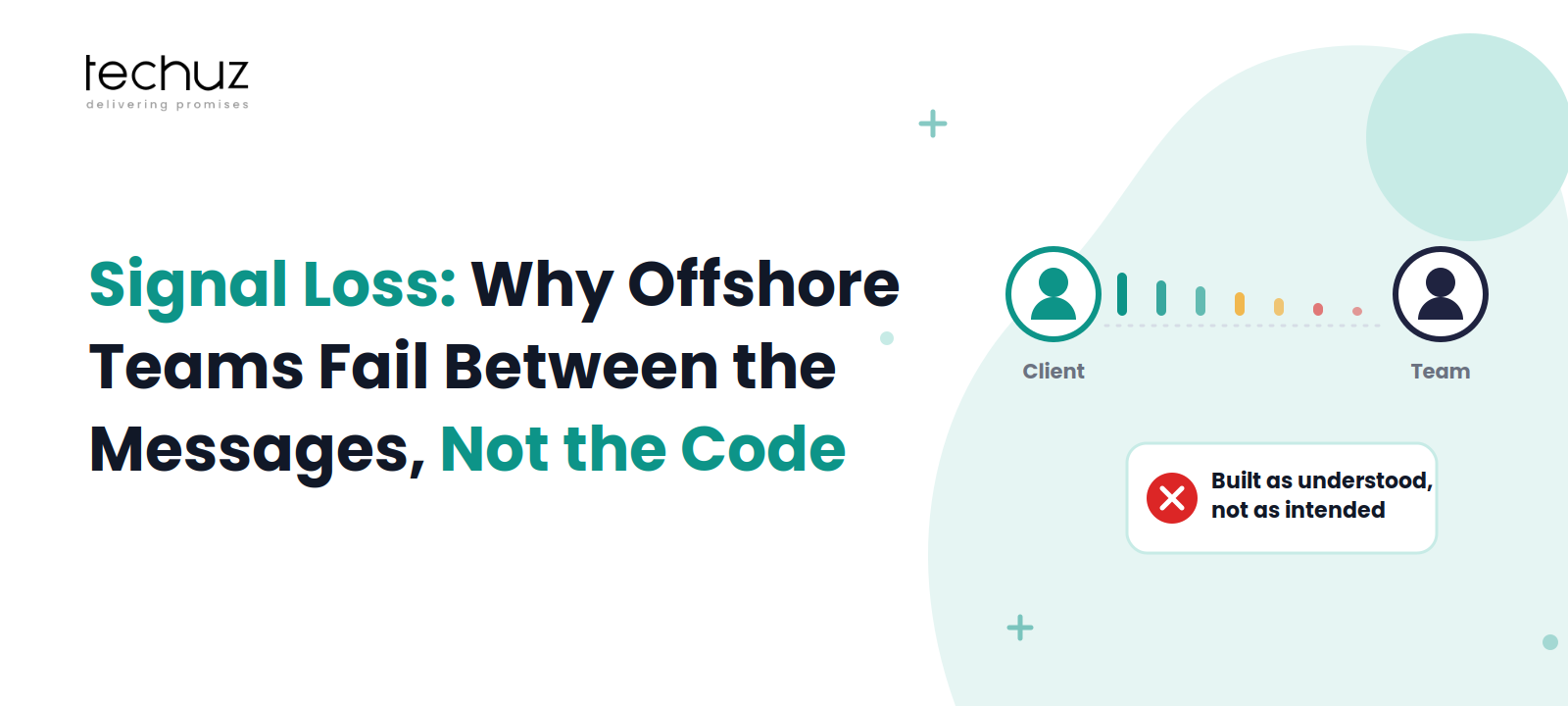
Most offshore projects don’t collapse because of one catastrophic mistake. They unravel through a series of small misunderstandings. A requirement is written, someone interprets it differently, the feature gets built exactly as understood rather than as intended, and nobody notices until weeks later. By then, the rework is expensive, deadlines have slipped, and frustration takes over.
The easy conclusion is “the offshore team’s quality was poor.” The harder and more useful question is where the communication first broke down. Unless you can pinpoint that exact moment, the only lesson you’ll take into the next project is “we’ll be more careful next time.” And that’s rarely enough to stop the same failure from happening again.
It’s Not Distance, It’s Latency: How Time Zones Multiply Small Miscommunications
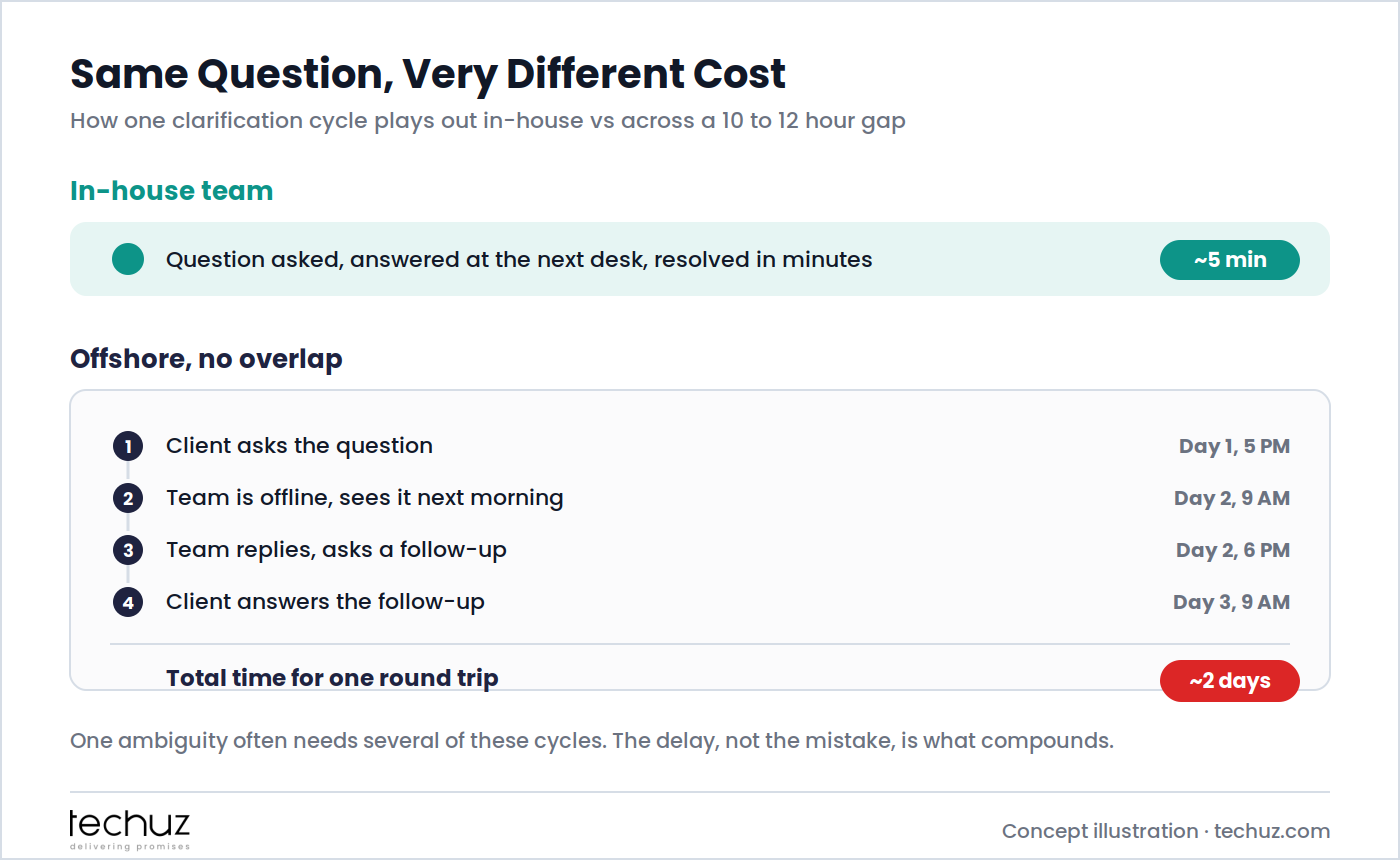
Not all communication mistakes cost the same. In an in-house team, a misunderstanding is often resolved in the next stand-up or a five-minute conversation. In an offshore team separated by a 10 to 12 hour time difference, that same misunderstanding can cost an entire day for every question-and-answer cycle, and most issues require several of those cycles before everyone is aligned.
Industry research estimates that time-zone differences contribute to delays in around 60% of offshore projects, with average schedule impacts of about 31%. That’s why the biggest risk isn’t the mistake itself; it’s the waiting. A tiny ambiguity that would disappear in minutes can quietly snowball into weeks of missed deadlines and unnecessary rework.
The Spec Gap: Why “They Should Have Known What I Meant” Is the Real Failure
The biggest communication gap in offshore projects isn’t language; it’s context. Founders often hand over a specification assuming everyone already understands the customer, the market, and why a feature matters. But that context never leaves their head.
The Standish Group’s CHAOS research has consistently ranked incomplete or unclear requirements among the leading causes of software project failure, and lists a clear statement of requirements as one of the top three predictors of success. Other industry studies attribute well over half of failed projects to communication breakdowns.
Here’s the uncomfortable truth: the same vague specification would probably fail with an in-house team, too. The difference is that office conversations, impromptu desk visits, and quick Slack huddles usually catch the misunderstanding before it becomes expensive. Offshore teams rarely have that safety net, which is why a dedicated team model with defined communication rituals tends to outperform a purely transactional handoff.
The Missing Middle: What “Process Gap” Actually Means in Practice
The most expensive phase of an offshore project is often the one where nothing seems to be happening. After the specification is handed over, many projects disappear into a black box for days or even weeks, with no planned checkpoints in between. The silence feels reassuring, so founders assume progress is on track.
Then comes the demo, and that’s when the real shock arrives: the team built exactly what they understood, not what was intended. By then, fixing the mistake is costly. The problem isn’t that communication suddenly failed at the end. It failed much earlier, the moment the project was allowed to run without regular feedback and course corrections.
Quality Gates: The Checkpoints Most Offshore Engagements Skip
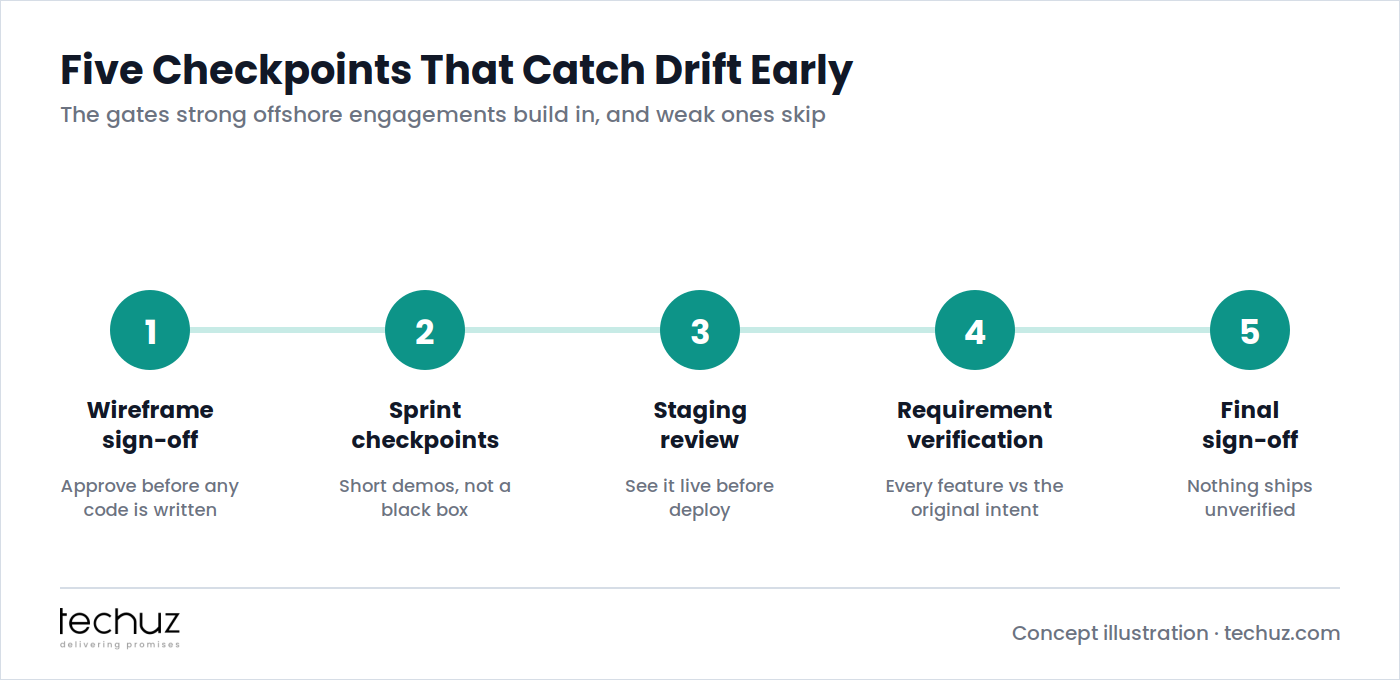
The best offshore projects don’t succeed because the developers are more talented. They succeed because the process catches mistakes before they become expensive. Smart teams build in clear checkpoints: approve the wireframes before coding begins, review the staging version before deployment, and verify every feature against the original requirements before sign-off. These aren’t bureaucratic steps; they’re insurance against costly misunderstandings.
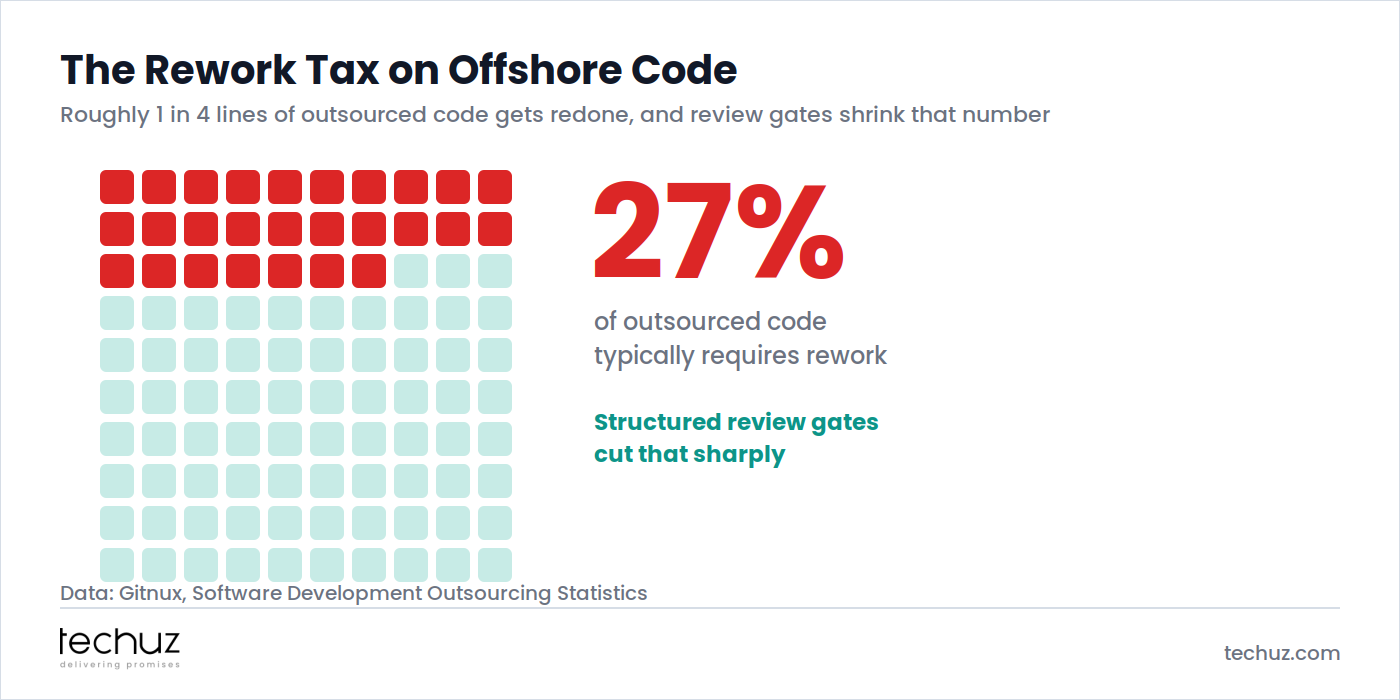
Industry data estimates that around 27% of outsourced code requires rework, but that number drops dramatically when structured review gates are in place. The lesson is simple: communication problems don’t disappear on their own. The earlier you catch them, the cheaper they are to fix.
Why Cheap Rates Quietly Cause This (Without Anyone Deciding It Should)
Lower hourly rates can create a hidden trap. The savings often go toward producing more code, not toward the project management, technical leadership, and quality assurance needed to keep that code on the right track. It rarely happens by design; it’s simply what follows when the primary goal is to spend less.
Industry analyses have linked aggressive 25 to 40% budget reductions in offshore engagements to higher failure rates, because companies often cut senior oversight to meet those cost targets. The result is predictable: development moves quickly, but without enough guidance. You don’t lose speed; you lose direction. And fast progress toward the wrong outcome is still a failed project.
Here’s how the trade-off tends to play out across three common engagement models:
| Model | What you optimize for | Hidden cost | Best fit |
|---|---|---|---|
| Lowest-bid freelance | Cheapest hourly rate | No oversight layer; rework and drift land on you | Tiny, well-specified, throwaway tasks |
| Staff augmentation | Filling a named skill gap | You still own process, QA, and interpretation | Teams with strong in-house project leadership |
| Managed dedicated team | Outcomes, with communication built in | Higher headline rate, lower total cost of rework | Founders who need direction owned, not just hours |
What the Teams That Get It Right Actually Do Differently
The most successful US and India partnerships don’t rely on better developers. They rely on better communication systems. They schedule meaningful overlap hours instead of depending entirely on asynchronous messages, use short video walkthroughs to explain features that text can’t capture, and assign a single person to own interpretation, not just project coordination.
The difference is subtle but powerful. High-performing teams treat communication as part of the product, not as something that will naturally happen once the right developers are hired. That’s often the difference between an offshore team that delivers exactly what you wanted and one that delivers exactly what it understood. It’s the same discipline that separates a smooth web application build from one that stalls in endless clarification loops.
The Trust Rebuild: Working With Offshore Teams After a Past Burn
After one bad outsourcing experience, many founders swing to the opposite extreme: they try to eliminate every possible ambiguity by writing massive, hyper-detailed specifications. It feels like the safest solution, but it creates a new problem. Instead of building the product, the founder ends up spending weeks documenting every edge case, sacrificing the very time outsourcing was meant to save.
The better answer isn’t to remove all ambiguity; that’s impossible. It’s to catch misunderstandings early through a handful of well-timed checkpoints and one trusted person responsible for interpreting requirements before small gaps become expensive mistakes.
Been burned by an offshore build before?
Techuz runs offshore web projects with overlap hours, sprint checkpoints, and one owner for requirement interpretation, so drift gets caught in week one, not week six.
The Offshore Readiness Checklist for Founders
Before you commit to an offshore team, design the communication process before the development process:
- Schedule review checkpoints upfront, not after problems appear.
- Assign one person to own requirement interpretation, not just project updates.
- Create real overlap hours instead of relying entirely on asynchronous communication.
- Start with a small paid trial before committing to a larger engagement.
- Agree on what “done” means for each feature, in writing, before the sprint starts.
One question predicts the success of almost every offshore project: who will catch the first wrong turn in week one, not discover it in week six after the feature has already been built the wrong way?
FAQs
What’s the actual failure rate for offshore software outsourcing?
Dun & Bradstreet’s research found 20 to 25% of outsourcing relationships fail within two years, and roughly 50% within five, though the failure driver is usually process, not the offshore model itself.
How much does time zone difference really slow down an offshore project?
Industry research found time zone gaps cause delays in around 60% of offshore projects, averaging roughly 31%, mostly from round-trip clarification delays, not actual work capacity lost.
What’s the single biggest predictor of offshore project failure?
Unclear or incomplete requirements consistently rank among the top causes in long-running Standish CHAOS research, with communication breakdowns cited in well over half of failed projects overall.
Should a founder over-specify requirements to avoid another offshore failure?
No. Over-specifying creates its own failure mode. A small number of checkpoints and one trusted interpreter catches drift more reliably than an exhaustive, ambiguity-free spec that’s rarely achievable anyway.
How do successful US and India engagements structure communication differently?
They build in real overlap hours, use video walkthroughs instead of text-only specs, and name one point of contact who owns interpretation, treating communication as a deliverable, not an assumption. If you want to see how this works in practice, talk to the Techuz team.
Sources
- Auxis, citing Dun & Bradstreet Barometer of Global Outsourcing (2 in 4 fail within five years)
- The Standish Group, CHAOS Report (requirements and project failure)
- Gitnux, Software Development Outsourcing Statistics
- Bluewren, Why 70% of Software Projects Fail
- TekRecruiter, Software Development Offshoring for CTOs
Looking for timeline and cost estimates for your app?
Contact us

Nilesh K.

Nilesh Kadivar leads Marketing & GTM at Techuz, where he helps startups and enterprises turn software, AI, and automation ideas into shipped products. He's spent 10+ years in business development and enjoys writing about tech trends, growth strategy, and the realities of building for the web and mobile.