
Posted on
August 3, 2026
Updated on
August 6, 2026
Read time
 10 mins read
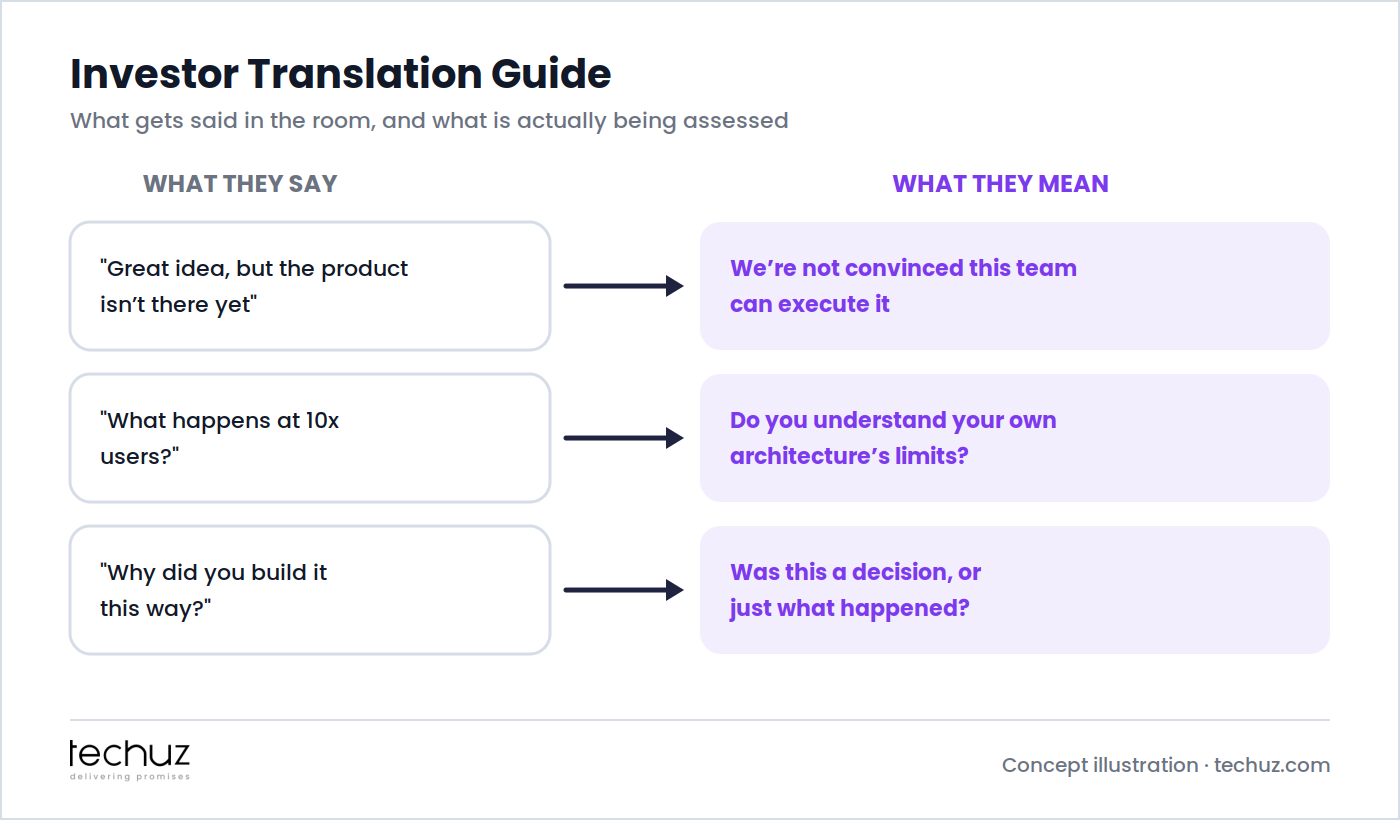
Quick Answer: When investors say, “Great idea, but the product isn’t strong enough,” they’re often talking about something much deeper than the product itself. In many cases, it’s a polite way of saying, “We’re not yet convinced this team can execute.”
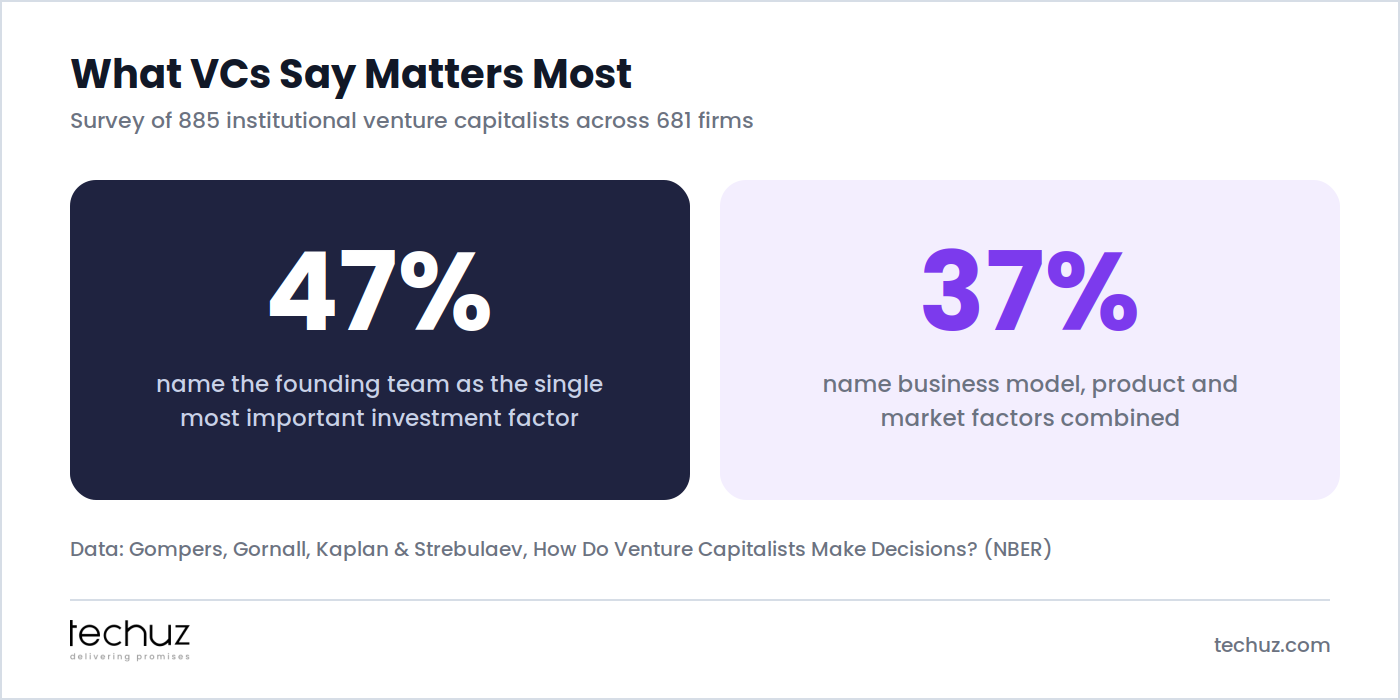
Research involving 885 institutional venture capitalists found that 47% consider the founding team the single most important investment factor, more than the 37% who prioritize the business model, product, and market opportunity combined. That’s why adding more features or a shinier UI rarely changes the outcome. What investors really want to see is a team that can justify every feature they built, every feature they deliberately left out, and every decision they made to reach product-market fit.
When an investor says, “Great idea, but the product isn’t there yet,” don’t assume they’re criticizing your feature set. More often than not, they’re evaluating something far more important: your ability to execute. Investors know that products can be improved, features can be added, and markets can evolve. What they’re really trying to answer is whether this team can consistently make the right decisions under uncertainty.
That helps explain why a landmark survey of 885 institutional venture capitalists across 681 firms found that 47% ranked the founding team as the single most important investment factor, more than the 37% who prioritized the business model, product, and market opportunity combined. Your MVP isn’t just a product demo. It’s the clearest evidence investors have of how your team thinks, prioritizes, and executes when resources are limited.
What Investors Are Actually Evaluating (It’s Not the Feature List)
By the time an investor agrees to meet, your idea has usually passed the first test. They already believe the market is real, or they wouldn’t be spending time with you. What they’re evaluating now is far more difficult to fake: can this team turn that opportunity into a successful business? Can you make smart decisions under pressure, prioritize ruthlessly, and execute consistently with limited time and resources?
The same research found that venture capitalists attribute more of a startup’s ultimate success or failure to the founding team than to the business itself. That’s why your MVP matters so much. It’s not just a product; it’s the strongest evidence investors have of how your team will perform after the investment is made. This is also why the discipline built into a well-run MVP development process pays off twice: once in the product, and again in the story you can tell about it.
Credibility Signals: The Proxies Investors Use When They Can’t Assess Code Directly
Most investors will never inspect your codebase, and they don’t need to. Instead, they evaluate the signals surrounding it. They pay attention to how you explain technical trade-offs, how your product behaves when the demo goes off-script, and whether your answers reveal a deep understanding of what you’ve built.
A few rough edges in an MVP rarely concern experienced investors; they’re expected. What raises doubts is a founder who can’t explain why those trade-offs were made or what comes next. Investors know that products evolve. Their real question is whether the team behind the product understands it well enough to keep improving it.
The “Strong Idea” Compliment Is Doing More Work Than You Think
When an investor says, “I love the idea,” don’t celebrate too quickly. That compliment often serves a purpose: it separates the market from the team. What they’re really saying is, “I believe the opportunity exists, but I’m not yet convinced you’re the team to capture it.”
Many founders miss this signal and respond by pitching the market all over again, expanding on the TAM, the vision, or the industry trend. But that isn’t the question investors are asking anymore. The conversation has shifted from “Is this a good opportunity?” to “Can you execute better than everyone else chasing it?” Misreading that distinction can unintentionally reinforce the very doubt you’re trying to overcome.
MVP Tech Red Flags Investors Actually Notice (Even the Non-Technical Ones)
You don’t need to be a technical investor to spot execution problems. They reveal themselves in surprisingly obvious ways: a demo that only works when every click follows the script, a feature that breaks the moment someone explores on their own, inconsistent screens that suggest no one owns the product end to end, or silence when asked, “What happens if you have 10x more users?”
These moments tell investors far more than a polished pitch ever could. CB Insights found that 23% of failed venture-backed startups cited team or execution issues, while 17% pointed to a poor product. Experienced investors know these risks are far easier to identify during a product demo than after writing a multimillion-dollar check.
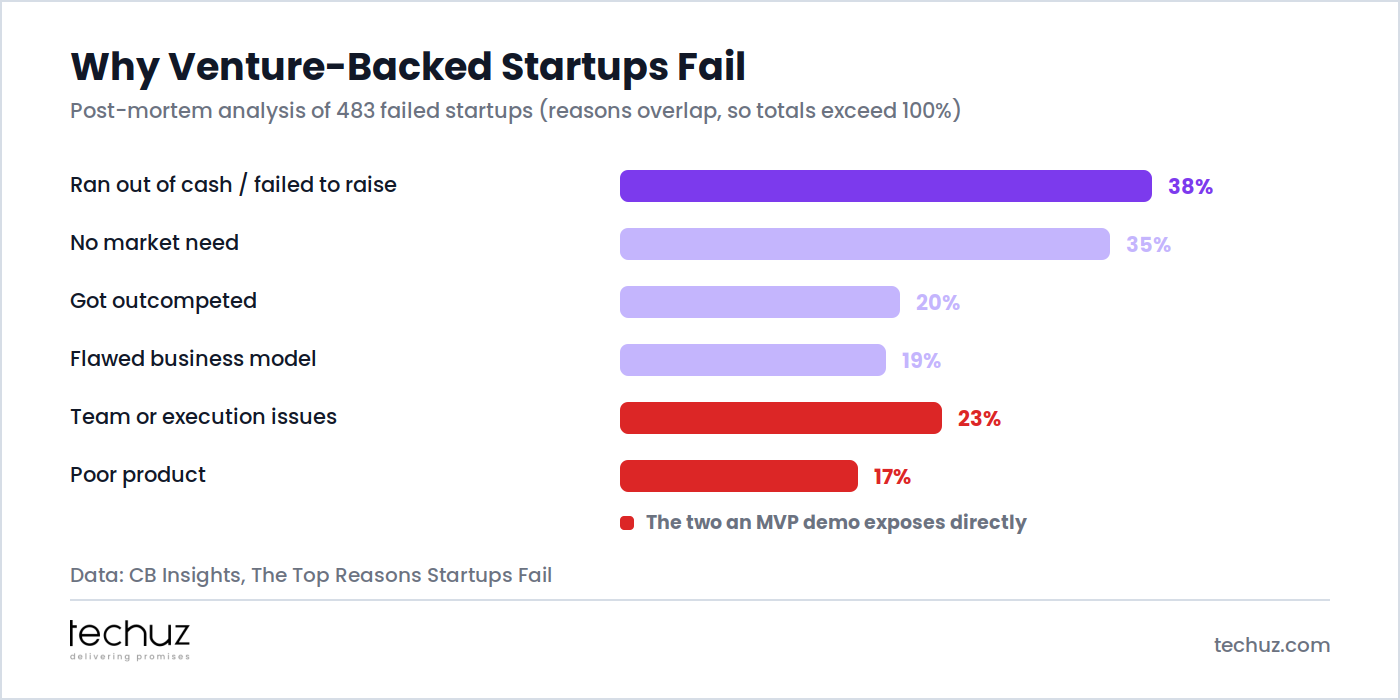
Note the scaling question in particular. It sounds like a technical curiosity, but it’s really a proxy for whether you know which of your early architecture decisions are structural, the distinction we broke down in load-bearing code. A founder who can name their next platform ceiling sounds in control; one who can’t sounds surprised by their own product.
The Silent Red Flag: When the Founder Can’t Explain Their Own Scope Decisions
Every MVP is defined as much by what it leaves out as by what it includes. Investors know that no early-stage product can do everything, so they pay close attention to the decisions behind the omissions. Saying, “We ran out of time,” suggests the product evolved through circumstance.
Saying, “We deliberately excluded this because…” signals something far more valuable: disciplined prioritization and strategic control. Investors don’t expect a finished product; they expect a founder who can explain every trade-off with confidence. In many cases, the features you chose not to build reveal more about your ability to execute than the ones you did.
Here’s how the same MVP reality reads differently depending on how it’s framed:
| The situation | Drift answer (raises doubt) | Control answer (builds confidence) |
|---|---|---|
| A missing feature | “We ran out of time” | “We cut it because only 6% of pilot users asked for it” |
| A rough interface | “We’re redesigning that soon” | “We spent our design budget on the one flow that drives retention” |
| A scaling limit | “We haven’t looked at that yet” | “Single database holds to roughly 5,000 users; here’s the plan past it” |
| A technical shortcut | “That’s just how it got built” | “We accepted that debt deliberately; it costs us about a day a sprint” |
Need an MVP you can defend in the room?
Techuz builds investor-ready MVPs with the scope decisions documented as you go: what shipped, what was deliberately cut, and where the next scaling ceiling sits.
Why Polish Isn’t the Fix (And Sometimes Makes It Worse)
After a rejection, most founders respond the same way: add more features, improve the UI, and make the MVP look more “complete.” It feels like the obvious fix, but experienced investors often see it as a warning sign. A pre-traction startup that spends too much time polishing the surface may be solving the wrong problem. Investors already expect an MVP to have rough edges.
What they’re evaluating is the quality of your decisions, not the perfection of your interface. A shinier product can’t compensate for weak prioritization or unclear judgment. In fact, adding unnecessary features after that feedback can reinforce the very concern investors were trying to signal: that the team doesn’t yet know what matters most. It’s worth remembering that Pendo’s analysis of 615 SaaS products found 80% of features are rarely or never used. Adding more of them is rarely the signal you think it is.
What “Fixing It Fast” Actually Means (It’s Not a Sprint to Add Features)
The quickest way to improve your next investor meeting isn’t to build more features; it’s to tell a better execution story. Investors want to see that you understand your product as deeply as you understand your market. Tighten your demo to showcase only what works exceptionally well.
Be ready to explain your toughest trade-offs, how the product will scale, and what you would change with more time and resources. Most importantly, remove anything from the demo that you can’t confidently defend under scrutiny. None of these improvements require writing a single line of code. They require something far more valuable: a founder who knows exactly why every product decision was made.
The Founder Debrief: Getting a Real Answer Instead of a Polite One
When an investor says, “Strong idea, weak product,” don’t assume you’ve heard the whole story. More often, it’s a softened version of a much more specific concern they chose not to express directly. Instead of defending your product or re-pitching the opportunity, ask a calm, focused follow-up: “I want to make sure I’m fixing the right problem. Was your concern the market, our execution so far, or something specific you saw in the demo?”
That single question often uncovers insights far more valuable than the original feedback. Your goal isn’t to change the investor’s mind in the meeting; it’s to discover the real reason behind the hesitation so you can improve what actually matters.
The Pre-Demo Credibility Checklist for First-Time Founders
Before your next investor demo, stop asking “What else should we build?” and start asking “Can we defend every decision we’ve already made?”
- Be ready to explain every feature you included, and every feature you deliberately left out.
- Make sure the demo holds up when someone clicks somewhere you didn’t expect.
- Have clear, rehearsed answers for how the product will scale and what its biggest technical limitation is today.
- Ask a technical friend to actively try to break it before an investor does.
- Remove anything from the demo you cannot confidently defend under follow-up questions.
One question predicts the outcome of almost every demo: if an investor points to any feature on the screen and asks, “Why did you build it this way?”, can you answer immediately, confidently, and without guessing?
Build the product story before the next pitch
Whether you need MVP development services for startups, a SaaS MVP development company to take you from prototype to pilot, or a custom web development company to harden what you already have, Techuz builds products founders can explain line by line.
FAQs
What do investors actually mean when they say “strong idea, weak product”?
It’s usually shorthand for “I believe the market exists, I don’t yet believe this team can execute against it,” a team and execution concern dressed as product feedback, not a market objection.
Do investors really care more about the team than the idea?
Yes, by a wide margin at early stage. A survey of 885 VCs across 681 firms found 47% named the team as the single most important investment factor, versus 37% for business, product, and market factors combined.
Should I rebuild or add features to my MVP after this kind of rejection?
Usually no. Excess polish or added features right before the next pitch often reads as its own red flag. The fix is almost always clearer narration of existing decisions, not more building.
What’s the best way to get more specific feedback after a vague rejection?
Ask directly and calmly whether the concern was about the market, the execution so far, or something specific in the demo. Most investors will give a sharper answer than the one they led with.
What’s the single biggest MVP red flag for non-technical investors?
An inability to explain why a specific feature was built the way it was, or what was deliberately left out. It signals drift rather than control, regardless of how polished the interface looks. CB Insights’ research links exactly this pattern to the team and product causes behind a large share of startup failures. If your MVP needs to be defensible before the next round, an experienced MVP development company can help you document the decisions as you build.
Sources
- Gompers, Gornall, Kaplan & Strebulaev, How Do Venture Capitalists Make Decisions? (NBER Working Paper)
- CB Insights, The Top Reasons Startups Fail
- Pendo, The 2019 Feature Adoption Report
Looking for timeline and cost estimates for your app?
Contact us

Nilesh K.

Nilesh Kadivar leads Marketing & GTM at Techuz, where he helps startups and enterprises turn software, AI, and automation ideas into shipped products. He's spent 10+ years in business development and enjoys writing about tech trends, growth strategy, and the realities of building for the web and mobile.