
Posted on
October 5, 2026
Updated on
October 6, 2026
Read time
 10 mins read
Quick Answer: In 2026, at mid-market agency quality, a brochure site runs $3,000 to $15,000, a CMS build $15,000 to $50,000, a custom web application $50,000 to $150,000, and a SaaS platform $150,000 to $500,000 or more. What moves you up a tier is specific and knowable: user accounts and roles, payments, third-party integrations, real-time features, multi-tenancy, and compliance. The rest of this guide explains the ranges, what an hourly rate actually buys, and the 18-month math that exposes the cheap-build trap.
The wider market context: Accelerance’s 2026 rate survey found hourly rates dipping single-digit percentages across every major region, and concludes that chasing the lowest sticker price is increasingly a false economy: outcomes, not hourly rates, determine real value. This guide is built on exactly that distinction.
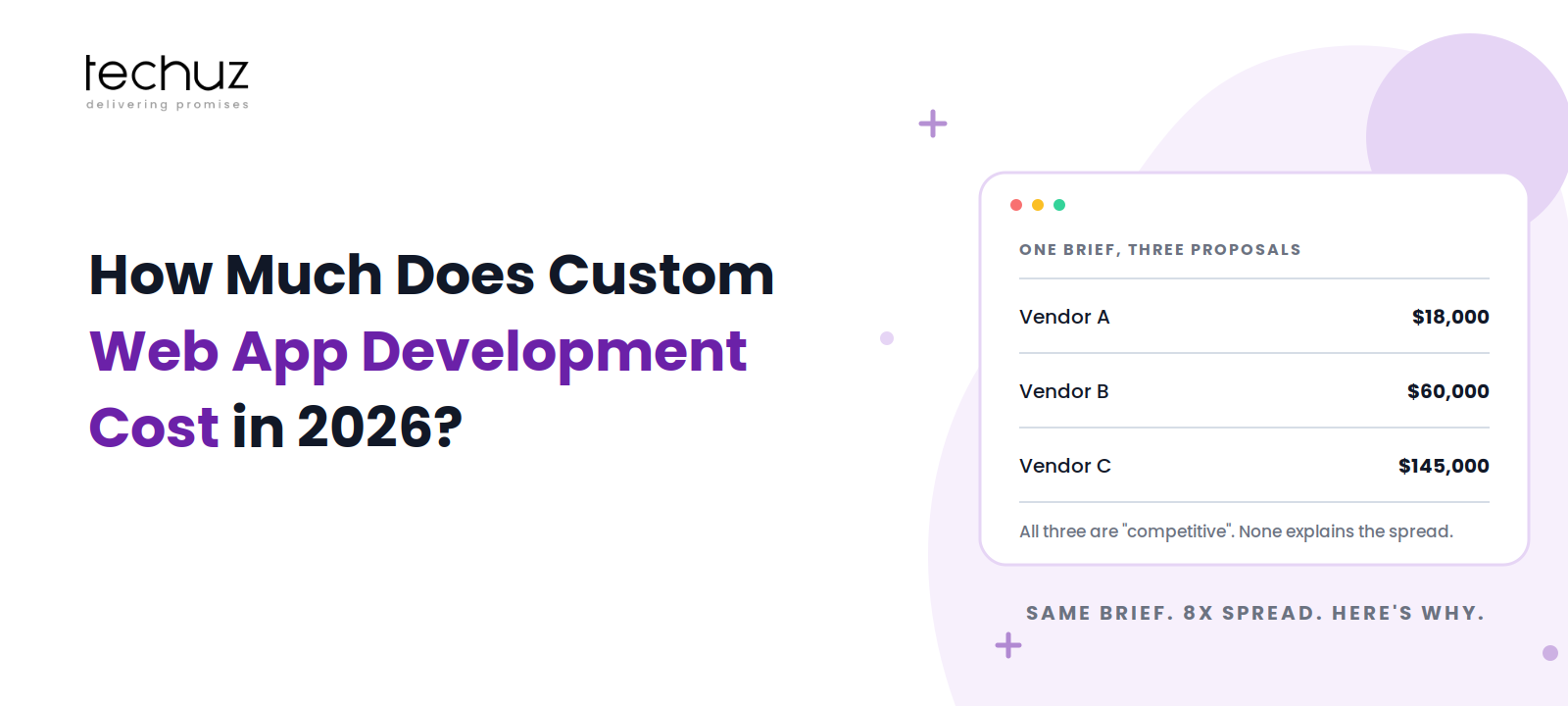
Here is the situation this article exists for. You have a build in mind, you’ve collected three proposals, and they read $18,000, $60,000, and $145,000 for what you’re fairly sure is the same brief. Every pricing page you’ve opened says “it depends,” and every agency wants a discovery call before saying a number out loud. You don’t want a call yet. You want a realistic range for the thing you’re describing, so you can tell who’s lowballing and who’s padding before you give anyone an hour.
So this guide commits. The numbers below are real 2026 ranges for mid-market agency work of professional quality, the kind we quote and see quoted, and where a number is an illustration rather than a benchmark we say so. “It depends” isn’t wrong, exactly; it’s just lazy, because the things it depends on are finite, listable, and about to be listed.
The Four Project Tiers, With Honest 2026 Ranges
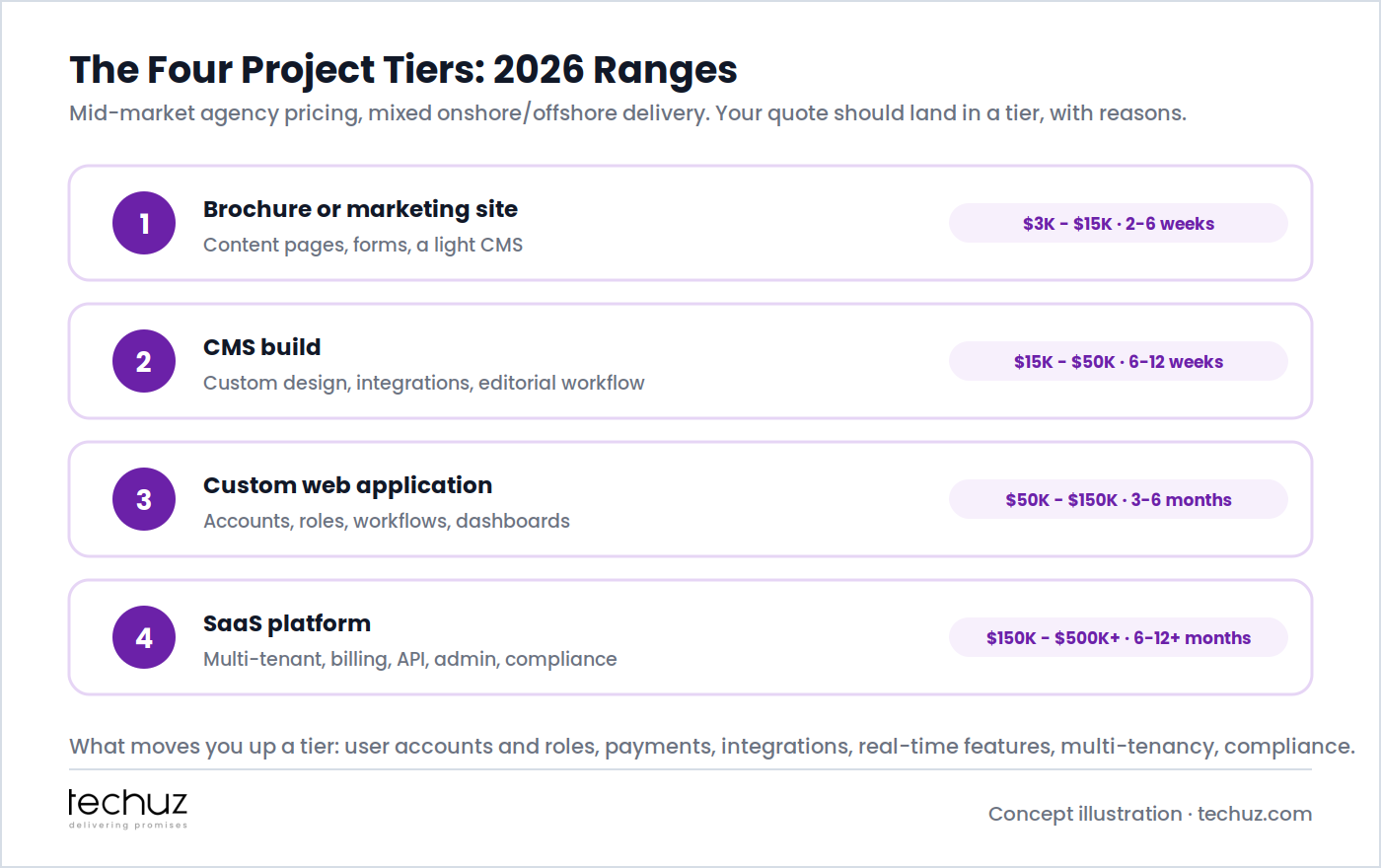
| Tier | 2026 range | Timeline | What moves you up a tier |
|---|---|---|---|
| 1. Brochure / marketing site: content pages, forms, a light CMS | $3,000 – $15,000 | 2-6 weeks | Custom design, integrations, editorial workflows push you to tier 2 |
| 2. CMS build: custom design system, integrations, structured content | $15,000 – $50,000 | 6-12 weeks | User accounts, roles, and any workflow logic push you to tier 3 |
| 3. Custom web application: auth, roles, workflows, dashboards, 1-2 integrations | $50,000 – $150,000 | 3-6 months | Multi-tenancy, billing, public API, compliance push you to tier 4 |
| 4. SaaS platform: multi-tenant, subscription billing, API, admin, compliance | $150,000 – $500,000+ | 6-12+ months | Scale, mobile apps, and regulated data extend the top end |
Two ways to use the table. First, place your own brief: the tier boundaries are feature-driven, not ambition-driven, and the single biggest jump is from tier 2 to tier 3, the moment your site becomes software, because accounts, roles, and workflows bring security, testing, and data modeling obligations that content sites simply don’t have (our 25-control security checklist is a tour of exactly those obligations). Second, place your quotes: a $18,000 proposal for a tier-3 brief isn’t a bargain, it’s a vendor who either hasn’t understood the brief or intends to build tier-2 software and call it tier 3; a $145,000 quote for a tier-2 brief needs line items you can interrogate. The spread stops being mysterious the moment everyone’s forced to name the tier.
Anatomy of an Hourly Rate: What $15 and $150 Actually Buy
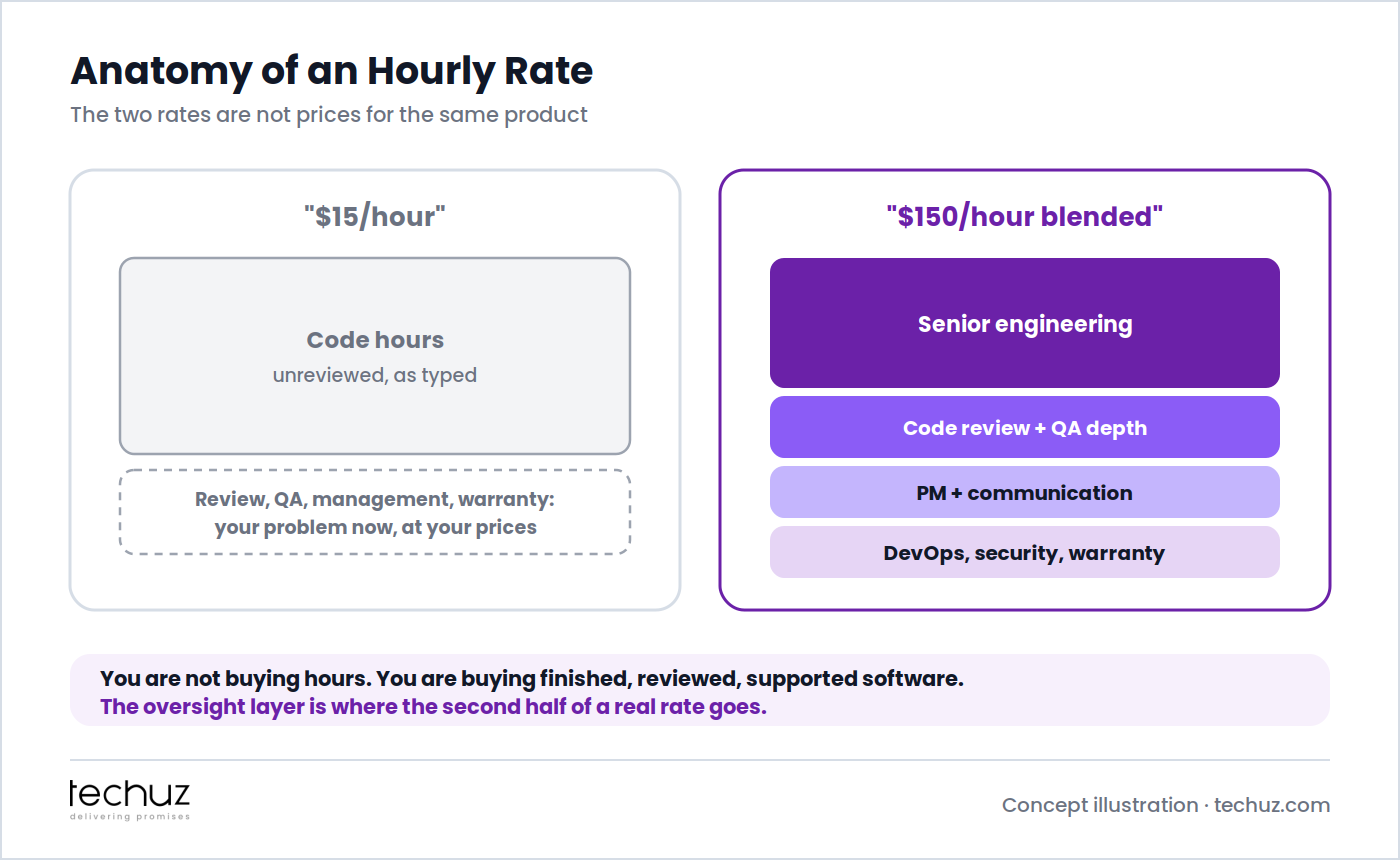
The 8x quote spread lives mostly inside this picture. A “$15/hour” rate and a “$150/hour blended” rate are not prices for the same product at different margins; they are prices for different products. The low rate buys code hours: text typed into files, as reviewed as you make it. Everything that turns code hours into working software (senior review that catches the architecture mistake in week two instead of month eight, QA that tests beyond the happy path, a PM who converts your Tuesday email into unambiguous tickets, DevOps and security work you’ll never see until it’s absent) is either inside the blended rate or it’s your problem now, purchased separately at your prices, usually after something breaks. This is the arithmetic behind the mirage: 400 hours at $15 is $6,000 of typing, and the oversight layer you then hire, or skip, is where the real bill forms. Warren Buffett kept the whole argument to nine words, crediting his teacher:
“Price is what you pay; value is what you get.”
Warren Buffett, crediting Benjamin Graham, Berkshire Hathaway shareholder letter (2008)
Region Benchmarks, Honestly Presented
Per Accelerance’s 2026 survey, senior developer rates run $60-75/hour in Latin America (down 7.1% year-on-year, the sharpest regional drop) and $64-76 in Europe (down 4.4%); market consensus puts North American senior agency rates around $100-180+ and senior rates across India and Southeast Asia around $25-60. Now the honest part, which most rate tables omit. We say this as a custom web development company in the USA market with engineering in India, so we sit inside this arbitrage rather than above it: geography prices the labor market, not the outcome. The quality variance within every region is larger than the variance between regions; a disciplined $40/hour team with senior review, written change control, and a real definition of done beats an undisciplined $120/hour team, and an undisciplined $18/hour team beats nobody. Rate tells you where a team lives. Process tells you what you’ll receive. Which is why the correct due-diligence questions are the five vendor questions from our overrun guide, not “what’s your rate?”: the answers to those five predict your month six far better than the hourly number does.
The 18-Month View: Where the Cheap Build Gets Expensive
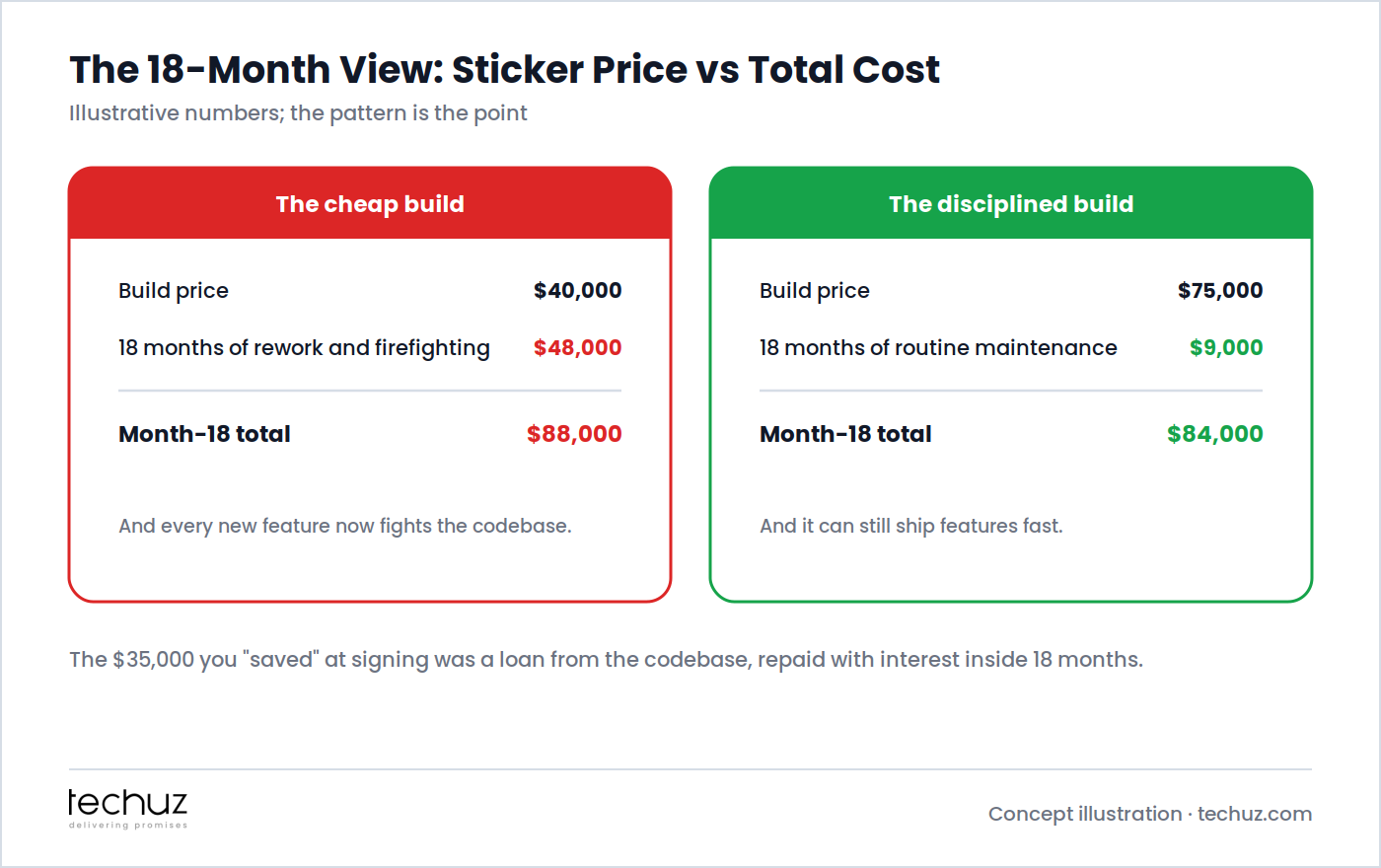
Sticker price is the wrong number to compare, because a build’s cost doesn’t stop at launch; it continues as maintenance, and how much maintenance is decided by how the build was done. The pattern is measured at industry scale: Stripe’s Developer Coefficient found developers spending roughly 42% of their time on maintenance and bad code, and CISQ priced poor software quality in the US at $2.41 trillion for 2022. Run it on one project, illustratively: a $40,000 cheap build that ships with skipped tests and copy-paste architecture typically generates a few thousand a month in firefighting, patches, and slow-motion rework, call it $48,000 over 18 months, for a true total of $88,000 and a codebase that fights every new feature. The $75,000 disciplined build with routine maintenance lands at $84,000 over the same window, still able to ship fast. The $35,000 “saved” at signing was a loan from the codebase, repaid with interest inside 18 months; we’ve charted the full crossover mechanics, with the compounding math, in the hidden APR of cheap code. The numbers above are illustrative; the crossover is not.
Want a number for your actual brief?
Techuz scopes transparently: a short paid discovery produces a written specification, a ranged estimate with stated assumptions, and a tier-honest price, all of which you own whoever builds. No “it depends,” no mystery line items.
What Quotes Silently Exclude
Two quotes $30,000 apart are often the same quote with different honesty. Before comparing totals, check five line items that low bids routinely leave out. Revision rounds: how many design and feature revisions are included, and what does round three cost? QA depth: is testing happy-path-only, or does it include edge cases, devices, and load, and is it a line item you can see? Post-launch support: is there a warranty window for defects, and what does month two cost when something breaks? Code ownership: do you own the repository, the infrastructure accounts, and the documentation from day one, in writing? The pattern of vendors who keep these is exactly the hostage codebase, and it converts a cheap build into an expensive relationship. Third-party costs: hosting, licenses, and per-use API fees are yours forever and belong in the 18-month math, not discovered on your first invoice. A vendor who volunteers all five in the proposal is showing you their controls; one who gets vague is showing you their month six.
Cost-Control Levers That Don’t Wreck Quality
There are real ways to spend less, and none of them is “find a lower rate for the same scope.” Phase it: build the one journey that matters first and let its real usage prioritize phase two; a two-week prototype ahead of the build regularly deletes 30% of the imagined scope by proving nobody wanted it. Scope discipline: the written change-order habit from the overrun guide isn’t just overrun protection, it’s a price tag on every “small addition,” which is the only thing that has ever stopped scope from drifting. Use proven components: auth, payments, admin panels, and email are solved problems; paying custom prices for them is buying handmade wheels, and a good team will say so unprompted. Buy the discovery separately: a small fixed-scope discovery converts your fog into a spec that multiple vendors can price against the same document, which does more to compress that 8x spread than any negotiation. What doesn’t work is cutting QA, review, or the definition of done, because those aren’t padding; they’re the difference between the two columns in the 18-month chart above, and any web development services partner offering to remove them to hit a number is quoting you the $88,000 build with a $40,000 label. For tier-4 work, the same logic scales: a SaaS development company that phases the platform and prices the discovery first is protecting your runway, not padding it.
Tier-honest pricing, in writing
Bring us the brief and the quotes you already have. We’ll tell you which tier it really is, what the spread means, and what we’d charge, with the assumptions on paper.
FAQs
How much does it cost to build a custom web application in 2026?
At mid-market agency quality: $50,000 to $150,000 for a custom web application with accounts, roles, workflows, and a couple of integrations, over 3 to 6 months. Below that, brochure sites run $3,000 to $15,000 and CMS builds $15,000 to $50,000; above it, multi-tenant SaaS platforms run $150,000 to $500,000 or more. Quotes far outside the tier that matches your feature list need explaining.
Why do web development quotes for the same project vary so much?
Because the quotes are rarely for the same product. The spread comes from what’s inside the rate (senior review, QA depth, PM, DevOps, warranty, versus raw code hours), what’s silently excluded (revisions, support, code ownership, third-party fees), and whether the vendor actually understood which tier your brief is. Forcing every quote to name its tier and its exclusions collapses most of the mystery.
Is offshore web development worth the lower rates?
It can be excellent value, and the honest caveat is that quality varies more within regions than between them. Rates tell you where a team lives, roughly $25-60/hour for senior developers across Asia versus $100-180+ in North America, while process tells you what you’ll receive. Judge any team, at any rate, on its controls: written specs, ranged estimates, change orders, a real definition of done, and code ownership from day one.
What does a web development quote usually not include?
The five common silent exclusions: limited revision rounds (with round three priced separately), happy-path-only QA, no post-launch warranty or support window, code and infrastructure ownership that stays with the vendor, and third-party costs like hosting, licenses, and API fees. Ask for all five in writing before comparing totals; a low bid is often a normal bid with these removed.
How can I reduce web development costs without hurting quality?
Four levers: phase the build around the one journey that matters and let real usage prioritize the rest, enforce written change orders so scope has a visible price, use proven components for solved problems like auth and payments instead of paying custom rates for them, and buy a small fixed-scope discovery first so multiple vendors price the same specification. What never works is cutting QA, code review, or the definition of done, because those savings return as rework with interest.
Sources
- Accelerance, 2026 Global Software Development Rates & Trends (regional rate bands and year-on-year trends)
- Stripe, The Developer Coefficient (developer time lost to maintenance and bad code)
- CISQ, The Cost of Poor Software Quality in the US (2022)
- Warren Buffett, Berkshire Hathaway shareholder letter (2008)
Looking for timeline and cost estimates for your app?
Contact us

Nilesh K.

Nilesh Kadivar leads Marketing & GTM at Techuz, where he helps startups and enterprises turn software, AI, and automation ideas into shipped products. He's spent 10+ years in business development and enjoys writing about tech trends, growth strategy, and the realities of building for the web and mobile.