
Posted on
August 7, 2026
Updated on
August 12, 2026
Read time
 10 mins read
Quick Answer: A fast-moving engineering team can be your biggest competitive advantage or your biggest hidden liability. The problem is that non-technical founders often can’t tell the difference. A polished demo, rapid feature releases, and confident updates can hide fragile architecture, mounting technical debt, and serious security flaws that won’t surface until customers, investors, or acquirers look under the hood.
Speed genuinely matters at the MVP stage. But speed without engineering discipline is expensive. Veracode’s research across more than 100 large language models found AI-generated code introduced security vulnerabilities in 45% of tests, rising to 72% in Java. The good news? You don’t need to be an engineer to spot the warning signs. You just need to ask the four questions most founders never think to ask.
Nothing builds confidence like shipping fast. A working demo, a live product, and customers clicking through your MVP create the feeling that real progress is finally happening. And in many cases, that’s exactly the right instinct. Getting a working product in front of real users beats polishing a concept deck, and Startup Genome’s research found that startups which pivot once or twice based on real signal raise 2.5 times more money and see 3.6 times better user growth than those that don’t. You cannot pivot on evidence you never collected.
But here’s the trap: shipping fast and building credibility are not the same thing. Speed is something you experience today. Technical credibility is something investors, enterprise customers, and acquirers evaluate months later, when they look beneath the surface. That’s why the biggest risk in a rushed build isn’t the launch itself. It’s the hidden weaknesses that stay invisible until the moment they matter most.
The Speed Myths Non-Technical Founders Believe
One of the biggest myths in startups is that speed automatically equals progress. Ship an MVP quickly, polish the interface, iterate faster than everyone else, and success will follow. It sounds logical, but software doesn’t play by those rules. Unlike sales or marketing, where a bad decision can often be corrected next week, software remembers every shortcut you take.
A rushed architectural decision, an overlooked security issue, or a “we’ll clean it up later” compromise can remain invisible through every demo, impress every early customer, and still become the reason your product slows to a crawl months later. In software, speed and long-term credibility are related, but they’re far from the same thing.
What “Fast” Actually Measures (And What It Doesn’t)
Fast measures how quickly something visible got assembled. It says nothing about whether it was assembled in a way that can be extended, secured, or trusted later. This is the distinction a non-technical founder genuinely cannot see by looking at the product: a fast MVP built on solid foundations and a fast MVP built on none look identical in a five-minute demo.
Both have a working signup flow. Both take payments. Both look “done.” The difference only shows up the moment someone tries to add a feature, scale past a few hundred users, or open the codebase for the first time. A disciplined MVP development company ships just as fast, but leaves a paper trail of which corners were cut and why.
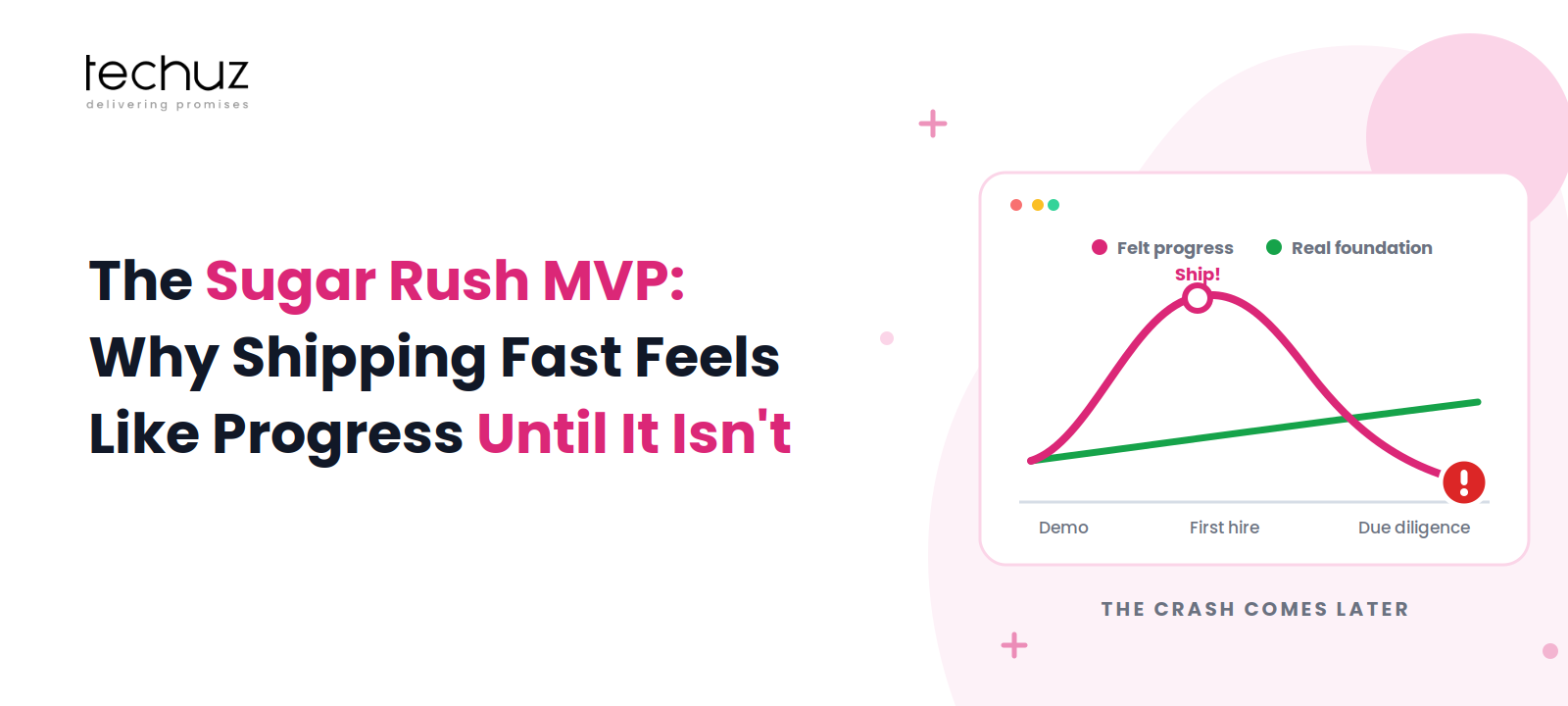
The Sugar Rush: Why Speed Feels Like Validation
Every fast milestone produces a real feeling of validation: a working demo, a launch date hit, a positive reaction from a first user. Founders reasonably read that feeling as evidence of good decisions. It usually isn’t correlated at all.
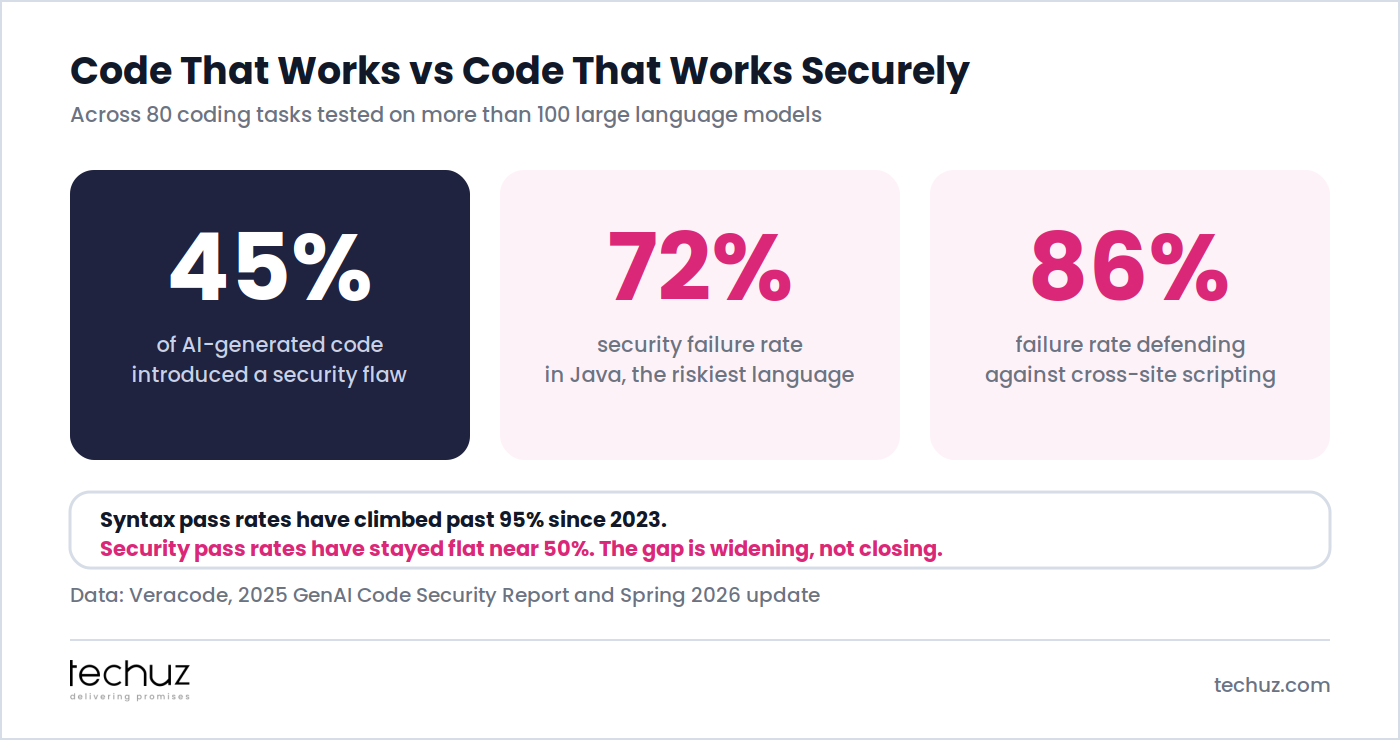
Veracode’s GenAI Code Security Report, which tested 80 curated coding tasks across more than 100 large language models, found AI-generated code introduces a security flaw in roughly 45% of cases, with Java failing security tests 72% of the time and cross-site scripting defenses failing in 86% of relevant samples. The most revealing detail is the trend: Veracode’s follow-up analysis found that while syntax pass rates have climbed past 95% since 2023, security pass rates have stayed flat near 50%. Models have become excellent at writing code that runs, and no better at writing code that’s safe.
None of that shows up in the sugar rush moment. The crash from a rushed foundation doesn’t arrive at the demo. It arrives later, at a completely different meeting.
The Long-Term Cost: Where the Crash Actually Shows Up
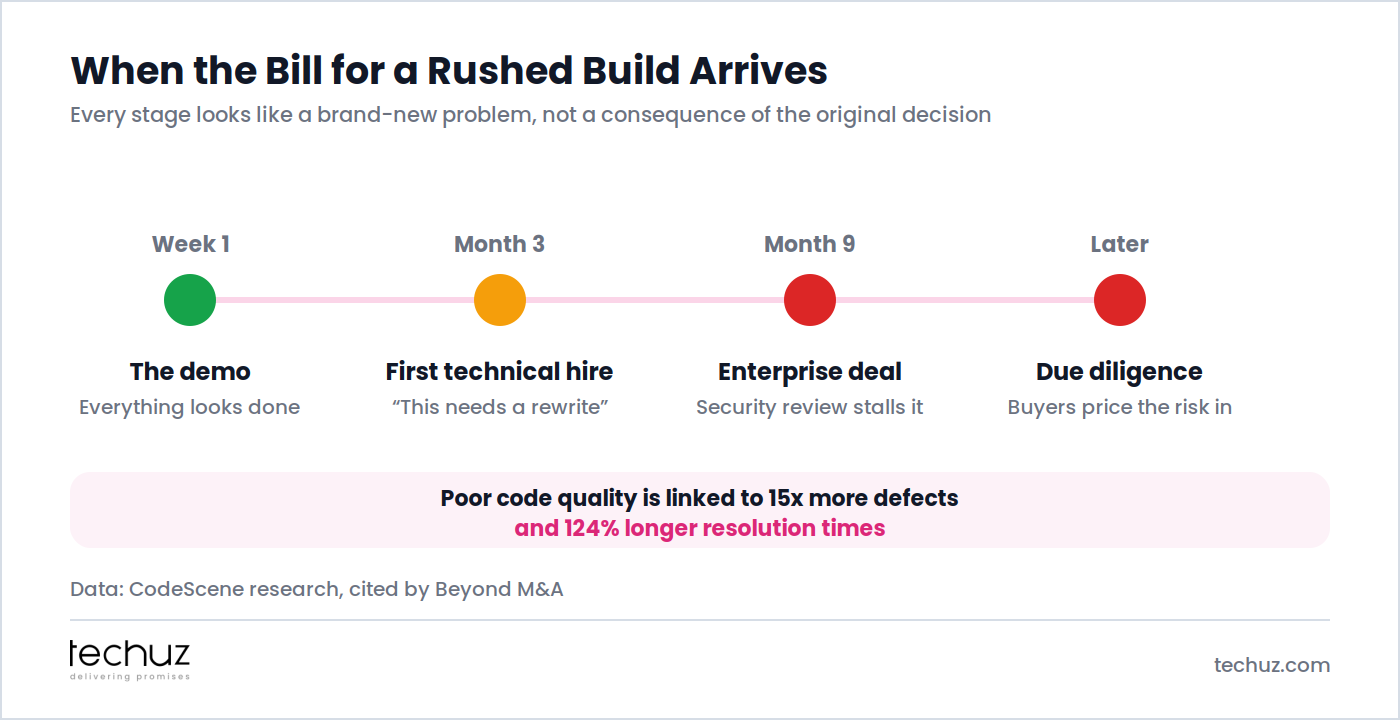
The bills arrive disguised as unrelated problems: a technical hire who won’t touch the codebase without a rebuild, a security issue surfaced during due diligence, a “quick feature” that takes three weeks because nothing was built to be extended.
The scale isn’t small. Technology due diligence research citing CodeScene found that poor code quality is linked to 15 times more defects and 124% longer resolution times, while Bain’s Global M&A Report found that over 50% of M&A failures trace back to insufficient diligence, frequently including overlooked technical issues. Non-technical founders often can’t connect these later problems back to the original speed decision, because by the time the bill arrives, it looks like a brand-new problem.
Technical Credibility: The Currency You Don’t Know You’re Spending
Every engineer, technical co-founder, or technical investor who looks at the MVP is silently pricing it, not on features, but on whether the foundations suggest competent judgment. Industry statistics on technology due diligence put the failure rate for technology acquisitions that miss their financial objectives at 76%, which is evidence that technical foundations get scrutinized closely and expensively, not casually.
Credibility, once spent, is hard to earn back. A technical hire’s first-week assessment of “this needs a rewrite” is very difficult to undo with future good decisions. That judgment is the same one investors are quietly forming during a pitch, a dynamic we broke down in what investors really mean by “weak product”.
The Credibility Framework: Four Questions Any Non-Technical Founder Can Ask
You don’t need to read code to assess a foundation. You need four questions, and a technical reviewer who can answer them honestly.
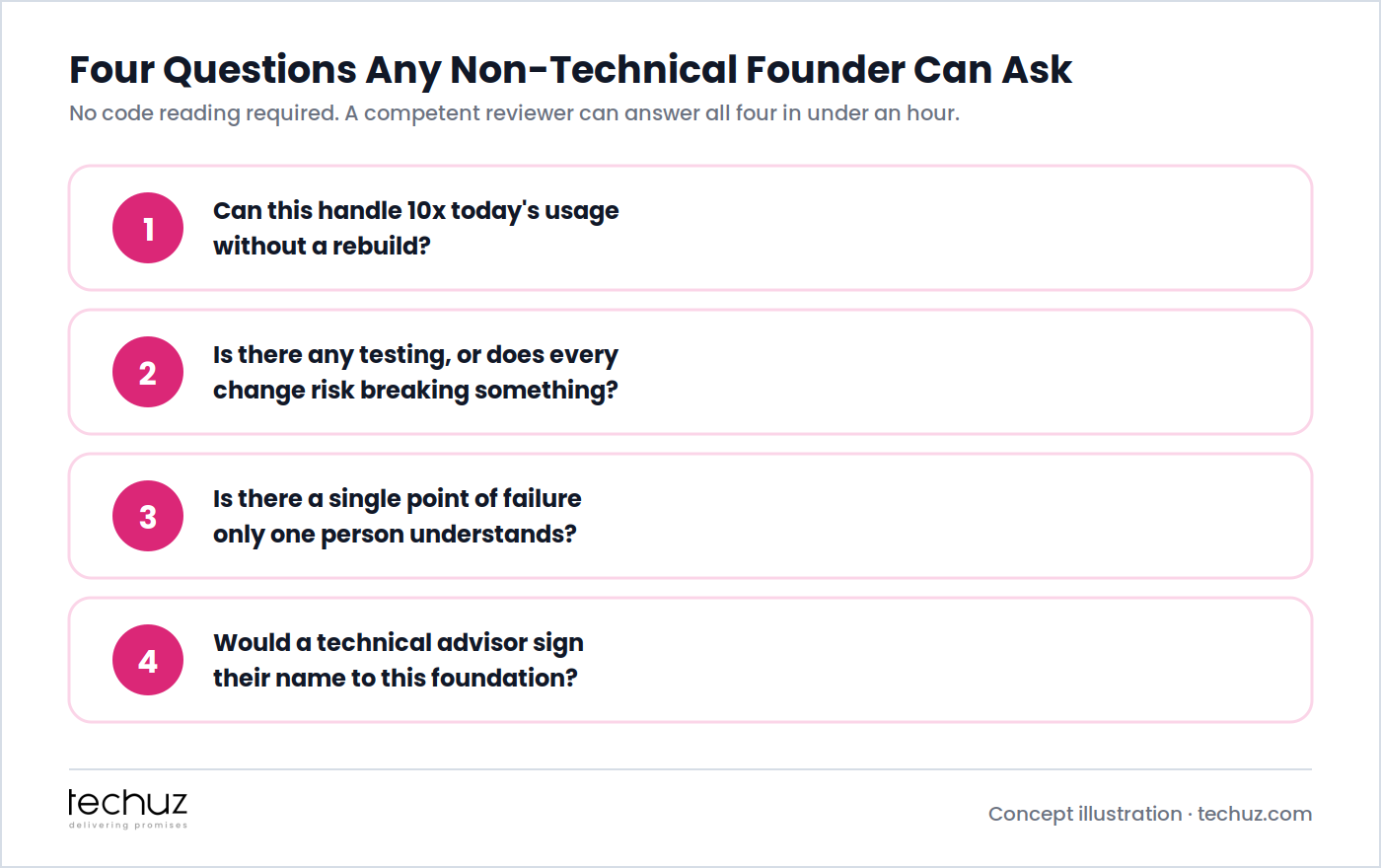
A competent technical reviewer can answer all four in under an hour, which makes this a cheap, fast credibility check in its own right, no different in spirit from the speed the MVP itself was built for.
MVP Quality Benchmarks: What “Good Enough” Actually Means
“Good enough” isn’t zero technical debt. It’s debt taken on knowingly, in low-risk places, with a plan to repay it, versus debt taken on by accident everywhere because nobody was tracking it. Here’s the difference in practice:
| Area | Healthy fast (deliberate debt) | Unhealthy fast (accidental debt) |
|---|---|---|
| Testing | Basic tests on signup, payment, and core flows | No tests anywhere; every release is a gamble |
| Shortcuts | Documented, with a reason and a rough repayment cost | Undocumented; nobody can list them on request |
| Scaling | Team can name what breaks first and at roughly what usage | “We haven’t looked at that yet” |
| AI-assisted code | Reviewed and security-scanned before merge | Shipped as generated because it worked in testing |
| Knowledge | More than one person can explain each critical part | One developer is the only one who understands it |
None of the healthy-column requirements slow down a legitimate MVP build. They only slow down the version being built carelessly.
Want speed without the sugar crash?
Techuz ships MVPs fast and hands over the paper trail with it: documented shortcuts, tests on critical paths, and a plain-language note on what breaks first under growth.
Speed and Credibility Aren’t Actually Opposites
The false choice founders are sold: move fast and stay scrappy, or slow down and “do it right.” Real technical discipline doesn’t require slowness, just deliberateness about where corners get cut. Teams that do both well aren’t slower on average. They’re faster on the second and third feature, specifically because the first one didn’t require a rebuild first.
The strangler-fig pattern, replacing weak components gradually while the product stays live, exists precisely because good teams don’t choose between speed and soundness; they sequence around both. We covered how that renovation works in practice in load-bearing code, and the compounding cost of skipping it in the hidden APR of cheap code.
The Non-Technical Founder’s MVP Credibility Checklist
- Get one independent technical opinion before launch, not after a rejection.
- Ask the four credibility-framework questions of any agency or freelancer before hiring them, not after the invoice.
- Request a plain-language list of known shortcuts and their risk level as a deliverable, not an afterthought.
- Require that AI-generated code be reviewed and security-scanned before it merges, given the 45% flaw rate.
- Budget real time for debt repayment before the next feature push, not only after something breaks.
The one question that predicts whether speed will hold up: if a skilled engineer joined tomorrow, would their first week be spent building, or discovering what’s broken?
Get an independent read before the next investor meeting
Whether you need MVP development services for startups, a SaaS MVP development company to take a prototype to pilot, or a custom web development company to audit what you already shipped, Techuz gives founders a straight answer about what they’re standing on.
FAQs
Is it bad for a non-technical founder to prioritize speed for their MVP?
No. Getting a real product in front of real users is how you collect the evidence to iterate, and Startup Genome found that startups pivoting once or twice on that evidence raise 2.5 times more money. The problem isn’t speed itself; it’s speed with zero visibility into what foundation it was built on.
How can a non-technical founder tell if their MVP has hidden technical debt?
Ask whether the codebase could handle 10x usage without a rebuild, whether any tests exist, and whether one person is the only one who understands a critical part. A technical advisor can answer all three in under an hour.
Does AI-generated code make this problem better or worse?
Worse in specific ways. Veracode’s research found AI-generated code introduces a security flaw around 45% of the time overall and 72% of the time in Java, and follow-up testing found newer models haven’t improved that rate even as their syntax accuracy passed 95%. Speed from AI tools doesn’t remove the foundation risk; it can accelerate it.
What actually happens during technical due diligence that founders don’t expect?
Investors and acquirers examine code structure, test coverage, and security practices closely. Diligence research citing Bain found over 50% of M&A failures trace back to insufficient diligence, often including overlooked technical issues, which is exactly why buyers dig into the codebase before signing.
Should a non-technical founder rebuild their MVP the moment they hear it’s “messy”?
Not automatically. Most codebases need targeted fixes to specific modules, not a full rewrite, and full rewrites have a long track record of running far longer than estimated. Get an independent audit before committing to either path, ideally from someone with no stake in winning the rebuild contract.
Sources
- Veracode, 2025 GenAI Code Security Report
- Veracode, Spring 2026 GenAI Code Security Update
- Startup Genome, Why Startups Fail (Premature Scaling Report)
- Beyond M&A, Technology Due Diligence Isn’t a Single Offering (citing Bain and CodeScene)
- Beyond M&A, 10 Must-Know Statistics About Tech Due Diligence
Looking for timeline and cost estimates for your app?
Contact us

Nilesh K.

Nilesh Kadivar leads Marketing & GTM at Techuz, where he helps startups and enterprises turn software, AI, and automation ideas into shipped products. He's spent 10+ years in business development and enjoys writing about tech trends, growth strategy, and the realities of building for the web and mobile.

