

Posted on
July 25, 2026
Updated on
July 26, 2026
Read time
 10 mins read
Quick Answer: The biggest risk in software development isn’t hiring the cheapest engineers; it’s hiring a team that writes expensive code cheaply. Poor engineering rarely shows up in the first demo. It quietly accumulates as technical debt, fragile architecture, and hidden maintenance costs that compound for years.
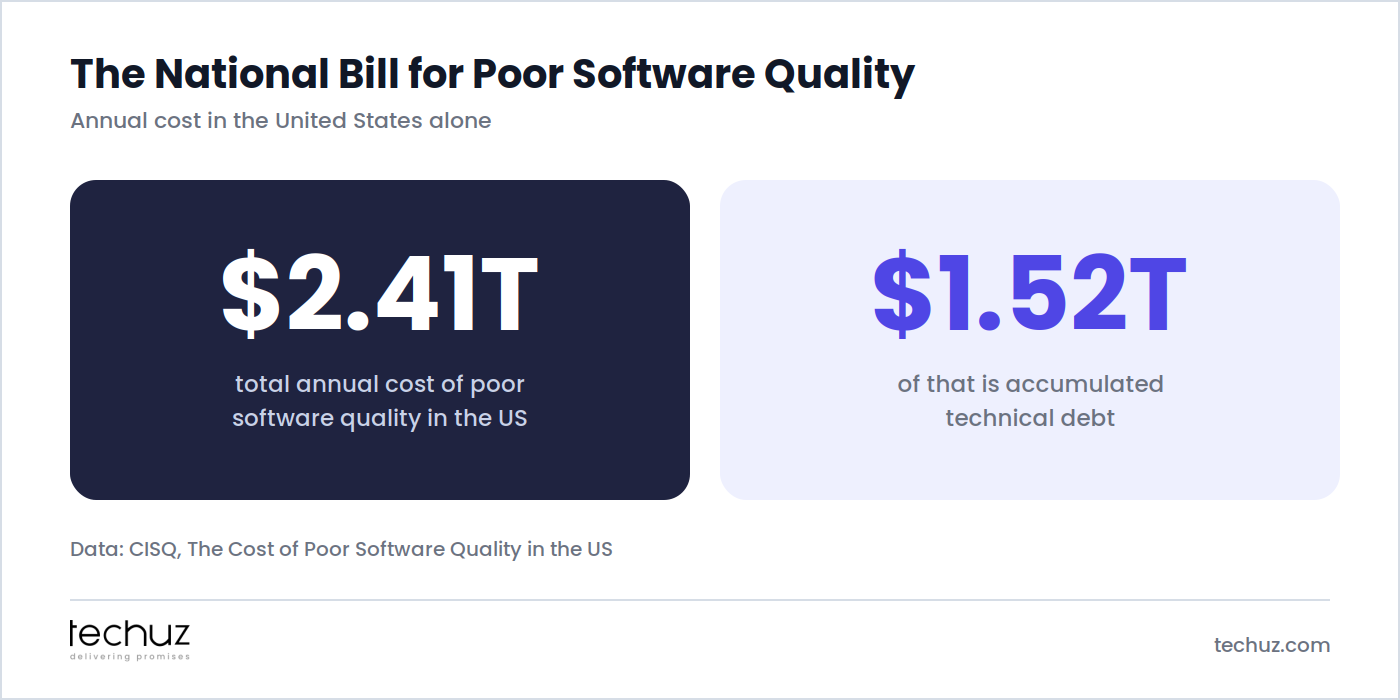
Stripe’s Developer Coefficient report found that developers lose 42% of a 41.1-hour work week to technical debt and inefficient code, while CISQ estimates the annual cost of poor software quality in the US at $2.41 trillion, including $1.52 trillion in accumulated technical debt. The uncomfortable truth? You won’t spot this risk on a resume or in an interview. You’ll find it in the standards a team refuses to compromise, even when deadlines are slipping.
Every engineering shortcut feels like a win in the moment. Skip the test. Delay the refactor. Approve the “temporary” workaround. Ship now and fix it later. Nothing breaks immediately, deadlines are met, and everyone moves on.
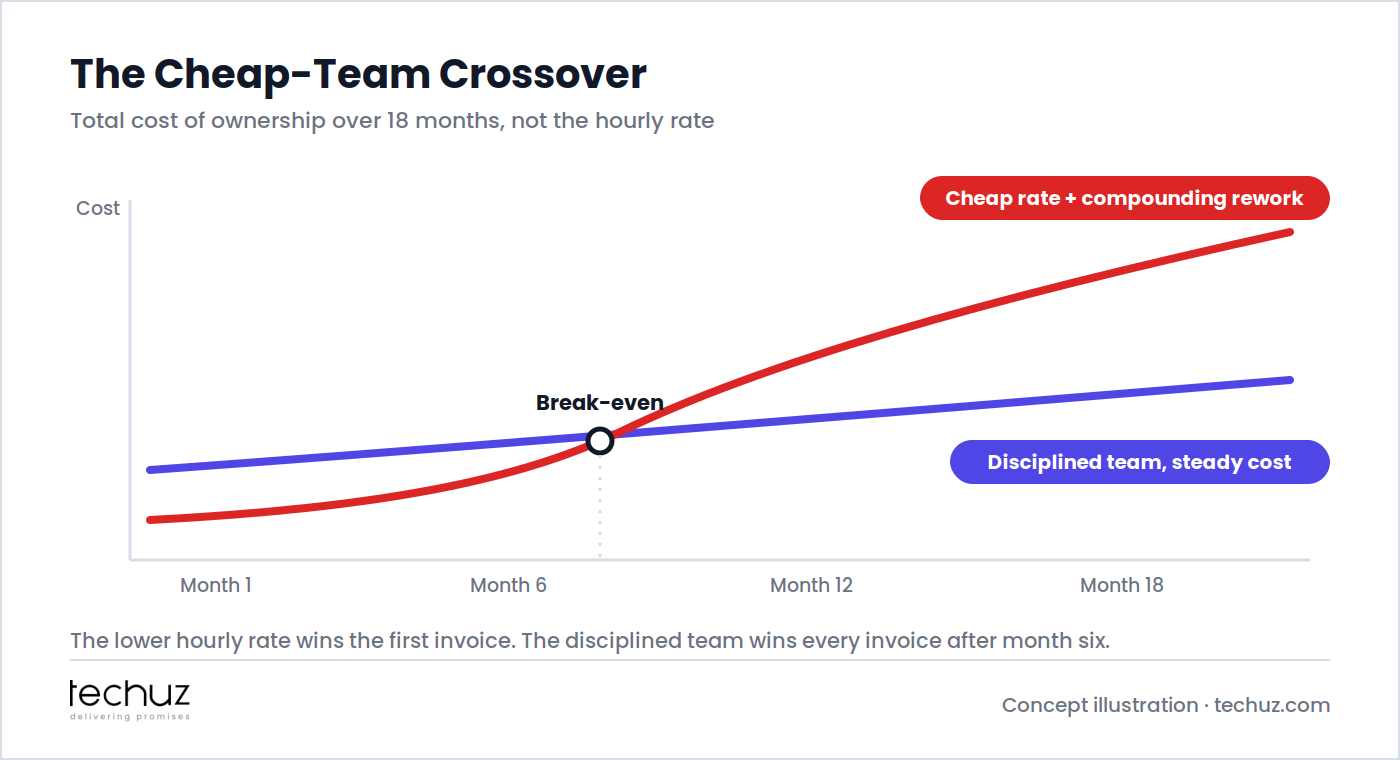
But software has a long memory. Every shortcut quietly becomes tomorrow’s maintenance burden, slowing every future release. It works exactly like a loan: the low hourly rate is the principal, and the rework is the interest. The difference is that nobody ever quotes you the rate.
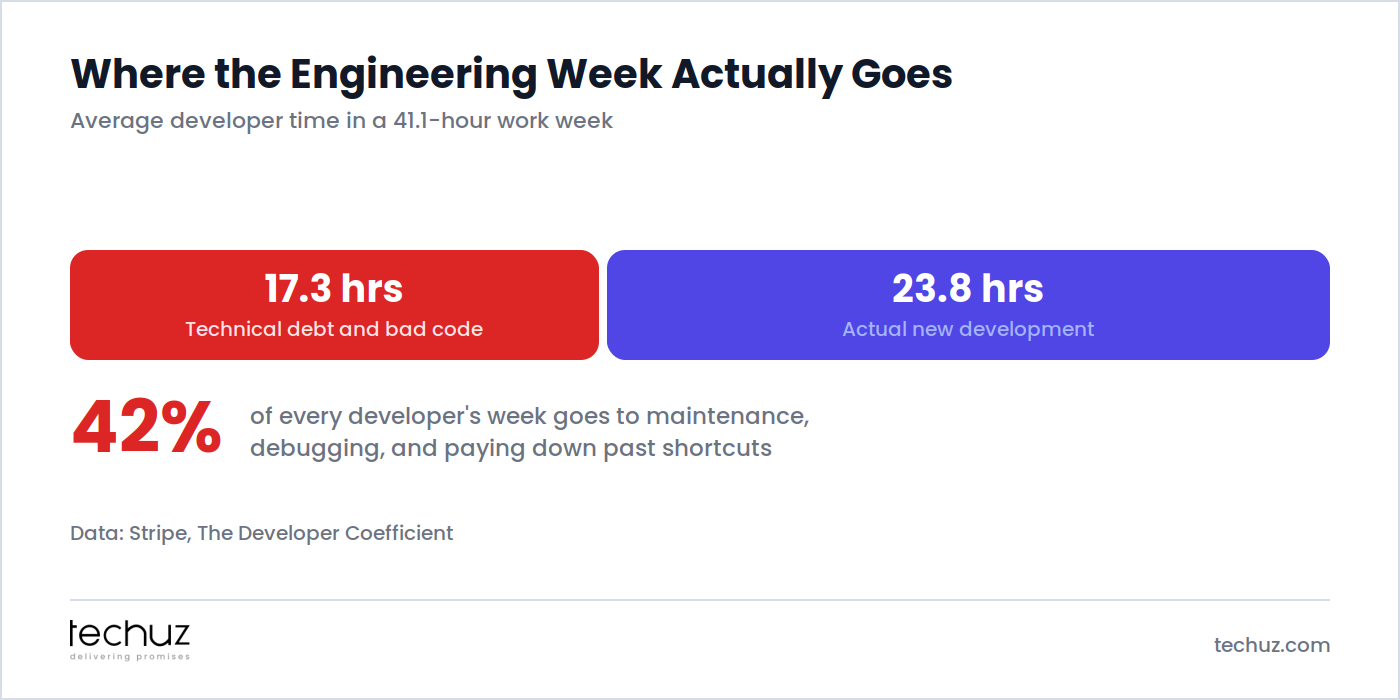
Stripe’s Developer Coefficient found that developers spend 17.3 hours of a 41.1-hour work week, 42% of their time, dealing with technical debt and poor-quality code instead of building new features. That’s the hidden cost of bad engineering: it doesn’t appear on the first invoice. It compounds silently until every new feature becomes slower, more expensive, and harder to deliver than the last.
The Resume-Driven Hiring Trap: Why Impressive CVs Predict Nothing About Discipline
A decade of experience, an impressive portfolio, and a list of well-known clients can all look reassuring, but they don’t tell you how the code was written. They measure exposure, not engineering discipline. A developer can spend ten years shipping software in a chaotic environment and still carry habits that quietly weaken every codebase they join.
Interviews rarely uncover this because they’re designed to reward polished explanations of best practices, not the decisions people make when deadlines are tight and trade-offs are unavoidable. And that’s the difference that matters. Great engineers aren’t defined by what they say about quality; they’re defined by what they refuse to compromise when shipping fast becomes the easier option.
What “Discipline” Actually Means (And Why It’s Invisible in an Interview)
Engineering discipline isn’t revealed when everyone is watching; it’s revealed when no one is. It’s the decision to give variables meaningful names, write the test nobody requested, document the edge case, and reject the tempting shortcut at 11 p.m. the night before a release.
These choices rarely appear on a resume and almost never surface in a coding interview, because interviews reward what candidates produce, not what they deliberately choose not to compromise. Real discipline is forged under sustained production pressure, when deadlines keep coming and quality standards are hardest to maintain. That’s where great engineers quietly separate themselves from merely experienced ones.
The Absence of Standards: How “It Works” Replaces “It’s Right”
The most dangerous words in software development are often “It works.” Working today says nothing about whether the code will still work after the next five features, three bug fixes, and two new developers touch it. Without clear engineering standards, “good enough” quietly becomes the default. The damage isn’t immediate; it accumulates as random bugs, slower releases, and parts of the codebase that everyone avoids because they’re too risky to change.
The scale of that accumulation is staggering. CISQ estimates the annual cost of poor software quality in the US at $2.41 trillion, including $1.52 trillion in accumulated technical debt. McKinsey’s research adds a company-level view: technical debt often amounts to 20 to 40% of the value of an organization’s entire technology estate, and 10 to 20% of the budget meant for new products quietly gets diverted to servicing it. None of that debt appeared overnight. It was created one seemingly reasonable shortcut at a time.
QA Debt: The Bill That Compounds Silently in Every Untested Commit
Skipping a test feels like a time saver, until the next change breaks something nobody expected. The real cost isn’t paid today; it’s paid every time that piece of code is modified in the future. From the outside, “We shipped it” and “We shipped it safely” look exactly the same, right up until the first regression brings development to a halt. That’s why technical debt compounds so quickly.
Stripe’s Developer Coefficient found that developers spend 42% of their work week dealing with technical debt and poor-quality code, with much of that time consumed by debugging, maintenance, and fixing problems that could have been prevented long before the software ever reached production.
Why Senior Titles Don’t Guarantee Senior Practices
A senior title doesn’t automatically signal engineering excellence. In the wrong environment, it may simply mean someone has been shipping code for longer, not shipping it better. Years of working without rigorous reviews or quality standards can build confidence, but not discipline.
That’s why the most revealing interview question isn’t “What have you built?” It’s “What did you refuse to ship, and why?” Truly disciplined engineers can describe moments when they challenged deadlines, delayed releases, or pushed back to protect quality. Those stories reveal judgment under pressure, a far stronger predictor of long-term engineering quality than years of experience alone.
The Compounding Effect: How Small Shortcuts Become Unpayable Debt
No software project fails because of one skipped test, one vague variable name, or one “we’ll fix it later” decision. It fails because hundreds of those shortcuts quietly accumulate over time. Every new compromise doesn’t just add to the problem; it interacts with the ones already buried in the codebase, making future changes slower, riskier, and harder to predict.
“A little debt speeds development so long as it is paid back promptly.”
Ward Cunningham, who coined the term “technical debt” (1992)
The part most teams forget is the second half of that sentence. Debt that isn’t paid back promptly starts charging interest. Protiviti’s Global Technology Executive Survey of more than 1,000 CIOs, CTOs, and CISOs found that nearly 70% of organizations say technical debt has a high impact on their ability to innovate, and that companies spend an average of 30% of their IT budgets and about 20% of their IT workforce just managing it. The biggest threat isn’t a single bad engineering decision; it’s thousands of small ones that nobody stopped when they were still easy to fix.
Here’s how the most common shortcuts convert into interest over time:
| The shortcut | Feels like savings | The interest you pay | First symptom |
|---|---|---|---|
| Skipped tests | Hours saved per feature | Every future change risks silent regressions | Bugs appear in features nobody touched |
| No real code review | Faster merges, fewer meetings | Inconsistent patterns multiply across the codebase | Only one person can safely touch each module |
| Rushed architecture | Weeks cut from the initial build | Every new feature fights the structure | “Simple” features start taking six weeks |
| No documentation | Nobody “wastes” time writing it | Knowledge lives in heads that eventually leave | New hires take months to ship safely |
The Audit Moment: When Technical Debt Finally Comes Due
Technical debt rarely arrives with a warning label. It shows up disguised as a “simple” feature that inexplicably takes six weeks, a talented new engineer who gives up after wrestling with the codebase, or a production outage that nobody can diagnose because no one fully understands how the system fits together anymore.
By then, the blame usually falls on the current team or the latest sprint. But the real cause lies much deeper: in dozens of engineering decisions made months or even years earlier, often by people who have long since left the company. Technical debt doesn’t suddenly appear. It quietly accumulates until reality finally sends the bill. It’s the same silent-decay pattern we’ve mapped in AI systems in the half-life of an AI agent: nothing crashes, dashboards stay green, and the cost compounds anyway.
Suspect your codebase is already charging you interest?
Techuz runs codebase health audits: test coverage trends, architecture risk, and a prioritized payback plan, so you know what the debt actually costs before it decides for you.
What Disciplined Teams Actually Do Differently
The best engineering teams don’t rely on memory, experience, or good intentions; they rely on standards. Their coding guidelines are written, enforced, and applied consistently, regardless of who is writing the code. Code reviews don’t just ask, “Does it work?” They ask, “Does it meet our quality standard?” Testing isn’t treated as an optional extra; it ships with the feature.
The biggest difference is transparency. Ask a disciplined team about their error-handling rules, testing requirements, or code review criteria, and you’ll get a clear, consistent answer, not a vague reference to “best practices.” That’s what separates engineering discipline from engineering opinion, and it’s the foundation Techuz builds every web application project on.
How to Evaluate a Real Engineering Team (Not Just a Resume)
Don’t judge an engineering team by its portfolio; judge it by the standards it enforces under pressure. Ask to see a real code review, not a polished example, because genuine feedback reveals what quality actually looks like inside the team. Ask what they refused to ship, and why. Review test coverage trends over time, not a single snapshot that can be staged. And when speaking to past clients, don’t just ask what launched on schedule; ask what broke after launch and how the team responded.
This diligence matters double for offshore engagements, where the communication layer adds its own failure modes on top of the engineering ones, a dynamic we break down in why offshore web teams fail between the messages, not at the keyboard.
One question cuts through everything else: when a deadline collides with an engineering standard, which one wins?
Want engineers whose standards survive deadline pressure?
Techuz teams work to written coding standards, mandatory reviews, and tests that ship with every feature, so the code you pay for once doesn’t bill you again every quarter. Hire dedicated developers who treat quality as non-negotiable.
FAQs
How much time do developers actually lose to technical debt?
Stripe’s Developer Coefficient study found developers lose 17.3 hours of a 41.1-hour work week, 42% of total time, to technical debt and bad code rather than new development.
What’s the real cost of poor software quality in the US?
CISQ’s research estimates it at $2.41 trillion annually, with accumulated technical debt specifically around $1.52 trillion, a figure that keeps growing year over year.
Can a senior developer still have poor engineering discipline?
Yes. Seniority earned in a low-standard environment teaches survival habits, not necessarily rigor. A senior title reliably means longer tenure, not necessarily better practices.
What’s the best interview question to assess engineering discipline?
Ask what a candidate refused to ship, and why. Disciplined engineers have specific stories about pushing back against a deadline for a quality reason; others usually don’t.
How can a CTO tell if technical debt is compounding faster than it’s being paid down?
Watch for “simple” features taking far longer than expected, new hires leaving shortly after touching the codebase, and outages that take unusually long to root-cause. All are signs the debt has outgrown the team’s ability to track it informally, a pattern Protiviti’s research links directly to stalled innovation capacity. If you’re seeing these symptoms, a structured codebase audit is the fastest way to size the problem.
Sources
- Stripe, The Developer Coefficient
- CISQ, The Cost of Poor Software Quality in the US
- Protiviti, Global Technology Executive Survey: Technical Debt Remains a Major Burden
- McKinsey, Tech Debt: Reclaiming Tech Equity
- Ward Cunningham, The WyCash Portfolio Management System, OOPSLA Experience Report (1992)
Looking for timeline and cost estimates for your app?
Contact us

Nilesh K.

Nilesh Kadivar leads Marketing & GTM at Techuz, where he helps startups and enterprises turn software, AI, and automation ideas into shipped products. He's spent 10+ years in business development and enjoys writing about tech trends, growth strategy, and the realities of building for the web and mobile.