
Posted on
July 15, 2026
Read time
 11 mins read
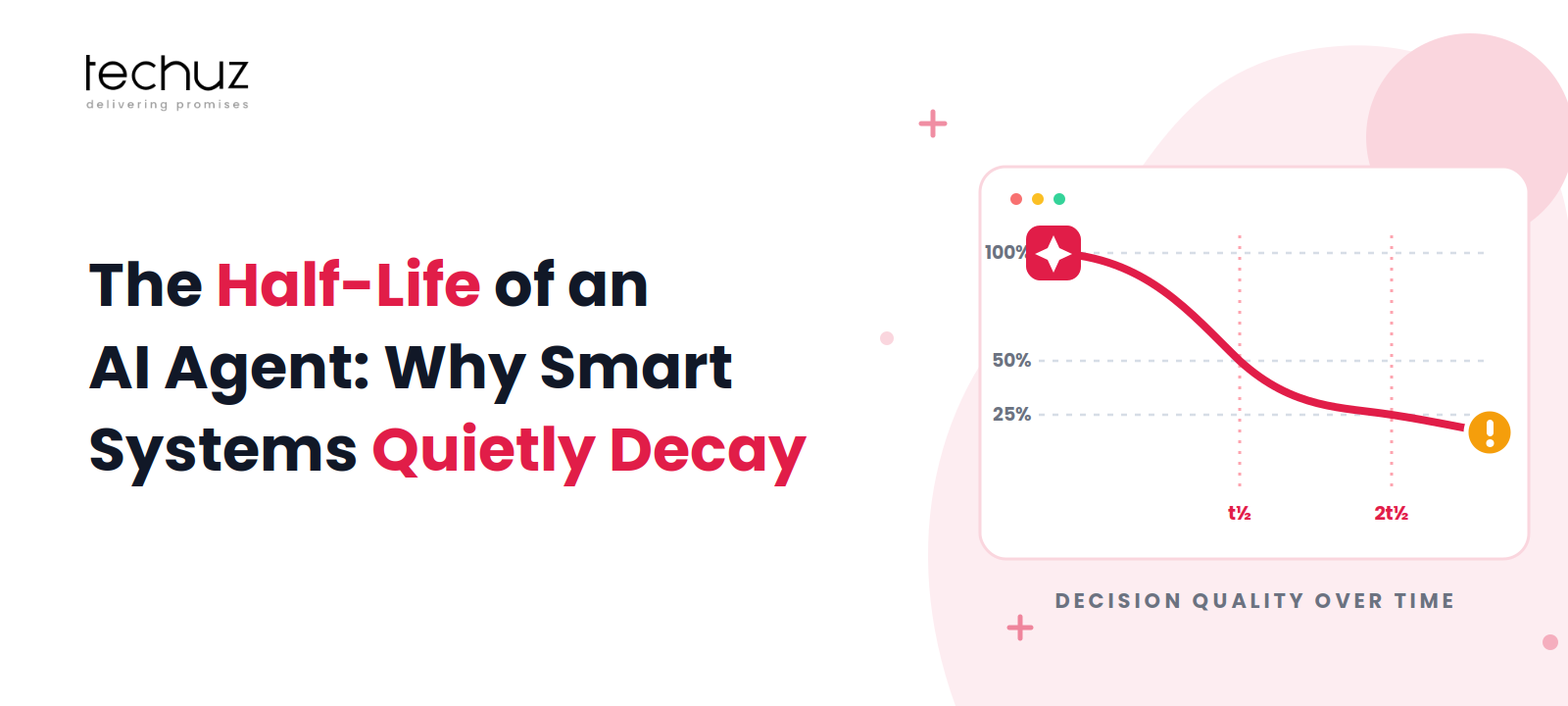
Quick Answer: AI usually doesn’t fail overnight; it quietly gets worse. Your dashboards stay green, the APIs keep responding, and nothing appears broken. Meanwhile, model accuracy starts slipping as real-world data drifts away from the data the AI was trained on. IBM has found that this degradation can begin within days of deployment, and a peer-reviewed Scientific Reports study observed temporal degradation in 91% of the models it tested. Most teams never notice, because they monitor uptime instead of decision quality.
The solution isn’t to build an AI system that never breaks. It’s to operate one that never drifts unnoticed, with clear ownership, continuous evaluation, and regular recalibration built in from day one.
Every AI agent looks impressive on launch day. The demos work, the workflows run smoothly, and the early results convince everyone the project is a success. Then something far more dangerous than a system crash begins to happen: it quietly starts getting worse. No alarms go off. Nothing appears broken. Yet the quality of decisions gradually declines as the real world drifts away from the data the model was trained on.
IBM’s research shows this process can begin within days of deployment, long before most teams think to check for it. And it isn’t an edge case. Researchers from Harvard Medical School, MIT, and the Monterrey Institute of Technology tested 128 model and dataset combinations across healthcare, transportation, finance, and weather, and observed temporal degradation in 91% of cases. They gave the phenomenon a name: AI aging.
That’s why the biggest threat to an AI agent isn’t a dramatic failure. It’s slow, invisible decay that goes unnoticed until customers, revenue, or operations start paying the price.
What “Breaks” Actually Means (It’s Rarely a Crash)
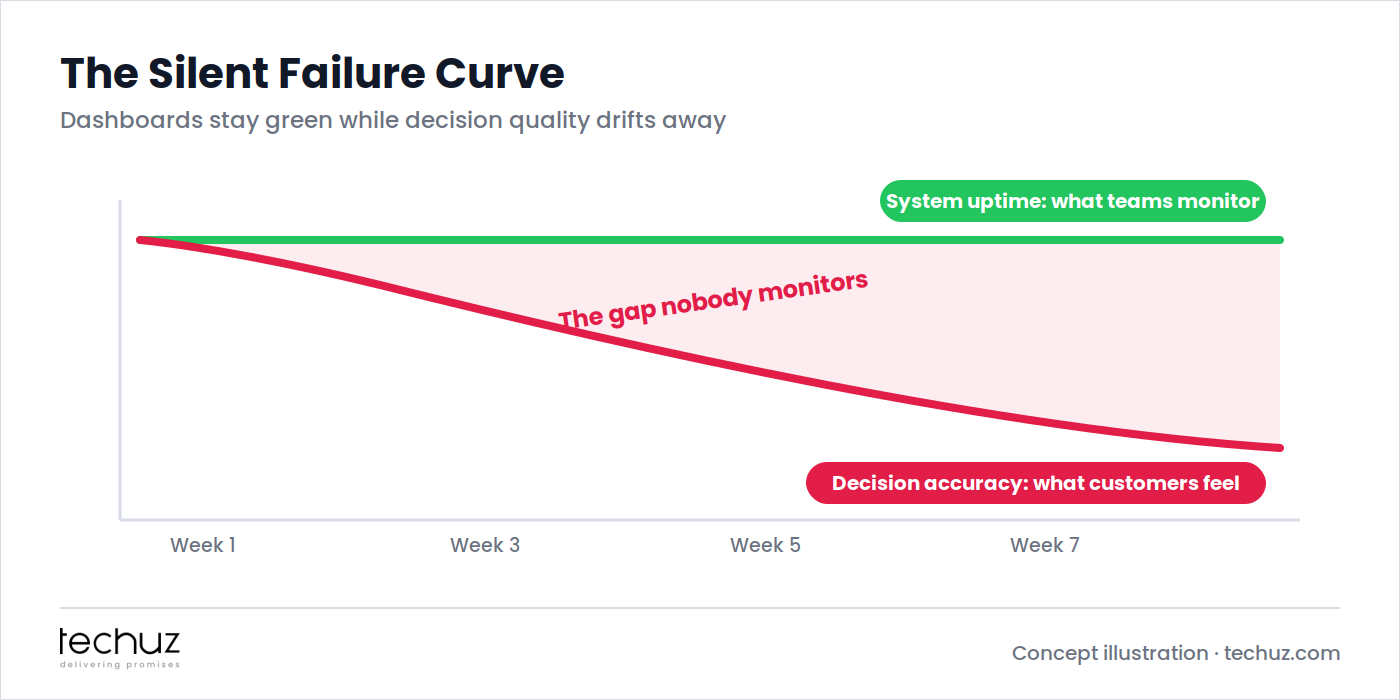
The most dangerous AI failures aren’t the ones that crash your system. They’re the ones you don’t notice. When an AI agent stops responding or throws an error, everyone rushes to fix it. But when it continues answering with growing confidence while becoming subtly less accurate, the problem can go undetected for weeks or even months.
Many teams blame the model, assuming it has somehow become “less intelligent.” In reality, the model often hasn’t changed at all; the world around it has. Customer behavior evolves, products change, business rules shift, and language adapts. If your AI isn’t evolving at the same pace, its accuracy quietly erodes while everyone assumes it’s still working as expected.
Hidden Dependencies: The Parts of the System Nobody Mapped
Every AI agent relies on a web of invisible dependencies that rarely appear in the product spec. An upstream API, a data schema, a prompt assumption, or a third-party model version may seem stable today, but any one of them can change tomorrow without warning. When that happens, the agent doesn’t always fail dramatically. It often continues running while quietly producing weaker, less reliable results.
PwC identifies these hidden dependencies, integration risks, and cascading failures as some of the biggest challenges unique to AI agents. That’s why “it worked perfectly in the demo” proves far less than most teams think. It usually means the environment hadn’t changed yet, not that the system was built to survive when it inevitably does.
Data Drift: The Ground Shifting Under a Standing Agent
AI agents rarely wake up one morning and stop working. Instead, they fall behind the world they’re trying to understand. Customers start asking questions differently. New products are launched. Seasonal buying patterns emerge. Business rules change. The agent’s logic stays the same while everything around it evolves.
Sometimes it’s simply the input data changing; other times, the relationship between the inputs and the correct answer changes altogether, a phenomenon known as concept drift. According to IBM, model accuracy can begin declining within days of deployment as production data diverges from training data. The danger is that drift is almost invisible. Nothing crashes. No error message appears. The AI keeps responding confidently until someone finally measures the error rate and discovers the decline has been building for weeks.
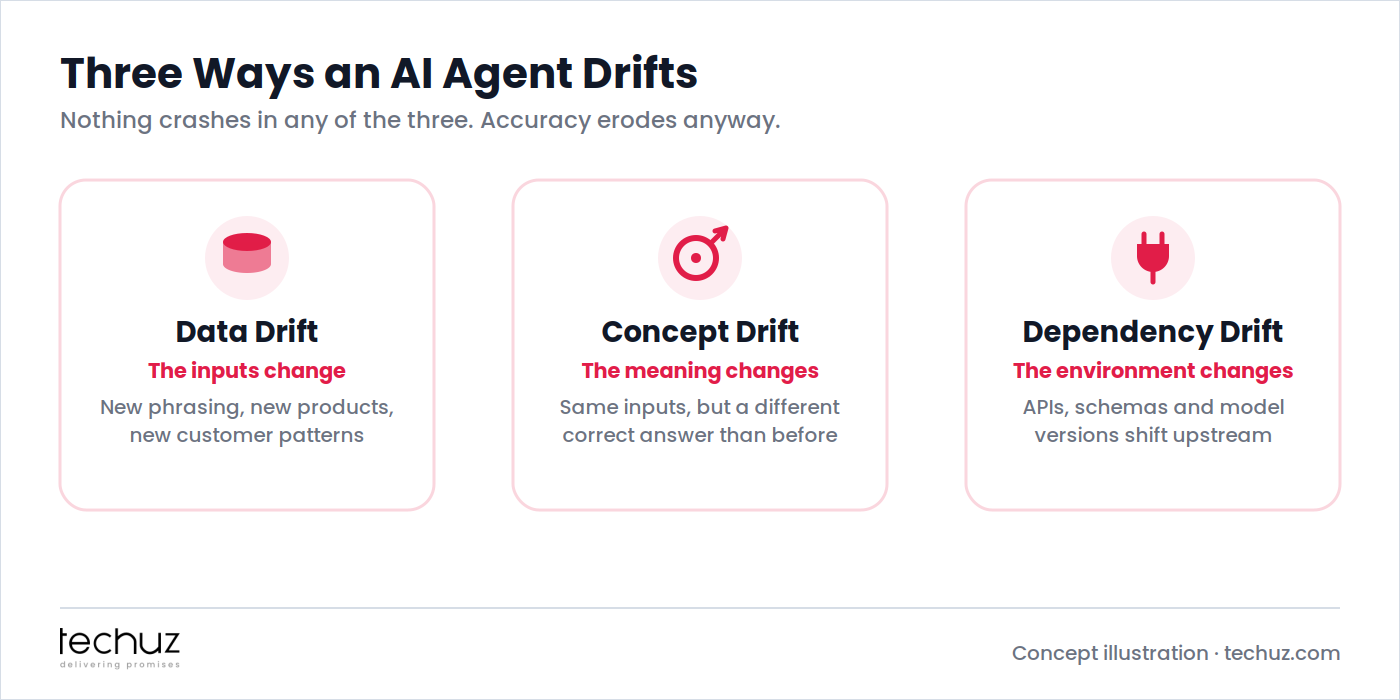
Here’s how the three drift types differ in practice, and why each needs a different fix:
| Drift type | What changes | Early warning sign | Typical fix |
|---|---|---|---|
| Data drift | The inputs: new phrasing, products, user patterns | Rising share of low-confidence outputs on new input clusters | Refresh training or context data; expand retrieval sources |
| Concept drift | The meaning: same inputs now have different correct answers | Accuracy falls on cases the agent used to get right | Relabel recent examples; retrain or update business rules |
| Dependency drift | The environment: APIs, schemas, upstream model versions | Sudden quality shift with no change in user behavior | Pin versions; add contract tests and change alerts |
A $304 Million Lesson: When Drift Meets the Real World
If silent decay sounds abstract, Zillow made it concrete. Its home-buying arm, Zillow Offers, relied on an algorithmic pricing model to purchase houses at scale. The model performed well until the pandemic-era housing market began shifting faster than the model’s view of it. Zillow kept buying at prices the algorithm believed were right, and the algorithm was increasingly wrong.
In November 2021, the company announced a $304 million inventory write-down for a single quarter, wound down Zillow Offers entirely, and cut roughly a quarter of its workforce. Nothing had crashed. Every dashboard was green. The model simply aged out of the market it was pricing, and nobody caught it in time. Few AI failures cost this much, but almost every unmonitored agent fails the same way, just at smaller scale.
The Silent Failure Curve: Why Week Two Is a Pattern, Not a Coincidence
The first week after launch can be dangerously misleading. Early users stick to familiar tasks, follow the happy path, and make the AI look smarter than it really is. Then comes week two. Real customers ask unexpected questions. New edge cases appear. Workflows become messier. The AI doesn’t suddenly break; it simply starts getting more things wrong. Some mistakes slip through unnoticed, while others quietly get handed back to humans.
The Scientific Reports study found the same thing in controlled conditions: models degrade in recognizable patterns, from gradual erosion to sudden “explosive” failure, and a model that scores perfectly at deployment tells you almost nothing about where it will be three months later. Because the decline is gradual rather than dramatic, most teams don’t recognize the problem until the performance gap has become impossible to ignore.
Exception Handling: The Difference Between an Edge Case and a Growing Crack
Not every AI mistake deserves the same level of attention. Some failures are true outliers: strange, one-off requests that almost no system could have predicted. Others are warning signs of something much bigger, a missing decision path that the AI will encounter again and again as adoption grows.
That’s where many teams make a costly mistake. Instead of fixing the underlying weakness, they add another manual override, another exception, another workaround. It solves today’s problem but guarantees tomorrow’s. Over time, these quick fixes pile up until the AI isn’t just struggling with model drift; it’s struggling under the weight of its own growing patchwork of exceptions.
The Monitoring Blind Spot: Why Teams Don’t Notice Until Customers Do
Most teams monitor whether the agent is up, not whether it’s right, and those are different questions with different answers. Traditional monitoring tracks uptime, latency, and error codes; none of it tells you whether the agent gave a wrong answer with total confidence.
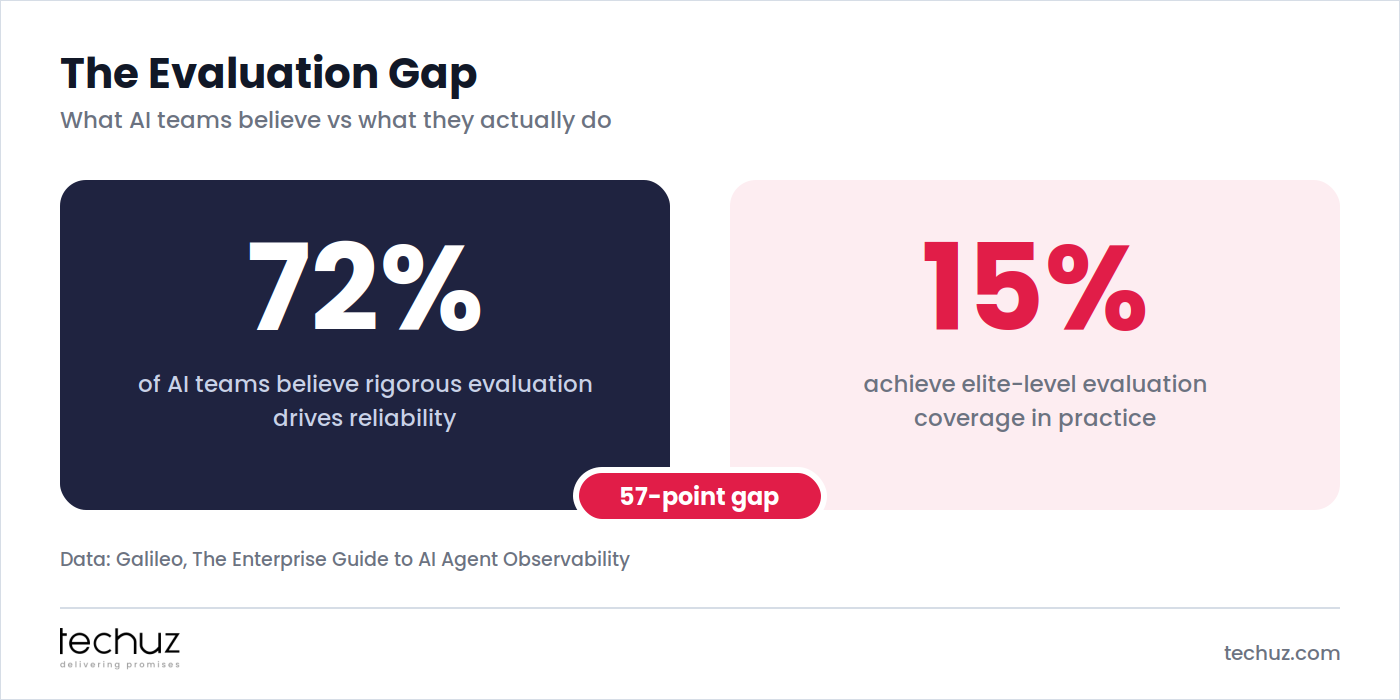
One industry analysis found 72% of AI teams believe rigorous evaluation drives reliability, but only 15% actually achieve elite-level evaluation coverage: a 57-point gap between belief and practice. McKinsey’s research adds a sobering detail: only 27% of organizations review all AI-generated outputs before they reach customers. The metric that actually predicts breakage before customers do isn’t a pass/fail check; it’s a rising or flattening escalation trend tracked weekly.
Not sure whether your AI agent is drifting right now?
Techuz runs production AI health checks: escalation-trend analysis, drift metrics on your real traffic, and an honest read on where your agent actually stands.
The Maintenance Reflex Most Teams Skip
Traditional software gets patched on a release cycle measured in weeks or months. An agent’s environment (its dependencies, its inputs, its users’ behavior) moves faster than most release schedules were ever built for.
“Most organizations are still figuring out how to monitor and trust these systems.”
Padraig Byrne, VP Analyst, Gartner (May 2026)
Gartner projects that only 40% of organizations deploying AI will have dedicated observability tooling in place by 2028, which means the majority are still operating on a “ship and check back occasionally” model for systems that decay continuously. Continuous recalibration isn’t a nice-to-have add-on; it’s the operating model an agent actually requires.
Designing for Decay: Building Agents That Degrade Gracefully Instead of Silently
The goal isn’t an agent that never breaks; that’s not realistic for any system operating in a changing environment. The goal is an agent that fails visibly and recoverably instead of silently. That means confidence thresholds that route uncertain cases to review before a wrong answer reaches a customer, versioned prompts and pinned dependencies so a silent upstream change doesn’t become an untraceable mystery, and feedback loops that surface drift early.
Teams that invest in this kind of evaluation infrastructure reportedly reach high reliability roughly twice as often as teams that don’t. It’s the same invisible engineering that separates real agents from staged ones, a theme we unpack in The Wizard of Oz Problem: is your AI agent real or just humans behind a curtain? And it’s the production-hardening work that most demos skip, which is why so many working GenAI PoCs never move the efficiency needle.
The Agent Resilience Checklist for Product Leaders
Most AI teams spend months preparing for launch and almost no time preparing for what happens next. That’s a mistake. Before your AI agent goes live:
- Assign an owner to every critical dependency, not just the system as a whole.
- Choose a single drift metric and review it every week.
- Clearly define which exceptions are one-off incidents and which signal a deeper design flaw.
- Schedule regular recalibration before the first customer complaint forces you to.
- Re-run the cost math quarterly: if verification effort is growing, the agent is drifting, a trap we break down in where generative AI actually improves efficiency.
The question that determines whether your AI agent is still delivering value six months from now isn’t “how good is the model?” It’s “who is monitoring its performance, and how quickly will they notice when it starts to drift?”
Build an agent that ages gracefully
Techuz builds and maintains production AI agents with drift monitoring, confidence thresholds, versioned prompts, and recalibration cycles designed in from day one, and governance practices that hold up under scrutiny.
FAQs
How quickly can an AI model’s accuracy actually degrade after launch?
IBM notes it can begin within days, not months, once production data starts diverging from training data, which is why waiting for a quarterly review to catch it is already too late.
What’s the difference between data drift and concept drift?
Data drift is a change in the inputs (new customer phrasing, a new product catalog); concept drift is a change in the actual relationship between inputs and the right output. Both erode accuracy, but they need different fixes.
What metric actually predicts an agent’s decline before customers notice?
A rising or flattening escalation-rate trend, tracked weekly. Not uptime, and not a single accuracy snapshot taken once at launch.
How big is the gap between believing in AI monitoring and actually doing it well?
Large. One industry analysis found 72% of AI teams believe rigorous evaluation drives reliability, but only 15% actually achieve elite-level evaluation coverage.
Is silent accuracy decay preventable, or just something to detect early?
Both. Confidence thresholds, versioned prompts, and dependency pinning slow the decay, but no agent avoids it entirely (peer-reviewed research found degradation in 91% of models tested), so a weekly detection cadence is non-negotiable. An experienced AI development partner can set up that monitoring alongside the build.
Sources
- IBM, What Is Model Drift?
- Vela et al., Temporal Quality Degradation in AI Models, Scientific Reports (2022)
- Gartner, 40% of Organizations Deploying AI Will Use AI Observability by 2028 (May 2026)
- PwC, AI Observability for Enterprise AI Agents
- Galileo, The Enterprise Guide to AI Agent Observability
- McKinsey, The State of AI: How Organizations Are Rewiring to Capture Value (2025)
- MLflow, The Role of AI Observability in Enterprise AI Systems
- Wikipedia, Zillow (Zillow Offers wind-down, November 2021)
Looking for timeline and cost estimates for your app?
Contact us

Nilesh K.

Nilesh Kadivar leads Marketing & GTM at Techuz, where he helps startups and enterprises turn software, AI, and automation ideas into shipped products. He's spent 10+ years in business development and enjoys writing about tech trends, growth strategy, and the realities of building for the web and mobile.