
Posted on
July 8, 2026
Updated on
July 13, 2026
Read time
 11 mins read
Quick Answer: Trustworthy AI is built, not audited. It comes from embedding safety, fairness, transparency, and accountability into every stage of development, from the first dataset to post-launch monitoring. The urgency is real: IBM’s 2026 study found 77% of organizations say AI adoption is outpacing their governance, and only 11% feel fully prepared for what’s coming. A generative AI development company that builds trust in from day one is how that gap gets closed.
Ask people why they stopped using an AI product and the answer is rarely “the model wasn’t smart enough.” It’s that the product got something wrong at the wrong moment: a biased output, a leaked detail, a confident answer that turned out to be invented. Capability gets users in the door. Trust decides whether they stay.
That’s the shift happening across the industry right now. Artificial intelligence has quite literally changed the way we live and work, moving from a nascent technology to a business imperative that powers customer experiences, automation, content, and decision-making. But as AI gets bigger, the defining question has changed from “can we build it?” to “will people trust it?”
The numbers say most companies aren’t ready for that question. According to IBM’s 2026 study of 2,000 technology executives, 77% of organizations report AI adoption outpacing their governance capabilities, and only 11% feel fully prepared for the volume of AI deployment expected in the next year. That’s a widening gap between what companies are shipping and what they can actually stand behind, and it’s exactly the gap a trusted generative AI development company exists to close.
This guide walks through what responsible AI really means, the four pillars that make an AI system trustworthy, how ethics gets built into each stage of the development lifecycle, and how to choose a custom AI development company that treats trust as an engineering requirement rather than a marketing line.
What Trustworthy AI Actually Means
Responsible AI is not a single feature, a policy PDF, or a checkbox at the end of a project. It’s a mindset baked into every decision made while building, from the first dataset to the final deployment.
At its heart, a trustworthy system is one that is safe, fair, explainable, and accountable. And because something will eventually go wrong in any complex system, trustworthy also means there’s a clear process to figure out what broke, fix it, and prevent it from happening again. Users forgive products that fail and recover honestly. They abandon products that fail and hide it.
Plenty of companies talk about AI ethics without putting real practices behind the talk, and the difference shows up fast: in biased outputs, privacy violations, and systems that fail the people they were supposed to help. A 2025 study published in Frontiers in Artificial Intelligence found that approximately 70% of companies report minimal impact from AI implementations, and only about 13% of data science projects actually reach production. That’s not a technology problem; it’s a governance and trust problem.
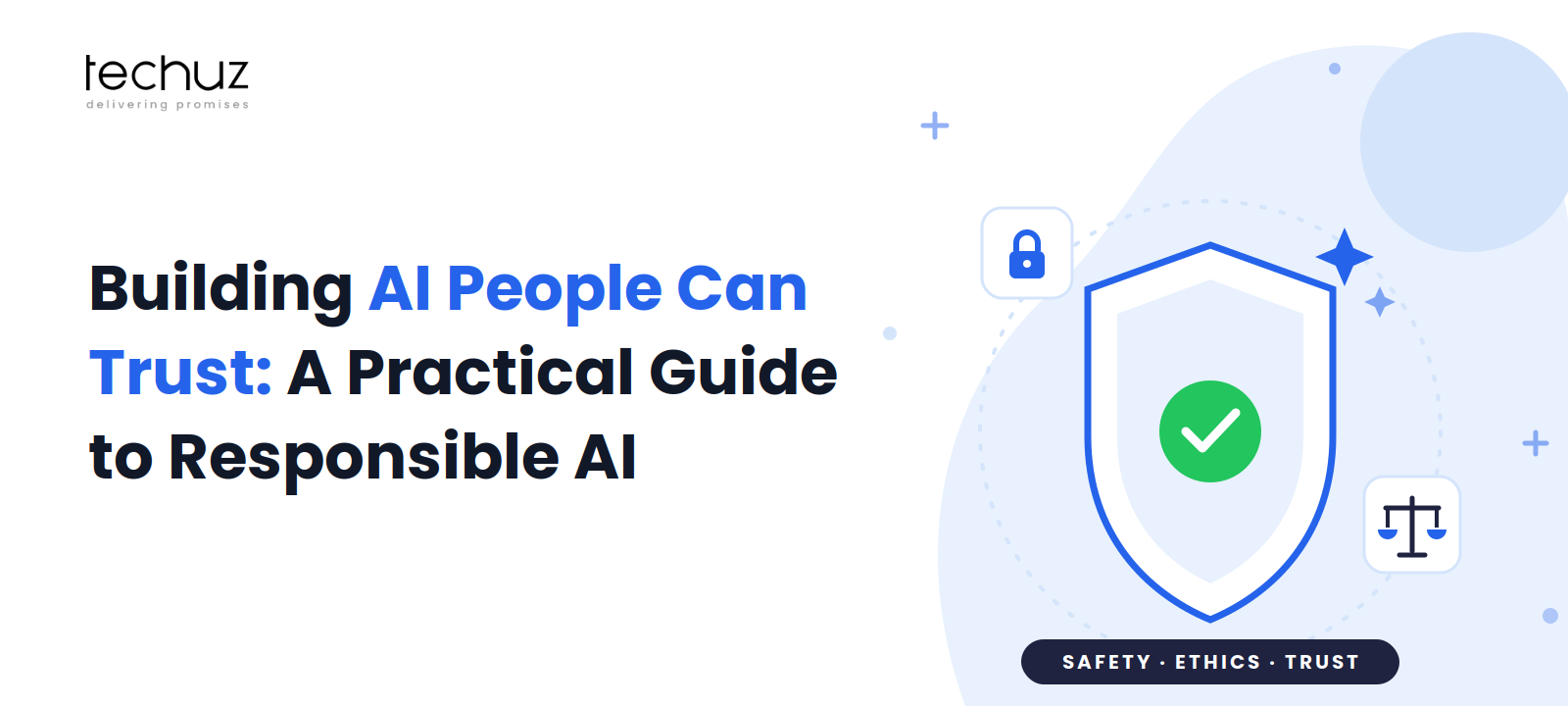
The Four Pillars of AI People Can Trust
Safety
Safety in AI application development services means the system shouldn’t cause harm: to users, to data subjects, or to society broadly. That sounds obvious, but in practice it means proactive testing across use cases, edge cases, and failure modes before anyone else finds them.
A responsible generative AI development company red-teams its models, stress tests them against surprises, and monitors deployed systems constantly. Safety is a habit, not a one-time audit.
Fairness and Bias Mitigation
AI learns from data, and if that data carries historical bias (most real-world data does), the model will amplify it without deliberate intervention.
Bias isn’t just a PR problem. It directly affects real people: who gets flagged by a hiring tool, who gets approved for a loan, who gets seen by a recommendation engine. A 2025 analysis across 84 responsible AI standards found that fairness is one of the five most-cited principles in AI ethics frameworks globally, yet it remains one of the hardest to operationalize.
Trustworthy systems address bias at three levels: data collection, training, and post-deployment monitoring. It’s a continuous practice, not a one-off fix.
Transparency
People trust what they can understand. If you can’t explain how your AI made a decision, that’s a problem for your users, your legal team, and your reputation.
Transparency means being clear about what data a model was trained on, how it generates outputs, what its limitations are, and when a user is talking to an AI rather than a human. Regulation is now enforcing this: the EU AI Act, rolling out in phases since 2024, requires AI-generated content to be clearly labeled, with those transparency rules fully applying from August 2026.
Transparency also points inward: documentation, audit trails, model cards, and clear accountability inside the development team. Teams that can explain their system to a regulator can explain it to a user.
Accountability
Who answers when the AI gets it wrong? That question needs an answer before a single line of production code is written. Accountability frameworks assign responsibility across the AI lifecycle, from the company that builds the model to the organization that deploys it.
The public has already made up its mind on where the bar sits: the Thomson Reuters Future of Professionals Report 2025, which surveyed over 2,000 professionals, found 91% believe AI systems should be held to higher standards than humans. Trust, in other words, has to be earned uphill.
Building Trust Into Every Stage of the AI Lifecycle
Responsible AI is not a final checklist completed before launch. Each stage of development either deposits trust or borrows against it.
Discovery and Planning
Every trustworthy AI project starts by defining both the business goals and the potential risks. A solid custom AI solutions development process weighs business outcomes and user impact together, so nobody discovers an ethical landmine in week twelve that should have been mapped in week one.
Data Collection
Data is the foundation, and poor data reliably produces poor outcomes. Responsible teams focus on data quality, accuracy, consent management, privacy protection, and bias detection, so models are trained on data that is both trustworthy and representative of the people they’ll serve.
Model Development and Training
Training is where problems get cheap to fix. Developers test system behavior across situations: fairness testing, performance evaluation, risk analysis, safety assessment, and output verification. For a responsible LLM development team, training is more than a technical exercise; it’s the best opportunity to find ethical problems before users do.
Testing and Validation
Before launch, systems undergo extensive testing across reliability, accuracy, security, fairness, and compliance. The goal is to discover weaknesses under real-world conditions while the stakes are still internal.
Deployment and Continuous Monitoring
Trust doesn’t stop compounding (or eroding) at launch. Continuous monitoring identifies new risks, catches performance drift, reviews user feedback, maintains compliance, and increases reliability. AI systems operate in dynamic environments, and ongoing oversight is what keeps a system worthy of the trust it earned on day one.
Data Privacy: Where Trust Is Won or Lost Fastest
Nothing destroys trust faster than mishandled data, and it’s usually the first concern clients bring to the table.
The risk is now measured, not hypothetical. IBM’s Cost of a Data Breach Report found one in five organizations experienced breaches through “shadow AI”: employees pasting sensitive source code, meeting notes, and customer data into unauthorized tools. High levels of shadow AI added an average of $670,000 to breach costs, and 97% of AI-breached organizations lacked proper access controls.
Users feel this shift too. In 2026, 92% of people surveyed expressed concern about their personal data being used inappropriately by corporations, up from 89% the year before, and roughly 40% of organizations have reported an AI privacy incident, often quiet leaks through prompts, logs, and APIs.
Building trust here means privacy by design: secure data storage, access control, encryption, consent management, and data minimization built in from the earliest planning stages. A strong custom AI solutions development strategy treats privacy as architecture, not as an afterthought, and stays transparent about what data is collected, why, and how it’s used.
Why Trustworthy AI Is Also the Better Business Decision
There’s a commercial argument here, beyond the ethical one.
Companies that build responsibly build better products: fewer failures, fewer surprises in production, fewer incidents that erode customer confidence. That translates into lower long-term costs, stronger client relationships, and a product that holds up under scrutiny as regulation tightens.
The most successful generative AI companies won’t treat EU AI Act compliance as a checkbox exercise. They’ll embed responsible AI principles and transparency by design into their core product development, because a system designed for trust passes compliance almost as a side effect.
Clients who’ve been burned by quick-and-dirty AI implementations already know the cost of shortcuts. A system that produces biased outputs, exposes user data, or fails compliance checks doesn’t just create problems; it creates liability, public trust damage, and expensive retrofits. Working with a generative AI development company that takes governance seriously from the start is simply the smarter investment.
How Techuz Builds AI People Can Trust
With 500+ projects delivered and 12 years of experience, responsible development at Techuz isn’t a policy document; it’s how the work gets done. Here’s what that looks like in practice:
- Ethically sourced data, from the start. Every GenAI strategy begins with selecting the right model (GPT-4, LLaMA-3, PaLM-2, Gemini, or a custom variant) and building a clean, responsible data pipeline behind it. No shortcuts on sourcing.
- Fine-tuning that reduces risk, not just improves accuracy. Techuz fine-tunes models on curated, domain-specific data. Tighter training sets mean fewer hallucinations, less bias, and outputs that are actually relevant to your use case.
- Transparency built into every engagement. Each project includes clear documentation of what the model does, what it doesn’t do, and where its limits are.
- Integrations with governance, not just code. When connecting models like GPT to your infrastructure, Techuz maps data flows, sets access controls, and reviews every input and output touchpoint.
- End-to-end custom builds, no isolated handoffs. For ground-up solutions, data preprocessing, model development, integration, and deployment are treated as one continuous process. Responsible practices carry through each stage, not just the final one.
- Post-deployment monitoring as a default, not an add-on. Techuz builds in feedback loops and model performance reviews so issues get caught early, not after they’ve eroded user trust.
Building an AI product your users need to trust?
Techuz combines technical depth with a working governance framework: ethically sourced data, transparent documentation, and monitoring built in from day one.
FAQs
What makes an AI system trustworthy?
Four things working together: safety (it doesn’t cause harm), fairness (bias is actively detected and mitigated), transparency (its decisions and limits can be explained), and accountability (someone owns the outcome when it fails). All four have to be engineered in during development, not claimed afterward.
What is responsible AI development?
It’s the practice of embedding those trust pillars into every stage of the AI lifecycle, from data collection and training through testing, deployment, and continuous monitoring, rather than treating ethics as a final pre-launch audit.
Why do most AI projects fail to earn trust or deliver impact?
Research suggests roughly 70% of companies see minimal impact from AI implementations, and only about 13% of data science projects reach production. The root causes are usually governance gaps, poor data quality, and missing accountability, not model quality.
What is shadow AI and why does it matter?
Shadow AI refers to employees using unapproved AI tools with company data. IBM found one in five breached organizations were compromised through shadow AI, with those incidents adding an average of $670,000 to breach costs.
How does the EU AI Act affect AI products?
The EU AI Act introduces phased obligations, including transparency rules requiring AI-generated content to be clearly labeled and users to be told when they’re interacting with AI. Those rules fully apply from August 2026, so products serving EU users need compliance designed in now.
How do I choose a responsible AI development partner?
Look for evidence of practice, not policy: documented model limitations, bias testing in the workflow, data governance during integration, and post-deployment monitoring included by default. For more guidance on evaluating AI partners, visit the Techuz blog.
Sources
- IBM, AI Control Gap Study (2026)
- IBM, Cost of a Data Breach Report (2025)
- EU AI Act, Implementation Timeline
- Frontiers in Artificial Intelligence, AI Implementation Impact Study (2025)
- Thomson Reuters, Future of Professionals Report (2025)
Looking for timeline and cost estimates for your app?
Contact us

Hemagini Jain

Hemangini Jain is a Co-Founder at Techuz, where she helps startups turn ideas into market-ready SaaS products often in 16 weeks or less. She's worked with founders behind $10M+ success stories and enjoys writing about MVP development, AI, product strategy, and what it really takes to launch.