
Posted on
July 31, 2026
Updated on
August 1, 2026
Read time
 10 mins read
Quick Answer: Every product team reaches a point where working harder stops producing faster results. Features take longer to ship, roadmaps slip, and hiring more engineers somehow makes progress feel even slower. The problem isn’t a lack of talent or effort; it’s accumulated drag. Product debt, technical debt, platform complexity, bloated backlogs, and overloaded teams quietly compound until they overwhelm the organization’s ability to move.
Pendo found that 80% of SaaS features are rarely or never used, while Brooks’s Law reminds us that new engineers typically need 3 to 9 months before they become fully productive. The answer isn’t to add more people or push the team harder. It’s to identify and eliminate the biggest source of drag before it slows everything else down.
Have you ever wondered why the same engineering team that once shipped a new feature every week suddenly struggles to deliver one in a month? It usually isn’t because the team became less talented or less motivated.
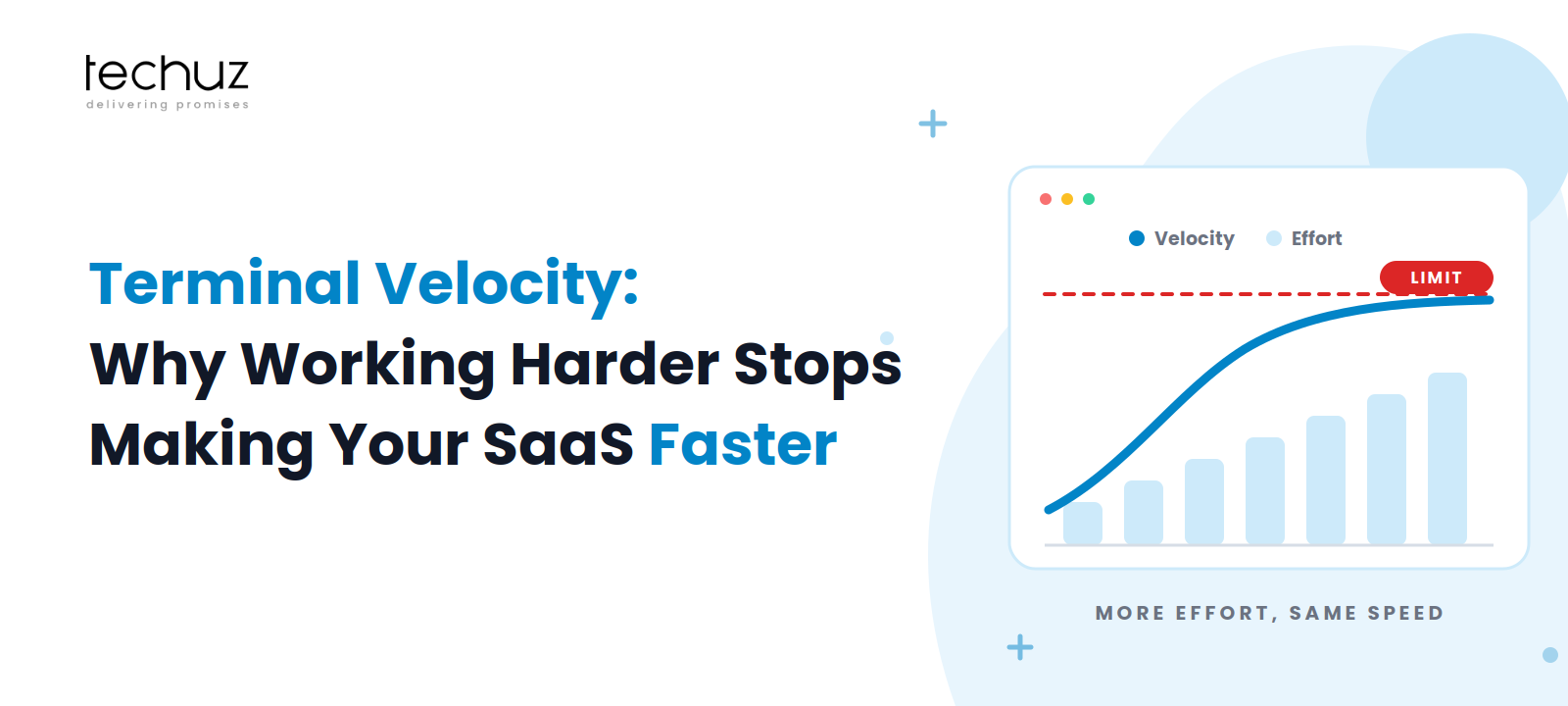
The real culprit is far less obvious: drag. As a product grows, every new feature adds complexity, technical debt, dependencies, approvals, and legacy code that quietly slow everything down. Just like an object in free fall eventually reaches terminal velocity, where air resistance cancels out the force of gravity, product teams reach a point where every extra hour of effort is offset by growing friction. At that stage, working harder doesn’t make you faster. Removing the drag does.
And the stakes are bigger than sprint morale. McKinsey’s Developer Velocity research found that companies in the top quartile of developer velocity grow revenue four to five times faster than those in the bottom quartile. Velocity isn’t an engineering vanity metric. It’s a business outcome with a compounding cost when it slips.
The Two Debts Founders Confuse: Product Debt vs Engineering Debt
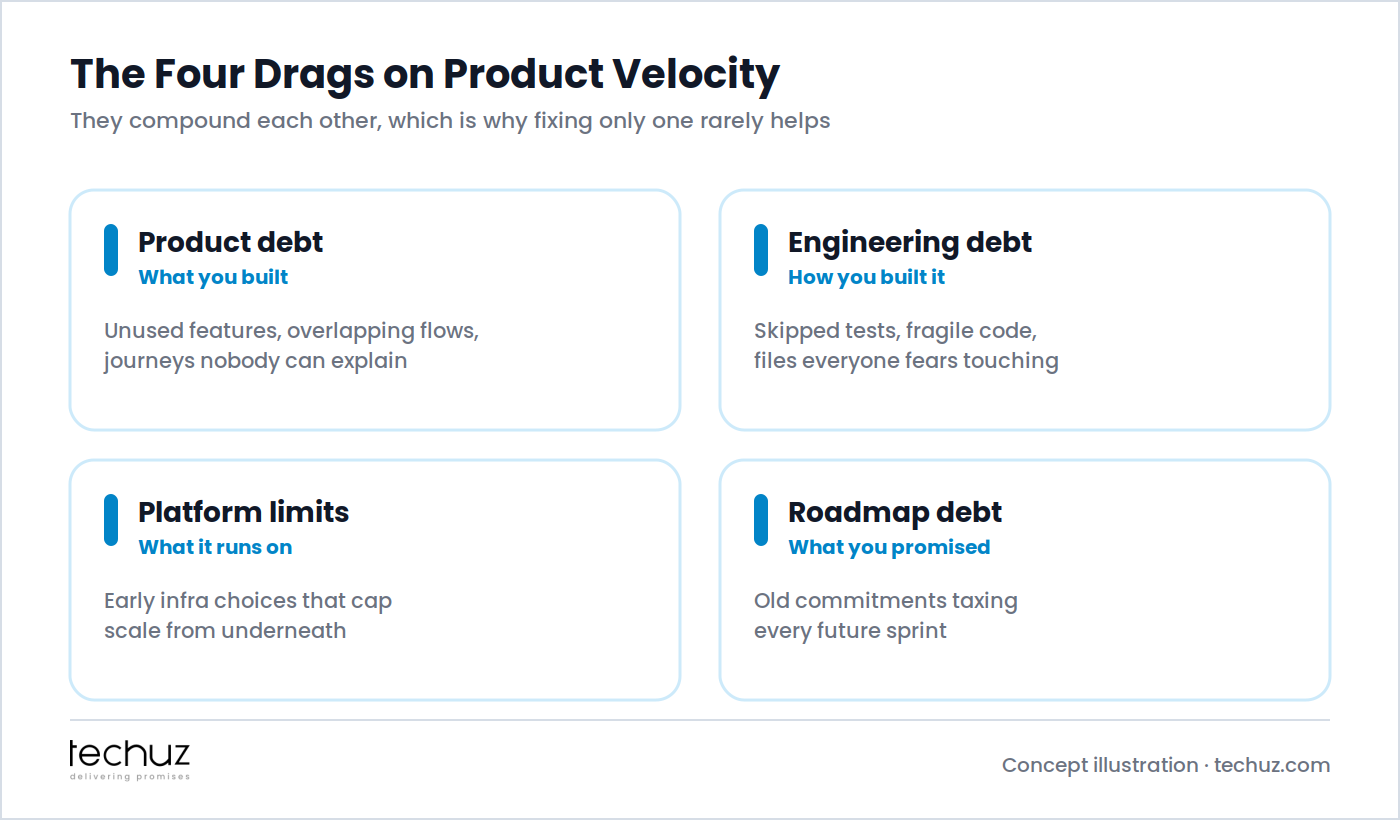
Not all product drag comes from the same place. Sometimes the problem is what you’ve built. Other times, it’s how you built it. Product debt shows up as forgotten features, confusing user journeys, and multiple ways to accomplish the same task. Engineering debt hides beneath the surface in skipped tests, fragile architecture, and code that becomes harder to change with every release. The two often look similar, but solving the wrong one only wastes more time.
Pendo’s analysis of 615 SaaS products found that 80% of features are rarely or never used, while just 12% generate 80% of daily engagement, representing an estimated $29.5 billion in development effort that delivered little value. That’s why the first step isn’t fixing faster; it’s diagnosing the right problem. (The engineering-debt half of this equation has its own economics, which we broke down in the hidden APR of cheap code.)

Why the Same Team That Shipped Fast Pre-Traction Can’t Anymore
Early product velocity is often deceptive. Those rapid releases weren’t necessarily the result of a perfect engineering process; they were possible because the product was still small. With a handful of customers, a simple database, and limited complexity, shortcuts rarely had time to create problems. That’s the correct trade-off at MVP stage, and it’s exactly how a good MVP development approach for startups is supposed to work.
But as the product grows, so does the cost of every shortcut. More customers, more integrations, more data, and more dependencies turn yesterday’s quick fixes into today’s bottlenecks. The team didn’t suddenly become slower; the environment became far more demanding, while the engineering practices that worked for a small product stayed largely unchanged.
Platform Limits: The Ceiling You Don’t Notice Until You Hit It
Every successful product carries invisible decisions from its earliest days. A single database, a monolithic architecture, or one hosting region can feel perfectly adequate when you have 10 customers. The problem is that every one of those choices comes with a hidden scalability limit. Early on, that limit is invisible because the product isn’t pushing against it. Then growth arrives, and what once felt like a smart shortcut suddenly becomes the biggest obstacle to shipping new features.
That’s why platform constraints often seem to appear overnight. They don’t. They’ve been there from the beginning; you just didn’t have enough scale to expose them. Telling which of these early choices are structural and which are harmless is a discipline of its own, one we mapped in detail in load-bearing code: the shortcuts that quietly cap your SaaS growth.
Roadmap Debt: The Promises That Quietly Tax Every Future Sprint
Not all drag is buried in the codebase. Some of it lives in promises. Every commitment made to win a major customer, close a funding round, or satisfy an investor quietly becomes future work that competes with every new idea. Unlike technical debt, roadmap debt doesn’t exist in a repository where engineers can identify and fix it. It accumulates in product backlogs, customer commitments, and feature promises made months earlier.
The result is subtle but powerful: before the team can build anything new, it must first pay for decisions that were made long ago, often without realizing how much those promises are slowing the product down today.
Team Overload: Why Adding Headcount Doesn’t Restore Velocity
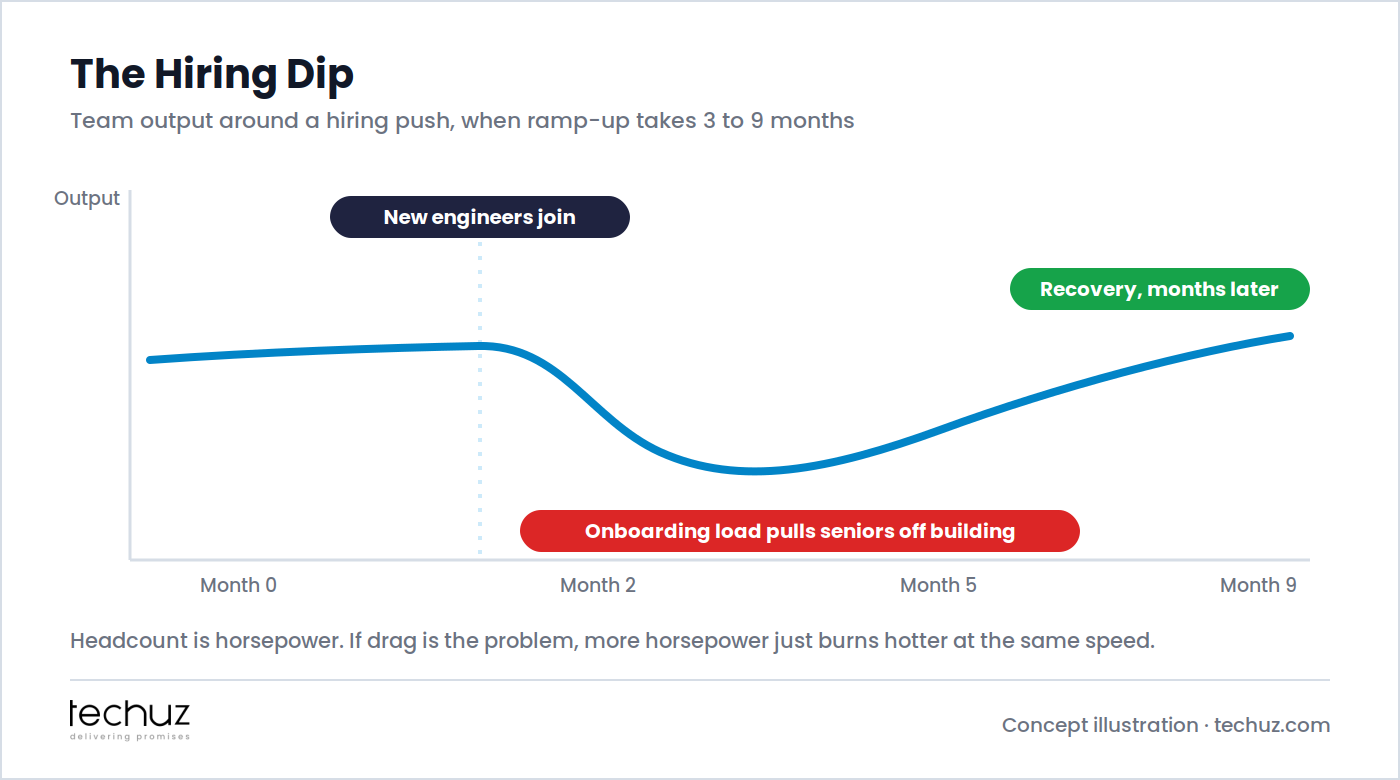
The post-traction instinct is to hire, but new engineers add coordination overhead before they add output. Fred Brooks documented this in 1975, and his formulation has aged uncomfortably well:
“Adding manpower to a late software project makes it later.”
Fred Brooks, The Mythical Man-Month (1975)
That ramp-up isn’t quick: one survey of engineers and managers found it takes 3 to 9 months on average for a new hire to become fully productive, and the existing team is teaching during most of that window instead of building. Velocity often dips further right after a hiring push, before it recovers, if it recovers at all.
The Compounding Interaction: Why These Four Problems Multiply Instead of Add
The biggest mistake leaders make is treating these problems as if they exist in isolation. They don’t; they reinforce one another. Product debt creates confusion about what should be improved. Engineering debt makes every change slower and riskier. Platform limits force infrastructure work before new features can even begin. Roadmap debt keeps adding commitments before the existing ones are finished.
Here’s how to tell them apart in practice:
| Drag type | Where it lives | Telltale symptom | First fix |
|---|---|---|---|
| Product debt | The feature set and user journeys | Support tickets about overlapping or confusing features | Measure adoption; sunset the unused 80% |
| Engineering debt | The codebase and tests | Bugs in untouched features; files nobody dares change | Fixed debt allocation in every sprint |
| Platform limits | Infrastructure and architecture | Incidents that spike with load, not with releases | Map load paths; renovate before the next growth event |
| Roadmap debt | Sales calls, investor decks, old backlogs | Sprints consumed by promises nobody remembers making | Audit commitments; renegotiate or schedule them explicitly |
Together, they create a cycle where every problem amplifies the next. That’s why fixing just one source of drag rarely restores velocity. Until you identify the biggest bottleneck in the system, the others will continue pulling your team back.
Velocity been sliding for two quarters or more?
Techuz runs velocity diagnostics for SaaS teams: separating product debt from engineering debt, mapping the next platform ceiling, and ranking the drags by what’s actually costing you sprints.
The Founder’s Instinct That Makes It Worse: Pushing Harder Instead of Diagnosing
When product velocity starts slipping, most leaders reach for the same playbook: more meetings, tighter deadlines, longer hours, and relentless pressure to “just ship it.” It feels decisive, but it’s usually the wrong diagnosis. Slowing velocity is rarely a motivation problem; it’s almost always a structural one. Extra pressure may create a short burst of progress, but it comes at a cost.
Teams respond by taking more shortcuts, deferring more cleanup, and accumulating even more technical and product debt. Before long, every new release becomes slower than the last. The irony is hard to miss: the harder you push, the more drag you create, and the slower the product becomes. Sustainable velocity doesn’t come from squeezing more effort out of the team; it comes from removing the obstacles that are quietly holding them back.
How to Actually Restore Velocity: Diagnose Before You Push
The fastest way to regain product velocity isn’t to demand more output; it’s to remove the friction slowing every release. Start by separating product debt from engineering debt, because each requires a different owner and a different solution. Identify the next platform constraint before it becomes tomorrow’s emergency. Review your roadmap for hidden promises made during sales calls, customer meetings, and investor updates, not just what’s written in the backlog.
Most importantly, reserve a fixed portion of every sprint for reducing technical and product debt, treating it as essential work rather than something you’ll do “if there’s time.” It may feel like you’re slowing down at first, but that’s exactly how high-performing teams start moving faster again.
The Velocity Restoration Checklist for Repeat Founders
Before you hire more engineers or accelerate the roadmap, measure what’s actually slowing the team down:
- Quantify support tickets caused by product debt.
- Count production incidents linked to platform limitations.
- List backlog items created by forgotten customer or investor promises.
- Fix the single biggest source of drag before adding more people. Otherwise, you’re simply adding more engine to a system that’s still fighting itself.
- Then measure again. One productive sprint doesn’t mean the underlying problem has been solved.
The question that separates teams that regain momentum from those that don’t is surprisingly simple: are we removing the drag, or just adding more horsepower?
Build a product that gets faster as it grows
As a SaaS product development company, Techuz builds with debt allocation, adoption measurement, and platform headroom designed in from sprint one, and as a custom web development company, we help existing teams remove the drag without stopping the roadmap.
FAQs
How do I tell if my velocity problem is product debt or engineering debt?
Product debt shows up as user confusion and support tickets about overlapping features; engineering debt shows up as bugs, slow builds, and fear of touching certain files. They need different fixes, so diagnose before treating either.
Does hiring more engineers actually help restore velocity after traction?
Not immediately. Brooks’s Law and ramp-up research both show new hires take months (commonly 3 to 9) to become fully productive, and the existing team loses capacity training them during that window.
What’s the fastest way to identify roadmap debt?
Audit commitments made in sales calls and investor updates, not just the formal backlog. Roadmap debt often lives in promises nobody wrote down as a standing obligation.
Why do most software features go unused?
Pendo’s research across 615 SaaS products found 80% of features are rarely or never used, with just 12% driving 80% of daily engagement, a sign most product debt comes from building before validating demand.
What’s the single best first step to restoring lost velocity?
Quantify the largest source of drag before doing anything else (support tickets, incidents, or stale roadmap promises) and fix that one thing before adding headcount or applying more deadline pressure. If the biggest drag turns out to be architectural, a SaaS architecture review is usually the highest-leverage next step.
Sources
- Pendo, The 2019 Feature Adoption Report
- McKinsey, Developer Velocity: How Software Excellence Fuels Business Performance
- Wikipedia, Brooks’s Law (from Fred Brooks, The Mythical Man-Month, 1975)
- HackerNoon, Engineer Onboarding: The Ugly Truth About Ramp-Up Time (Swimm survey)
Looking for timeline and cost estimates for your app?
Contact us

Nilesh K.

Nilesh Kadivar leads Marketing & GTM at Techuz, where he helps startups and enterprises turn software, AI, and automation ideas into shipped products. He's spent 10+ years in business development and enjoys writing about tech trends, growth strategy, and the realities of building for the web and mobile.